Cron表达式 python
·
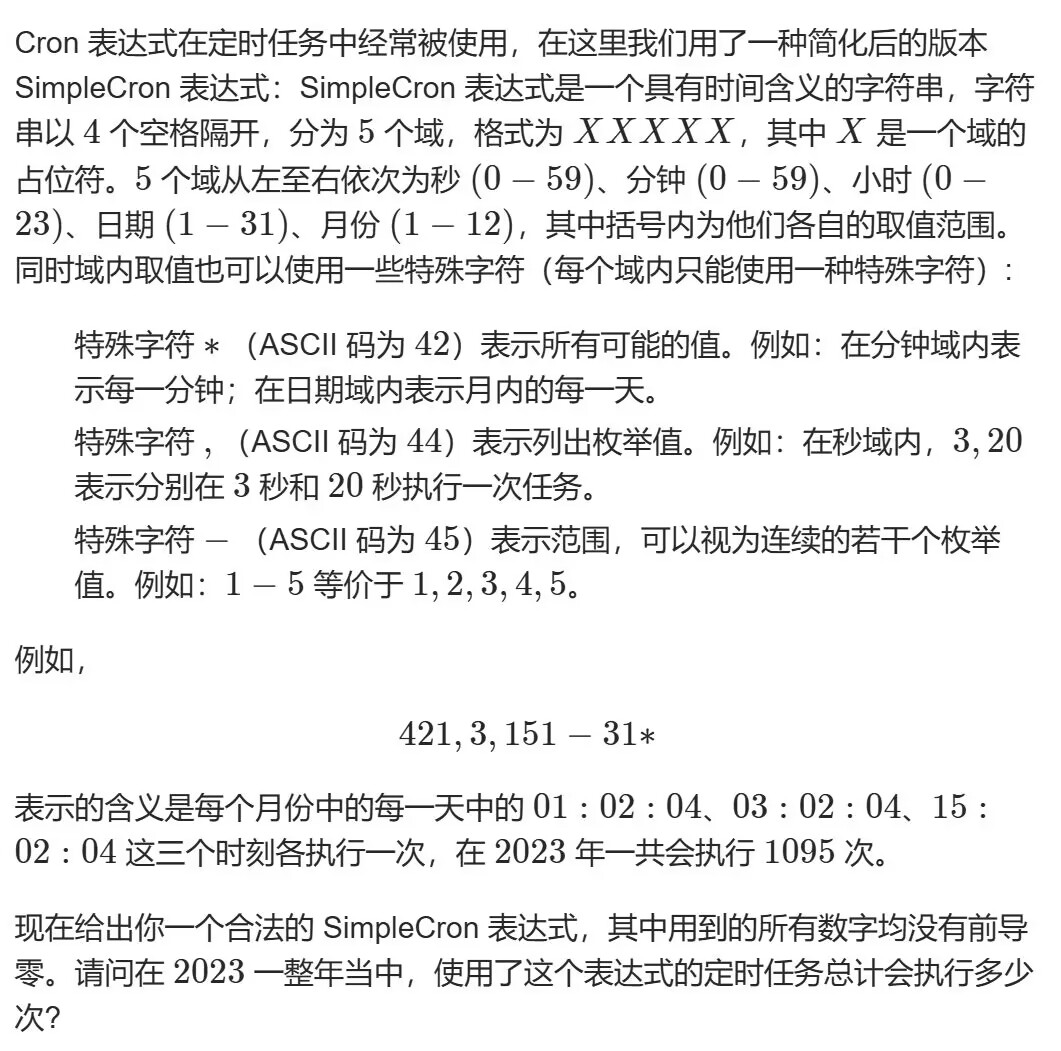
这段代码实现了一个时间组合计算器,主要功能是解析输入的时间格式并计算可能的组合数量。程序首先处理输入字符串,将其分割为列表。然后通过三种方式解析时间元素:通配符(*)返回预设范围,连字符(-)解析为连续数字区间,逗号(,)分隔为多个数值。最后计算前三项的组合数,并结合月份天数处理得出总组合数1095。代码展示了灵活的时间格式解析和组合计算能力,适用于需要处理多种时间表达式的场景。
def dataType(pos):
    # 位置的不同 *返回的值也不同
    if pos == 1 or pos == 2 :
        return list(range(0,60))
    elif pos == 3:
        return list(range(0,24))
    elif pos == 4:
        return list(range(1,32))
    elif pos == 5:
        return list(range(1,13))
    return None

def num_num(string):
    if '-' in string:
        strs = string.split('-')
        return list(range(int(strs[0]),int(strs[1]) + 1))
    return None

def num_d(string):
    if ',' in string:
        strs = string.split(',')
        return list(map(int,strs))
    return None


# 4 2 1,3,15 1-31 *
lst = list(input().split())
print(lst)

result = []
for index,string in enumerate(lst):
    if string=='*':
        tmp =dataType(index+1)
        if tmp:
            result.append(tmp)
            continue
    tmp = num_num(string)
    if tmp:
        result.append(tmp)
        continue
    tmp = num_d(string)
    if tmp:
        result.append(tmp)
        continue
    result.append([int(string)])

print(result)

res = 1
for index,lst in enumerate(result):
    if index == 3:
        break
    res *= len(lst)

print(res)
days = 0
for month in result[4]:
    day = len(result[3])
    if month not in [1,3,5,7,8,10,12]:
        if 31 in result[3]:
            day -= 1
    days += day

# 处理2月
if 2 in result[4]:
    if 29 in result[3]:
        days -= 1

if 2 in result[4]:
    if 30 in result[3]:
        days -= 1


res *= days
print(res)
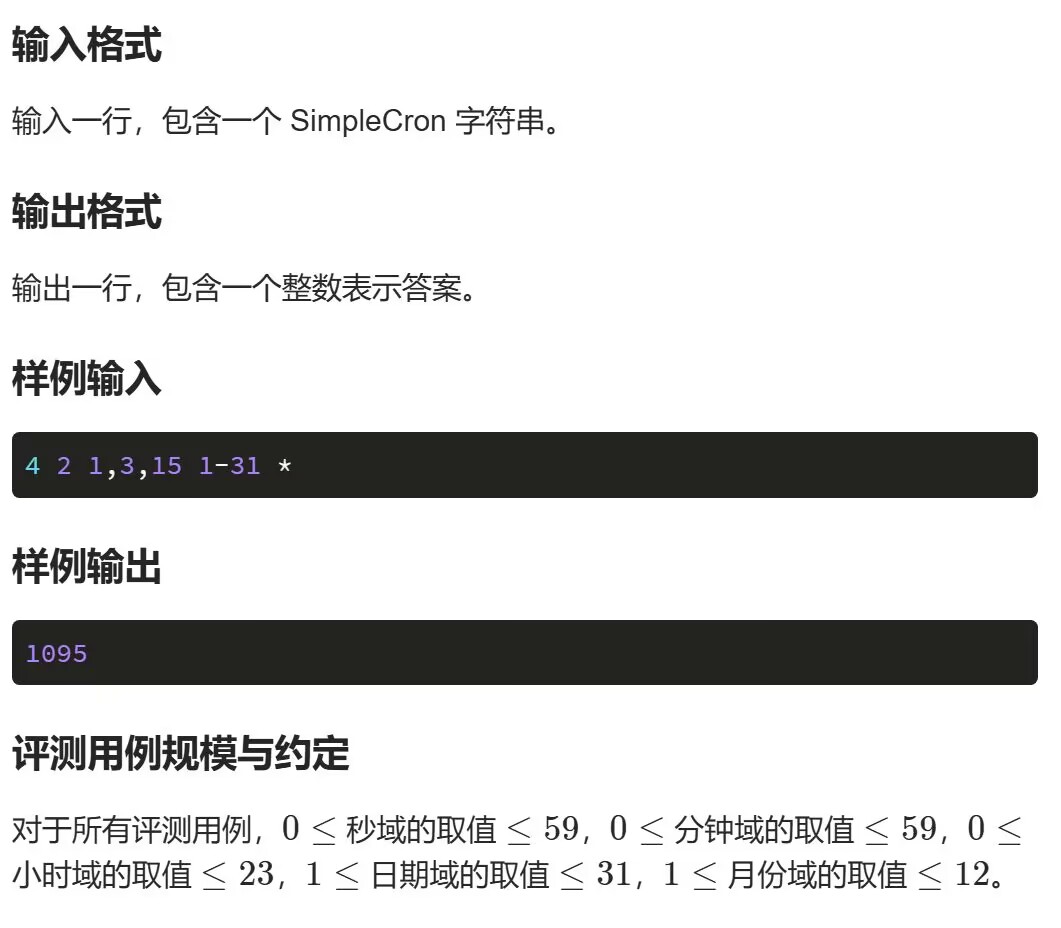
4 2 1,3,15 1-31 *
[‘4’, ‘2’, ‘1,3,15’, ‘1-31’, ‘*’]
[[4], [2], [1, 3, 15], [1, 2, 3, 4, 5, 6, 7, 8, 9, 10, 11, 12, 13, 14, 15, 16, 17, 18, 19, 20, 21, 22, 23, 24, 25, 26, 27, 28, 29, 30, 31], [1, 2, 3, 4, 5, 6, 7, 8, 9, 10, 11, 12]]
3
1095

Agent 垂直技术社区,欢迎活跃、内容共建。
更多推荐


 2
2 0
0- 0


 已为社区贡献11条内容

所有评论(0)