Qwen3-0.6B 复现GRPO Deepseek R1-Zero
TRL 单卡GRPO
由于Verl安装一直报错,docker都解决不了的Vllm不能初始化,看了官方issue以及源码,实在无法解决,随放弃。改用TRL库
- Model:
Qwen-3-0.6B-Base和Qwen-3-0.6B-Instruct
数据准备
数据:K-and-K/knights-and-knaves · Datasets at Hugging Face
-
该数据集为骑士和骗子,给定一段prompt,推理出谁是骑士谁是骗子。骑士用不说谎,骗子反之。
-
数据集切割为了7个子集,安装总人数区分。可是使用
split=numppl进行load,当前使用2ppl。 -
数据集会提供
solution,names的列表,前者是布尔数组,True代表骑士,False代表Lier。names与solution下标对应,是真实人名。
格式源自verl库,我这里额外处理了SFT的格式,因为R1是先SFT冷启动,R1-Zero是纯粹直接RL
def make_map_fn(split):
    instruction_following = (
        "You are a logical reasoning expert. "
        "Always think step by step inside <think> tags, showing your complete reasoning chain. "
        "After finishing your thinking, enclose your final conclusion in <answer> tags. "
        "Do not put any extra text outside these tags. "
        "Example format:\n"
        "<think>\nStep 1: Analyze Zoey's statement...\nStep 2: Consider possibilities...\n</think>\n"
        "<answer>\nZoey is a knave, Oliver is a knight.\n</answer>"
    )

    def process_fn(example, idx):
        question_raw = example.pop("quiz")
        names = example.pop("names")

        # 这个是Lets think step by step
        cot_head = example.pop("cot_head")
        # 核心思维链
        cot_core = example.pop("cot_repeat_steps")[0]
        # This leads to a feasible solution.
        cot_foot = example.pop("cot_foot")

        answer_raw = example.pop("solution_text")
        question = instruction_following + " " + question_raw + " " + cot_head
        solution = answer_raw

        reference_response = (
            "<think>\n"
            + cot_head
            + "\n"
            + cot_core
            + "\n"
            + cot_foot
            + "\n</think>\n"
            "<answer>\n"
            + answer_raw
            + "\n</answer>"  # 用 solution_text 作为最终答案
        )
        # True,False 数组
        solution = example["solution"]
        names = [name.lower() for name in names]
        ground_truth_roles = {}
        for i in range(len(names)):
            if solution[i]:
                ground_truth_roles[names[i]] = "knight"
            else:
                ground_truth_roles[names[i]] = "knave"
        data = {
            "data_source": split,  # 数据集名称
            "prompt": [
                {
                    "role": "user",
                    "content": question,
                }
            ],
            "response": reference_response,  # sft用的答案
            "ability": "logic",
            "cot": [cot_head, cot_core, cot_foot],
            "names": names,
            "ground_truth": ground_truth_roles,
            # "reward_model": {"style": "rule", "ground_truth": ground_truth_roles},
            # "extra_info": {
            #     "split": split,
            #     "index": idx,
            #     "answer": answer_raw,
            #     "question": question_raw,
            #     "names": names,
            # },
        }
        return data

    return process_fn
奖励函数
该奖励函数是照着verl库的自定义奖励格式编写的,我直接搬过来用力,TRL格式稍有不同,我向外再次封装了一层,去调用下方的
compute_score
def compute_score(
    data_source: str,
    solution_str: str,  # 模型的完整回复
    ground_truth: str,
    extra_info: dict = None,
) -> float:
    """
    score 的 Docstring
    输入模型回复,人物名,以及对应骑士的True/False,返回分数

    data_source: 源数据,如 "gsm8k"
    solution_str: 模型生成的答案,纯字符串,仅回复
    ground_truth: 源数据中的答案,纯字符串,仅回复
    extra_info: 额外的信息
    """
    # [False, True, True]

    names = extra_info["names"]
    format, think, answer = check_format(solution_str)

    # 格式正确
    if format[0]:
        parsed = parse_answer(answer, names)
        if not format[1]:  # 格式对了一半
            return 1
        print(parsed)
        print(ground_truth)
        same = is_correct(parsed, ground_truth)
        if same:  # 答案一摸一样
            return 5
        else:
            return 3
    else:
        return -5
-
check_format会检查格式,如果是<think> ..<think/> <answer> .. </answer>那返回的布尔列表均为True。如果只有一对标签,则返回一个True,给定一个标签奖励分,因为Base模型能力稍差,一刀切死,很难摸索出奖励。 -
如果标签完全完整,则会对比答案。这里答案处理方法是,规则处理匹配,只要人名与答案对的上即可,忽略大小写。
参数
tranning_args = GRPOConfig(
        output_dir=save_path(),
        per_device_train_batch_size=2,
        gradient_accumulation_steps=2,
        use_vllm=False,  # 为True时,需要自己启动vllm,端口8000
        learning_rate=1e-6,
        adam_beta1=0.9,
        adam_beta2=0.99,
        weight_decay=0.01,
        warmup_ratio=0.1,
        optim="adamw_8bit",
        report_to=["swanlab"],
        generation_batch_size=16,
        logging_steps=1,
        bf16=True,
        gradient_checkpointing=False,
        num_generations=8,
        loss_type='grpo',
        max_steps=500,
        epsilon=0.2,
        epsilon_high=0.28,  # one sided
        # SFTTrainer 有max_length这个,GRPO没有
        max_prompt_length=412,      # 输入(Prompt)的最大长度
        max_completion_length=1000,  # 输出(思维链+答案)的最大生成长度

    )
显存告急,不想梯度检查耗费时间,所以batch设置为2,group为16。在单卡A5000上,跑了一个小时多点左右。显存占用21GB。
实际是近两个小时,为什么后面变快了,因为出现了奖励破解
为什么不用FSDP。因为模型太小,通信时延估计会比多卡带来的加速进行抵消。
这里注意,max_completion_length不能调太小,否则会截断,即使是6亿参数的模型,输出也是大几百的长度。
V1-Res
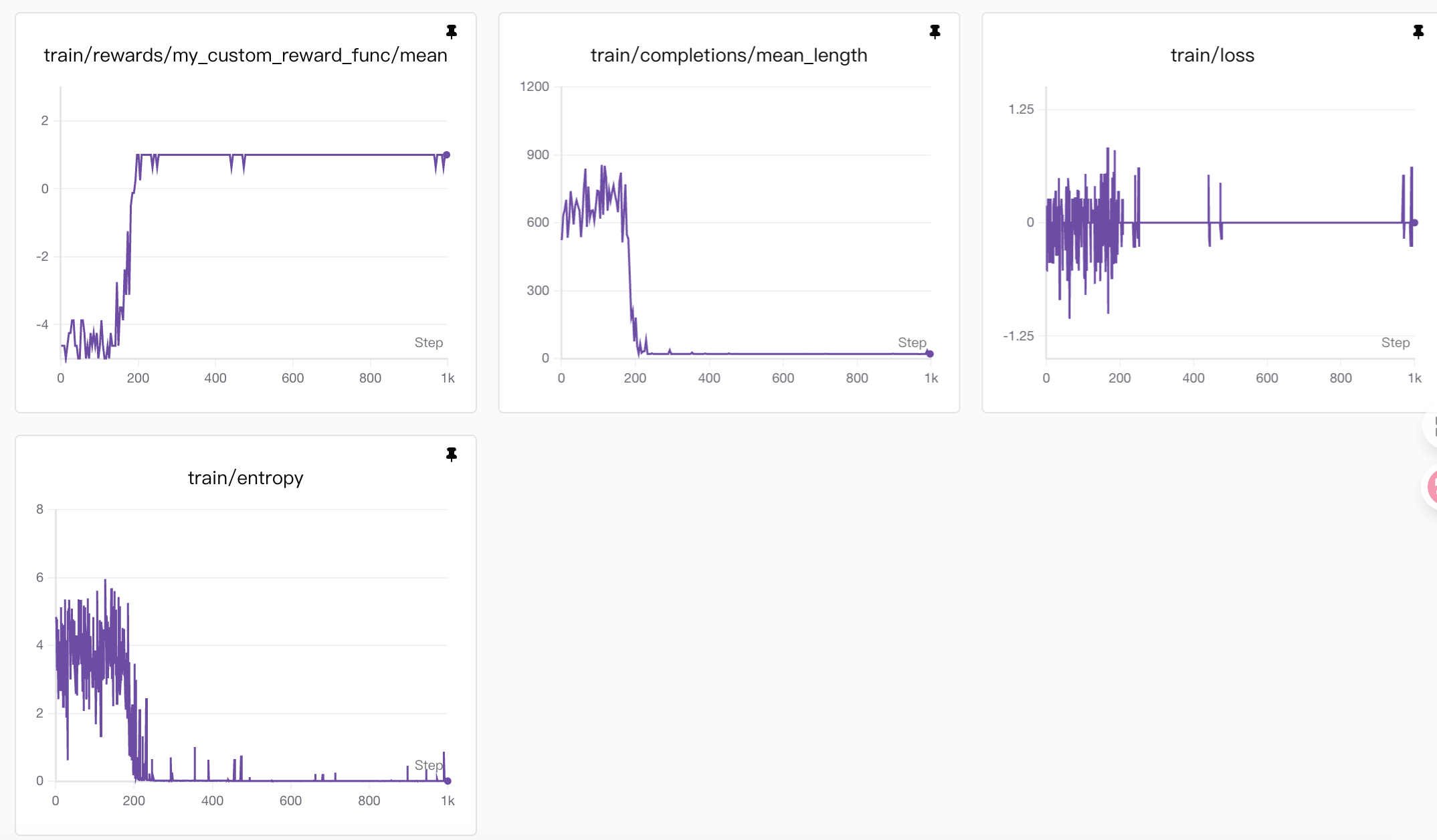
可以看到模型从200步之后,出现奖励破解了。因为1分的奖励,让模型学会了输出那两个格式化标签,不再思考了,entropy也直接到了近0
推理结果
{"accuracy": 0.04, "has_answer": 0.08, "answer_accuracy": 0.4999993750007813, "total": 100, "answer_total": 8, "answer_acc_count": 4}
100条测试集,只对了4个,有answer标签的只有8个。但是奖励最大值我印象里没有出现过5
后来发现,不知道是什么问题,如果你处理数据那里,返回了"ground_truth": ground_truth_roles字典,这个字典会额外多许多字段,似乎把所有人名都加进去了。
一条本该只有两个人名,可我输出发现,全部人名都有,只是其他名字的值为None
即本该{A:K,B:K},实际{A:K,B:K,C:K....}
现逻辑已修改
此外,我发现数据有不少是输出
Zoey is a knave, Oliver is a knight
3个epoch过拟合了,故改为1个,指令改为下方。
"<think>\nStep 1: Analyze Person A's statement...\n</think>\n"
"<answer>\nPerson A is a knave, Person B is a knight.\n</answer>"
解决方案:
-
最先想到的思路是进行长度惩罚,但不能多加损失。[2512.16649] JustRL: Scaling a 1.5B LLM with a Simple RL Recipe,去年年底的这篇论文指出,实际不需要那么多损失,只需要RL,就能激发模型的能力,很多不稳定,都是多个Tricks搞出来的,这篇论文很大道至简,后续会考虑复现一下。就是不知道有没有人蒸馏过0.6B这种小模型。
-
所以我调整了给分原则,之前从-5跳到1,差了6分,模型会认为学到了正确的方向
-
    if format[0]:
        parsed = parse_answer(answer, names)
        if not format[1]:  # 格式对了一半
            return -0.3
        print(parsed)
        print(ground_truth)
        same = is_correct(parsed, ground_truth)
        if same:  # 答案一摸一样
            return 5
        else:
            return 0.3
    else:
        return -1
V2-Res
结果如下:
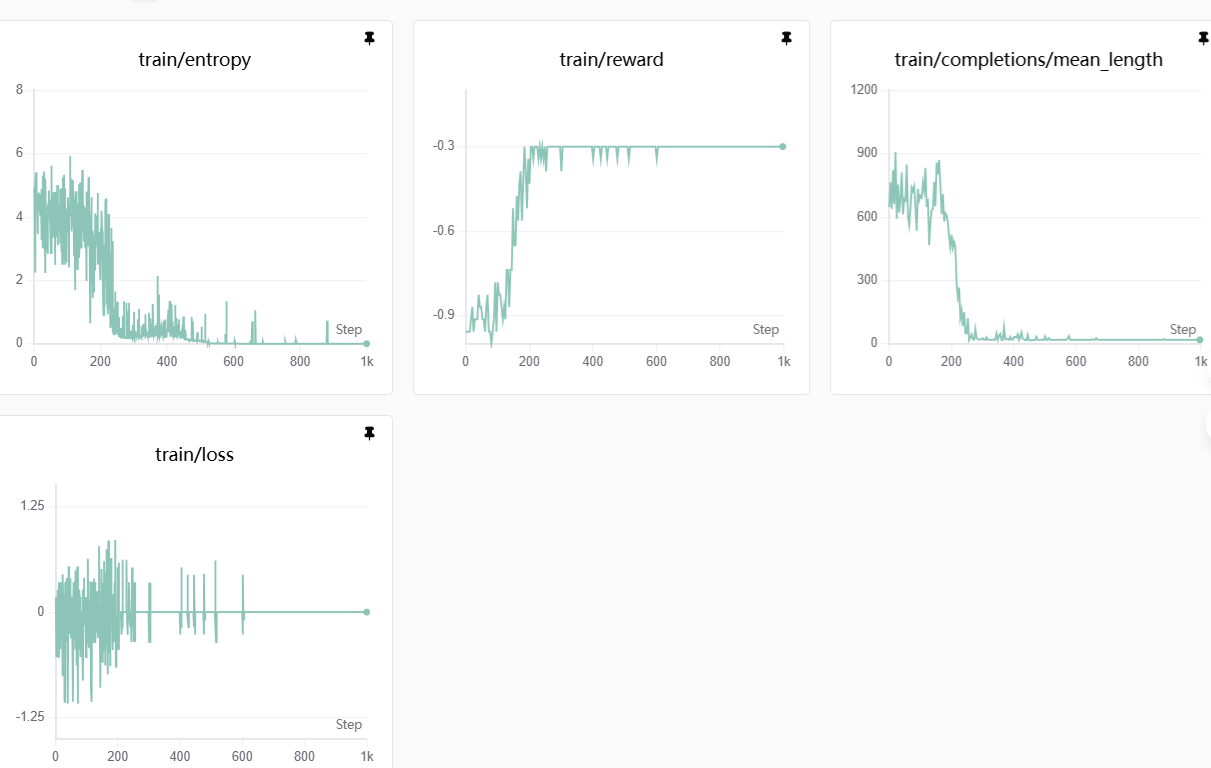
-
再次奖励破解。我猜测是两个原因
-
一是模型能力差,毕竟6亿参数,如果两个标签都完整,模型很难摸索出。
-
二是奖励不明确,如果think和answer的奖励不加以区分,即无论是有think,还是answer,都是一个分。模型会晕的,哪个先出现,模型就定死哪个了,不会再额外探索另一个。
-
-
数据
-
{"question": "A very special island is inhabited only by knights and knaves. Knights always tell the truth, and knaves always lie. You meet 2 inhabitants: Zoey, and Jacob. As Zoey put it, \"If Jacob is a knight then Zoey is a knight\". Jacob told you that Zoey is not a knave. So who is a knight and who is a knave?", "model_response": " \n\n1. Assume Zoey is a knave.\n2. If Zoey is a knave, then her statement \"If Jacob is a knight then Zoey is a knight\" would mean that Jacob is a knave (since a knave lies and says \"If A is a knave then B is a knave\" is false if A is a knave).\n3. However, if Zoey is a knave and Jacob is a knave, Jacob would have to lie about Zoey being a knave, which contradicts the fact that Zoey is not a knave.\n4. Therefore, Zoey cannot be a knave.\n5. Now consider Jacob.\n6. If Jacob is a knave, then his statement \"Zoey is not a knave\" would mean that Zoey is a knave (since a knave lies and says \"Zoey is not a knave\" is false if Zoey is a knave).\n7. But if Jacob is a knave and Zoey is a knave, Zoey would have to lie about Jacob being a knave, which again contradicts the fact that Zoey is not a knave.\n8. Therefore, Jacob cannot be a knave.\n9. Combining these two conclusions, we find that Zoey is a knave and Jacob is a knave.\n\n<answer>\nPerson A is a knave and Person B is a knave.\n</answer>", "names": ["zoey", "jacob"], "ground_truth": {"zoey": "knight", "jacob": "knight"}, "correct": 0} {"question": "A very special island is inhabited only by knights and knaves. Knights always tell the truth, and knaves always lie. You meet 2 inhabitants: David, and Jackson. David said that If Jackson is a knight then Jackson is a knave. Jackson stated, \"David is a knave or David is a knight\". So who is a knight and who is a knave?", "model_response": " \n\n1. Assume Jackson is a knave. \n - If Jackson is a knave, then his statement \"David is a knave or David is a knight\" must be a lie. \n - If David is a knave, then his statement \"If Jackson is a knave then Jackson is a knave\" must be a lie, which contradicts our assumption that Jackson is a knave. \n - Therefore, Jackson cannot be a knave under this assumption. \n2. Assume Jackson is a knight. \n - If Jackson is a knight, then his statement \"David is a knave or David is a knight\" must be a truth. \n - If David is a knave, then his statement \"If Jackson is a knave then Jackson is a knave\" must be a lie, which contradicts our assumption that Jackson is a knight. \n - Therefore, Jackson cannot be a knight under this assumption. \n\nSince both assumptions lead to contradictions, we conclude that Jackson is a knave and David is a knight. \n\n<answer>\nPerson A is a knave and Person B is a knight.\n</answer>", "names": ["david", "jackson"], "ground_truth": {"david": "knave", "jackson": "knight"}, "correct": 0} {"question": "A very special island is inhabited only by knights and knaves. Knights always tell the truth, and knaves always lie. You meet 2 inhabitants: Matthew, and Jackson. As Matthew put it, \"Jackson is a knave and Jackson is a knight\". \"Matthew is not a knight,\" Jackson claimed. So who is a knight and who is a knave?", "model_response": " \n\n1. **Assume Jackson is a knave and Matthew is a knight.**\n - If Jackson is a knave, he would lie. However, this contradicts his claim that \"Jackson is a knave and Jackson is a knight.\"\n - Therefore, this assumption is false.\n\n2. **Assume Jackson is a knight and Matthew is a knave.**\n - If Jackson is a knight, he would tell the truth. Since Matthew claims \"Jackson is a knave and Jackson is a knight,\" this aligns with his claim.\n - Therefore, this assumption is true.\n\nThus, the final conclusion is that Person B is a knight and Person A is a knave.", "names": ["matthew", "jackson"], "ground_truth": {"matthew": "knave", "jackson": "knight"}, "correct": -1} -
模型确实在推理,但是呢,强行拟合我要求的answer实例
-
-
更改思路
- 取消think,只要求模型将最终结果放在answer中,并且指令取消实例。
V3-Res
虽然上面提到取消think,写到answer标签即可,但是效果仍然很差,和V2结果差不多
所以参考Gsm8K数据的思想,最后结果放到####里
此时已经训练了436步,部分输出如下:



存在不少问题,胡言乱语,重复,截断。
再加上我的验证是基于简单规则,提取内容后进行一个简单的和答案匹配
def parse_answer(answer, names):
	# 这里的answer是提取标签内容后的结果
    content = answer.lower()

    # 简单规则:找名字 + knight/knave
    roles = {}
    for name in names:

        if re.search(rf"{name}.*?knave", content):
            roles[name] = "knave"
        elif re.search(rf"{name}.*?knight", content):
            roles[name] = "knight"
    return roles
def is_correct(parsed, ground_truth_roles):
    # ground_truth_roles = {"zoey": "knave", "oliver": "knight"}
    return parsed == ground_truth_roles
所以我认为主要三个原因:
- 答案截断抑制了模型的探索步伐(算力受限,此时长度为1024)
- 规则与奖励的不完善。这和上者是相辅相成的,答案截断必然影响奖励的获得,并且后续我虽然设计了更复杂的正则提取,但模型输出仍不固定,可能会输出Both are,以及人名在后的情况
- 模型本身能力问题。不少技术报告指出,小模型最好还是蒸馏比较好,参考[2505.09388] Qwen3 Technical Report,DeepSeek-V3 Technical Report.它们都是对小模型做的蒸馏。0.6B的Base模型,能力还是不太好
Base模型的探索就到此为止了,打算采用Instruct模型进行下一步的测试。后续Base可能会用GSM8K再试试,这个规则验证比较简单,思维链也不需要很长
V4-Instruct
奖励函数
def check_format_instruct(content):
    """
    提取 <think> 和 <answer> 标签的内容。
    标准格式:<think>...</think> ... <answer>...</answer>

    Returns:
        is_valid (bool): 格式是否匹配
        think_content (str/None): think 标签内的内容
        answer_content (str/None): answer 标签内的内容
    """


    # <think>(.*?)    -> 匹配 <think> 开头,并捕获中间的所有内容 (group 1)
    # </think>        -> 匹配 think 结束标签
    # .*?             -> 非贪婪匹配中间可能存在的换行或废话
    # <answer>(.*?)   -> 匹配 <answer> 开头,并捕获中间的所有内容 (group 2)
    # </answer>       -> 匹配 answer 结束标签
    pattern = r"<think>(.*?)</think>.*?<answer>(.*?)</answer>"

    match = re.search(pattern, content.strip(), flags=re.DOTALL)

    if match:
        # group(1) 是 think 的内容,group(2) 是 answer 的内容
        think_content = match.group(1).strip()
        answer_content = match.group(2).strip()

        # 返回: True, think内容, answer内容
        return True, think_content, answer_content
    else:
        # 格式不符合标准
        return False, None, None


def compute_score(
    data_source: str,
    solution_str: str,  # 模型的完整回复
    ground_truth: str,
    extra_info: dict = None,
) -> float:
    """
    score 的 Docstring
    输入模型回复,人物名,以及对应骑士的True/False,返回分数

    data_source: 数据名
    solution_str: 模型生成的答案,纯字符串,仅回复
    ground_truth: 源数据中的答案,纯字符串,仅回复
    extra_info: 额外的信息
    """
    # [False, True, True]

    names = extra_info["names"]
    format, think, answer = check_format_instruct(solution_str)

    # 格式正确
    if format:
        parsed = parse_answer(answer, names)
        print("模型生成的答案:")
        print(parsed)
        print("真实答案:")
        print(ground_truth)
        same = is_correct(parsed, ground_truth)
        print("模型回答正确:")
        if same:  # 答案一摸一样
            return 5
        else:
            return -0.1
    else:
        return -1


def my_custom_reward_func(completions, solution, names, **kwargs):
    """
    TRL 会自动把 dataset['ground_truth'] 传给 ground_truth 参数,
    把 dataset['names'] 传给 names 参数,
    把模型生成的内容传给 completions 参数。

    completions: [{'role': 'assistant', 'content': ""}]
    """
    rewards = []
    count = len(completions)
    # 遍历 Batch 中的每一条数据
    for solution_str, gt, name_list in zip(completions, solution, names):

        name_list = [name.lower() for name in name_list]
        extra_info = {"names": name_list}
        groud_truth = name2dict(name_list, gt)
        count -= 1
        if count == 0:
            print(f"模型回复:{solution_str}")
            print(f"真实答案:{groud_truth}")
            print("==========")
        score = compute_score(
            data_source="unknown",
            solution_str=solution_str[0]["content"],
            ground_truth=groud_truth,  # 注意这里传进去的是 dict
            extra_info=extra_info
        )

        rewards.append(score)

    return rewards
数据指令
instruction_following = (
        "You are a logical reasoning expert. "
        "Always think step by step inside <think> tags, showing your complete reasoning chain. "
        "After finishing your thinking, enclose your final conclusion in <answer> tags. "
        "Do not put any extra text outside these tags. "
    )

    SYSTEM_PROMPT = """
    Answer the question using the following format:
    <think>
    Your thinking process
    </think>
    <answer>
    Your answer
    </answer>
    """

 question = instruction_following + " " + \
            SYSTEM_PROMPT + "  " + question_raw + " " + cot_head
由于Instruct的版本,指令遵循能力已经很强了,所以直接让它按照规则回答就可以了。
V4-Res
可以看到,虽然奖励值并不全是是负数了,但是曲线并不好看
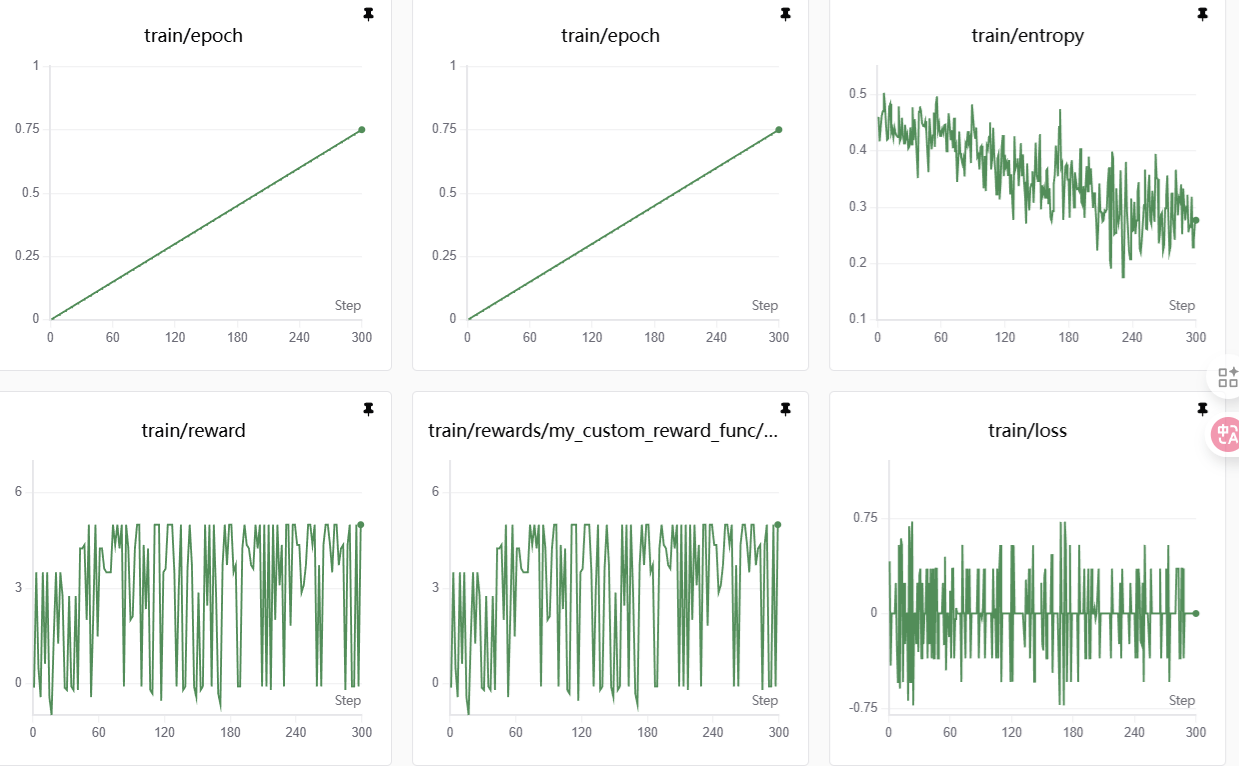
原因在于,推理长度很多,再次被截断了,为了避免喜报
我将参数进行了调整:
num_generations=8,
max_completion_length=1500,
回答长度涨到了1500个token,但仍发生会截断,有些问题模型假设的情景很多,这里就不放图了。
所以经过分析,奖励均值没有递增的原因如下:
- 截断,导致被惩罚
- 规则泛化性不强。我注意到模型会常会回复,
A and B are both knights这种,也有时人名会颠倒。这种正则可以处理,但只能是我观察到一个,打一次补丁,很难具有很强的泛化性。用模型去判断会更好些,但只有一张卡,实在没办法了
但整体奖励还是能看到,是逐渐往上增的,说明确实学到了。
其实也有优化思路,Qwen3的技术报告,有提到思考预算,我可以设置思考预算,用以解决上下文不够的问题
由于只有一张卡,每次跑要近两个小时,加上还有别的事情,所以这次的尝试就到这里了。
而且我还注意到一个有意思的bug,当你调用 dataset.map函数时,如果你返回了 dict的内容,会出现所有kv挤在一起
例如正常如下,因为一条数据只有两个人名
"ground_truth": {"zoey": "knight", "james": "knave"} // data 1
"ground_truth": {"Phoebe": "knight", "mike": "knave"} // data 2
可实际上你遍历返回的dataset后,取出的batch里,没条变成了这样:
"ground_truth": {"zoey": "knight", "james": "knave","Phoebe": None, "mike":None} // data 1
"ground_truth": {"Phoebe": "knight", "mike": "knave","zoey": None, "james": None} // data 2
所以不要返回字典。
后续可能会更新GRPO和PPO算法的torch实现,以及一些技术报告什么的。

Agent 垂直技术社区,欢迎活跃、内容共建。
更多推荐


 10
10 0
0- 0


 已为社区贡献1条内容

所有评论(0)