【NLP自然语言处理-投满分项目】5.模型剪枝
目标
- 理解什么是模型剪枝
- 掌握模型剪枝的基本操作
1.什么是模型的剪枝
- 基于深度神经网络的大型预训练模型拥有庞大的参数量, 才能达到SOTA的效果. 但是我们参考生物的神经网络, 发现却是依靠大量稀疏的连接来完成复杂的意识活动.
- 仿照生物的稀疏神经网络, 将大型网络中的稠密连接变成稀疏的连接, 并同样达到SOTA的效果, 就是模型剪枝的原动力.
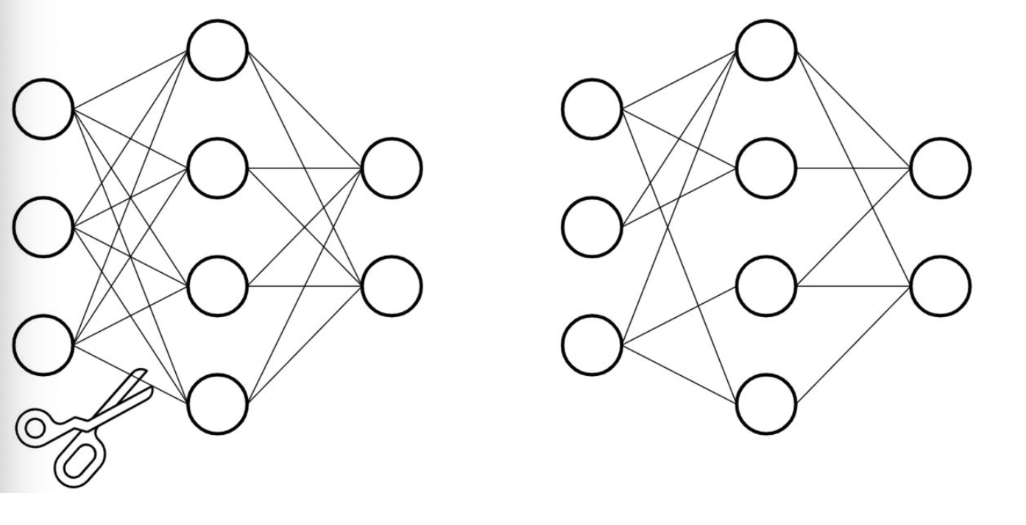
- Pytorch中对模型剪枝的支持在torch.nn.utils.prune模块中, 分以下几种剪枝方式(预剪枝,后剪枝):
- 对特定网络模块的剪枝(Pruning Model)
- 多参数模块的剪枝(Pruning multiple parameters)
- 全局剪枝(GLobal pruning)
- 用户自定义剪枝(Custom pruning)
- 注意: 保证Pytorch的版本在1.4.0以上, 支持剪枝操作
- 结构化剪枝(层)粗粒度
- 非结构化剪枝(逐元素,权重,偏置,细粒度)
2.对特定网络模块的剪枝(Pruning Model)
- 首先导入工具包:
import torch
from torch import nn
import torch.nn.utils.prune as prune
import torch.nn.functional as F
- 创建一个网络, 以经典的LeNet来示例:
LeNet是1998年由Yann LeCun等人提出的经典卷积神经网络架构,主要用于手写数字识别任务(如MNIST数据集),是现代CNN的奠基之作。它在MNIST上达到99.2%准确率,首次成功应用于商业系统,标志着深度学习在图像识别领域的重大突破。
该网络由7层组成(不含输入层),结构为:
- 输入 → C1 → S2 → C3 → S4 → C5 → F6 → Output
- C1:6个5×5卷积核,输出28×28特征图;
- S2:2×2平均池化,输出14×14;
- C3:16个5×5卷积核,输出10×10特征图;
- S4:2×2平均池化,输出5×5;
- C5:全连接层,120个神经元;
- F6:全连接层,84个神经元;
- Output:10个输出神经元(对应0-9数字)。
其核心思想是通过“卷积+池化”组合自动提取图像局部特征,再用全连接层进行分类。尽管结构简单,但奠定了现代CNN的基本范式
# 创建一个LeNet网络
device = torch.device('cuda' if torch.cuda.is_available() else 'cpu')

class LeNet(nn.Module):
    def __init__(self):
        super(LeNet, self).__init__()
        # 1: 图像的输入通道(1是黑白图像), 6: 输出通道数量, 3 * 3: 卷积核的尺寸
        self.conv1 = nn.Conv2d(1, 6, 3)
        self.conv2 = nn.Conv2d(6, 16, 3)
        self.fc1 = nn.Linear(16 * 5 * 5, 120) # 5x5 是经历卷积操作后的图片尺寸
        self.fc2 = nn.Linear(120, 84)
        self.fc3 = nn.Linear(84, 10)

    def forward(self, x):
        x = F.max_pool2d(F.relu(self.conv1(x)), (2, 2))
        x = F.max_pool2d(F.relu(self.conv2(x)), 2) # (2, 3, 4)
        x = x.view(-1, int(x.nelement() / x.shape[0])) # 2 *3 * 4
        x = F.relu(self.fc1(x))
        x = F.relu(self.fc2(x))
        x = self.fc3(x) # num_classes
        return x
- 调用:
module = model.conv1
print(list(module.named_parameters()))
- 输出结果:
[('weight', Parameter containing:
tensor([[[[-0.0254,  0.1457,  0.0110],
          [ 0.0713, -0.0144,  0.2965],
          [-0.0152, -0.2682,  0.0875]]],


        [[[ 0.0244,  0.3167,  0.2956],
          [-0.3083,  0.1962,  0.1066],
          [ 0.2876, -0.0089,  0.1293]]],


        [[[ 0.0633, -0.0308, -0.3286],
          [ 0.1230,  0.2197,  0.0340],
          [-0.2784, -0.2317,  0.2631]]],


        [[[-0.0297, -0.0610,  0.0419],
          [ 0.0170, -0.0198, -0.1801],
          [ 0.1693, -0.2444, -0.2623]]],


        [[[ 0.2038,  0.2900,  0.1935],
          [-0.2094, -0.0097, -0.1967],
          [-0.1092, -0.3028,  0.1658]]],


        [[[-0.1704,  0.1649, -0.1194],
          [ 0.0300, -0.0397, -0.1001],
          [ 0.0023, -0.2628, -0.3118]]]], requires_grad=True)), ('bias', Parameter containing:
tensor([ 0.0293,  0.0959,  0.3071, -0.2947, -0.1942,  0.2331],
       requires_grad=True))]
- 再打印一个特殊的属性张量
print(list(module.named_buffers()))
- 输出结果
# 这里面打印出一个空列表, 至于这个空列表代表什么含义? 剪枝操作后同学们就明白了!
[]
- 直接调用prune函数对模型进行剪枝操作:
# 第一个参数: module, 代表要进行剪枝的特定模块, 之前我们已经制定了module=model.conv1,
#             说明这里要对第一个卷积层执行剪枝.
# 第二个参数: name, 指定要对选中的模块中的哪些参数执行剪枝.
#             这里设定为name="weight", 意味着对连接网络中的weight剪枝, 而不对bias剪枝.
# 第三个参数: amount, 指定要对模型中多大比例的参数执行剪枝.
#             amount是一个介于0.0-1.0的float数值, 或者一个正整数指定剪裁掉多少条连接边.

prune.random_unstructured(module, name="weight", amount=0.3)
- 调用:
print(list(module.named_parameters()))
print(list(module.named_buffers()))
- 输出结果:
[('bias', Parameter containing:
tensor([-0.1123, -0.1366,  0.1363, -0.2220, -0.2483,  0.0461],
       requires_grad=True)), ('weight_orig', Parameter containing:
tensor([[[[-0.2651,  0.2065, -0.0896],
          [ 0.0528,  0.2238,  0.3318],
          [-0.2985,  0.1393, -0.1493]]],


        [[[ 0.2781, -0.1249, -0.0392],
          [ 0.0466,  0.1273, -0.1018],
          [-0.0826,  0.3091, -0.2098]]],


        [[[-0.1393,  0.0210, -0.1234],
          [-0.1896, -0.1994, -0.0462],
          [ 0.0557, -0.2999,  0.0516]]],


        [[[ 0.3008,  0.0956,  0.2682],
          [-0.2989,  0.1874,  0.1592],
          [ 0.2727,  0.2704,  0.0006]]],


        [[[ 0.3251, -0.3239, -0.2348],
          [-0.1258,  0.0858, -0.3125],
          [ 0.2276,  0.2538,  0.1164]]],


        [[[ 0.0952,  0.2404,  0.0902],
          [ 0.1100,  0.0312, -0.1120],
          [-0.2381, -0.0965,  0.1264]]]], requires_grad=True))]
[('weight_mask', tensor([[[[1., 1., 0.],
          [0., 1., 1.],
          [0., 1., 0.]]],


        [[[1., 0., 1.],
          [1., 1., 1.],
          [0., 0., 1.]]],


        [[[1., 1., 0.],
          [1., 1., 1.],
          [1., 1., 0.]]],


        [[[1., 0., 0.],
          [1., 1., 1.],
          [0., 1., 1.]]],


        [[[1., 1., 1.],
          [1., 1., 0.],
          [0., 0., 1.]]],


        [[[1., 1., 1.],
          [1., 0., 1.],
          [1., 1., 1.]]]]))]
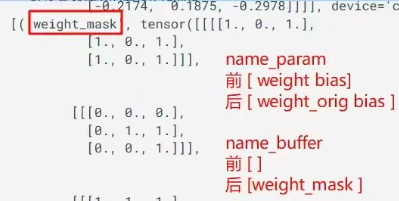
- 结论: 模型经历剪枝操作后, 原始的权重矩阵weight参数不见了, 变成了weight_orig. 并且刚刚打印为空列表的module.named_buffers(), 此时拥有了一个weight_mask参数.
- 这时打印module.weight属性值, 看看有什么启发?
print(module.weight)
- 输出结果:
tensor([[[[ 0.0679,  0.2268, -0.1991],
          [ 0.0000,  0.2966,  0.3167],
          [ 0.0000,  0.0369, -0.0000]]],


        [[[ 0.0000, -0.2860,  0.1816],
          [-0.0000, -0.2256, -0.0000],
          [-0.1371, -0.3128,  0.2542]]],


        [[[ 0.0585,  0.0000,  0.2298],
          [-0.0000,  0.0191, -0.1479],
          [ 0.0798,  0.0000,  0.1857]]],


        [[[ 0.2362, -0.0828,  0.1074],
          [ 0.0923,  0.3134,  0.0247],
          [ 0.3288, -0.2648,  0.3211]]],


        [[[ 0.0085,  0.0000, -0.0000],
          [ 0.0295,  0.0000, -0.0000],
          [ 0.0000, -0.1904,  0.0657]]],


        [[[-0.0000, -0.1548, -0.0882],
          [-0.2437,  0.0000, -0.1944],
          [-0.1716, -0.1389,  0.3330]]]], grad_fn=<MulBackward0>)
- 结论: 经过剪枝操作后的模型, 原始的参数存放在了weight_orig中, 对应的剪枝矩阵存放在weight_mask中, 而将weight_mask视作掩码张量, 再和weight_orig相乘的结果就存放在了weight中
- 注意: 剪枝操作后的weight已经不再是module的参数(parameter), 而只是module的一个属性(attribute)
上面剪枝weight的整体代码如下:
# 导入工具包
import torch
import torch.nn as nn
import torch.nn.utils.prune as prune
import torch.nn.functional as F

# 创建一个LeNet网络
device = torch.device('cuda' if torch.cuda.is_available() else 'cpu')

class LeNet(nn.Module):
    def __init__(self):
        super(LeNet, self).__init__()
        # 1: 图像的输入通道(1是黑白图像), 6: 输出通道数量, 3 * 3: 卷积核的尺寸
        self.conv1 = nn.Conv2d(1, 6, 3)
        self.conv2 = nn.Conv2d(6, 16, 3)
        self.fc1 = nn.Linear(16 * 5 * 5, 120) # 5x5 是经历卷积操作后的图片尺寸
        self.fc2 = nn.Linear(120, 84)
        self.fc3 = nn.Linear(84, 10)

    def forward(self, x):
        x = F.max_pool2d(F.relu(self.conv1(x)), (2, 2))
        x = F.max_pool2d(F.relu(self.conv2(x)), 2) # (2, 3, 4)
        x = x.view(-1, int(x.nelement() / x.shape[0])) # 2 * 3 * 4
        x = F.relu(self.fc1(x))
        x = F.relu(self.fc2(x))
        x = self.fc3(x) # num_classes
        return x


model = LeNet().to(device=device)

module = model.conv1
print(list(module.named_parameters()))

# 打印一个特殊的属性张量
print(list(module.named_buffers()))
print('-----------------------------------------------------------')

# 执行剪枝操作
# 第一个参数: module, 代表要进行剪枝的特定模块, 之前已经指定了module=model.conv1, 说明要对第一个卷积层执行剪枝操作
# 第二个参数: name, 指定要对选中的模型快中的哪些参数执行剪枝, 如果指定了name="weight", 意味着对连接网络中的weight剪枝, 不对bias进行剪枝
# 第三个参数: amount, 指定要对模型中多大比例的参数执行剪枝, 介于0.0-1.0之间的float数值, 代表百分比
prune.random_unstructured(module, name="weight", amount=0.3)


print(list(module.named_parameters()))
print(list(module.named_buffers()))
print('--------------------------------------------------------------')

print(module.weight)
可以对模型的任意子结构进行剪枝操作, 除了在weight上面剪枝, 还可以对bias进行剪枝.
# 第一个参数: module, 代表剪枝的对象, 此处代表LeNet中的conv1
# 第二个参数: name, 代表剪枝对象中的具体参数, 此处代表偏置量
# 第三个参数: amount, 代表剪枝的数量, 可以设置为0.0-1.0之间表示比例, 也可以用正整数表示剪枝的参数绝对数量
prune.l1_unstructured(module, name="bias", amount=3)

# 再次打印模型参数
print(list(module.named_parameters()))
print('*'*50)
print(list(module.named_buffers()))
print('*'*50)
print(module.bias)
print('*'*50)
- 输出结果
[('weight_orig', Parameter containing:
tensor([[[[-0.0159, -0.3175, -0.0816],
          [ 0.3144, -0.1534, -0.0924],
          [-0.2885, -0.1054, -0.1872]]],


        [[[ 0.0835, -0.1258, -0.2760],
          [-0.3174,  0.0669, -0.1867],
          [-0.0381,  0.1156,  0.0078]]],


        [[[ 0.1416, -0.2907, -0.0249],
          [ 0.1018,  0.1757, -0.0326],
          [ 0.2736, -0.1980, -0.1162]]],


        [[[-0.1835,  0.1600,  0.3178],
          [ 0.0579, -0.0647, -0.1039],
          [-0.0160, -0.0715,  0.2746]]],


        [[[-0.2314, -0.1759, -0.1820],
          [-0.0594,  0.2355, -0.2087],
          [ 0.0216,  0.0066, -0.0624]]],


        [[[-0.2772,  0.1479, -0.0983],
          [-0.3307, -0.2360, -0.0596],
          [ 0.2785,  0.0648,  0.2869]]]], device='cuda:0', requires_grad=True)), ('bias_orig', Parameter containing:
tensor([-0.1924, -0.1420, -0.0235,  0.0325,  0.0188,  0.0120], device='cuda:0',
       requires_grad=True))]
**************************************************
[('weight_mask', tensor([[[[0., 0., 0.],
          [1., 1., 1.],
          [1., 0., 1.]]],


        [[[1., 0., 1.],
          [1., 0., 1.],
          [1., 0., 1.]]],


        [[[1., 1., 0.],
          [1., 1., 1.],
          [1., 1., 1.]]],


        [[[1., 1., 1.],
          [1., 0., 0.],
          [0., 1., 0.]]],


        [[[1., 1., 1.],
          [1., 1., 1.],
          [0., 1., 1.]]],


        [[[1., 1., 1.],
          [0., 0., 1.],
          [1., 1., 0.]]]], device='cuda:0')), ('bias_mask', tensor([1., 1., 0., 1., 0., 0.], device='cuda:0'))]
**************************************************
tensor([-0.1924, -0.1420, -0.0000,  0.0325,  0.0000,  0.0000], device='cuda:0',
       grad_fn=<MulBackward0>)
**************************************************
- 结论: 在module的不同参数集合上应用不同的剪枝策略, 发现模型参数中不仅仅有了weight_orig, 也有了bias_orig. 在起到掩码张量作用的named_buffers中, 也同时出现了weight_mask和bias_mask. 最后, 因为在两类参数上应用了两种不同的剪枝函数, 因此_forward_pre_hooks中也打印出了2个不同的函数结果
- 序列化一个剪枝模型(Serializing a pruned model):
# 对于一个模型来说, 不管是它原始的参数, 拥有的属性值, 还是剪枝的mask buffers参数
# 全部都存储在模型的状态字典中, 即state_dict()中.
# 将模型初始的状态字典打印出来
print(model.state_dict().keys())
print('*'*50)

# 对模型进行剪枝操作, 分别在weight和bias上剪枝
# 直接执行剪枝操作
module = model.conv1
prune.random_unstructured(module, name="weight", amount=0.3)
prune.l1_unstructured(module, name="bias", amount=3)

# 再将剪枝后的模型的状态字典打印出来
print(model.state_dict().keys())
- 输出结果:
odict_keys(['conv1.weight', 'conv1.bias', 'conv2.weight', 'conv2.bias', 'fc1.weight', 'fc1.bias', 'fc2.weight', 'fc2.bias', 'fc3.weight', 'fc3.bias'])
**************************************************
odict_keys(['conv1.weight_orig', 'conv1.bias_orig', 'conv1.weight_mask', 'conv1.bias_mask', 'conv2.weight', 'conv2.bias', 'fc1.weight', 'fc1.bias', 'fc2.weight', 'fc2.bias', 'fc3.weight', 'fc3.bias'])
- 关键一步: 对模型执行剪枝remove操作.
- 通过module中的参数weight_orig和weight_mask进行剪枝, 本质上属于置零遮掩, 让权重连接失效.
- 这个remove是无法undo的, 也就是说一旦执行就是对模型参数的永久改变.
- 执行remove操作的演示代码:
# 打印剪枝后的模型参数
print(list(module.named_parameters()))
print('*'*50)

# 打印剪枝后的模型mask buffers参数
print(list(module.named_buffers()))
print('*'*50)

# 打印剪枝后的模型weight属性值
print(module.weight)
print('*'*50)

# 执行剪枝永久化操作remove
prune.remove(module, 'weight')
print('*'*50)

# remove后再次打印模型参数
print(list(module.named_parameters()))
print('*'*50)

# remove后再次打印模型mask buffers参数
print(list(module.named_buffers()))
print('*'*50)

# remove后再次打印模型的_forward_pre_hooks
print(module._forward_pre_hooks)
- 输出结果:
[('weight_orig', Parameter containing:
tensor([[[[ 0.1668,  0.0369, -0.2930],
          [-0.2630, -0.1777, -0.1096],
          [ 0.0481, -0.0898,  0.1920]]],


        [[[ 0.0729,  0.1445, -0.0471],
          [ 0.1525,  0.2986,  0.2602],
          [-0.0929, -0.2725, -0.0069]]],


        [[[-0.2006, -0.2577,  0.2754],
          [ 0.0999,  0.2106, -0.0046],
          [-0.2813, -0.2794, -0.0580]]],


        [[[-0.2944, -0.2214, -0.0795],
          [-0.0773,  0.2931, -0.2249],
          [-0.0796, -0.2343, -0.0457]]],


        [[[-0.1965,  0.2550,  0.2606],
          [ 0.0213, -0.2839,  0.2037],
          [-0.2068, -0.0507, -0.3097]]],


        [[[ 0.0030,  0.2340, -0.1122],
          [-0.0302, -0.0261,  0.1168],
          [ 0.0927,  0.1553,  0.1167]]]], device='cuda:0', requires_grad=True)), ('bias_orig', Parameter containing:
tensor([ 0.1147,  0.2439, -0.1753, -0.2578, -0.0994,  0.0588], device='cuda:0',
       requires_grad=True))]
**************************************************
[('weight_mask', tensor([[[[0., 0., 0.],
          [1., 1., 1.],
          [0., 1., 1.]]],


        [[[1., 1., 1.],
          [1., 0., 1.],
          [1., 1., 1.]]],


        [[[1., 1., 0.],
          [1., 1., 1.],
          [1., 0., 1.]]],


        [[[0., 1., 1.],
          [1., 1., 1.],
          [1., 1., 0.]]],


        [[[1., 0., 1.],
          [0., 1., 0.],
          [0., 1., 1.]]],


        [[[1., 1., 1.],
          [1., 0., 0.],
          [0., 1., 1.]]]], device='cuda:0')), ('bias_mask', tensor([0., 1., 1., 1., 0., 0.], device='cuda:0'))]
**************************************************
tensor([[[[ 0.0000,  0.0000, -0.0000],
          [-0.2630, -0.1777, -0.1096],
          [ 0.0000, -0.0898,  0.1920]]],


        [[[ 0.0729,  0.1445, -0.0471],
          [ 0.1525,  0.0000,  0.2602],
          [-0.0929, -0.2725, -0.0069]]],


        [[[-0.2006, -0.2577,  0.0000],
          [ 0.0999,  0.2106, -0.0046],
          [-0.2813, -0.0000, -0.0580]]],


        [[[-0.0000, -0.2214, -0.0795],
          [-0.0773,  0.2931, -0.2249],
          [-0.0796, -0.2343, -0.0000]]],


        [[[-0.1965,  0.0000,  0.2606],
          [ 0.0000, -0.2839,  0.0000],
          [-0.0000, -0.0507, -0.3097]]],


        [[[ 0.0030,  0.2340, -0.1122],
          [-0.0302, -0.0000,  0.0000],
          [ 0.0000,  0.1553,  0.1167]]]], device='cuda:0',
       grad_fn=<MulBackward0>)
**************************************************
OrderedDict([(0, <torch.nn.utils.prune.RandomUnstructured object at 0x7f65b879e7f0>), (1, <torch.nn.utils.prune.L1Unstructured object at 0x7f655c5ebfd0>)])
[('bias_orig', Parameter containing:
tensor([ 0.1147,  0.2439, -0.1753, -0.2578, -0.0994,  0.0588], device='cuda:0',
       requires_grad=True)), ('weight', Parameter containing:
tensor([[[[ 0.0000,  0.0000, -0.0000],
          [-0.2630, -0.1777, -0.1096],
          [ 0.0000, -0.0898,  0.1920]]],


        [[[ 0.0729,  0.1445, -0.0471],
          [ 0.1525,  0.0000,  0.2602],
          [-0.0929, -0.2725, -0.0069]]],


        [[[-0.2006, -0.2577,  0.0000],
          [ 0.0999,  0.2106, -0.0046],
          [-0.2813, -0.0000, -0.0580]]],


        [[[-0.0000, -0.2214, -0.0795],
          [-0.0773,  0.2931, -0.2249],
          [-0.0796, -0.2343, -0.0000]]],


        [[[-0.1965,  0.0000,  0.2606],
          [ 0.0000, -0.2839,  0.0000],
          [-0.0000, -0.0507, -0.3097]]],


        [[[ 0.0030,  0.2340, -0.1122],
          [-0.0302, -0.0000,  0.0000],
          [ 0.0000,  0.1553,  0.1167]]]], device='cuda:0', requires_grad=True))]
**************************************************
[('bias_mask', tensor([0., 1., 1., 1., 0., 0.], device='cuda:0'))]
**************************************************
OrderedDict([(1, <torch.nn.utils.prune.L1Unstructured object at 0x7f655c5ebfd0>)])
结论: 对模型的weight执行remove操作后, 模型参数集合中只剩下bias_orig了, weight_orig消失, 变成了weight, 说明针对weight的剪枝已经永久化生效. 对于named_buffers张量打印可以看出, 只剩下bias_mask了, 因为针对weight做掩码的weight_mask已经生效完毕, 不再需要保留了
3. 多参数模块的剪枝(Pruning multiple parameters)
model = LeNet().to(device=device)

# 打印初始模型的所有状态字典
print(model.state_dict().keys())
print('*'*50)

# 打印初始模型的mask buffers张量字典名称
print(dict(model.named_buffers()).keys())
print('*'*50)

# 对于模型进行分模块参数的剪枝
for name, module in model.named_modules():
    # 对模型中所有的卷积层执行l1_unstructured(l1 非结构化剪枝)剪枝操作, 选取20%的参数剪枝
    if isinstance(module, torch.nn.Conv2d):
        prune.l1_unstructured(module, name="weight", amount=0.2)
    # 对模型中所有全连接层执行ln_structured(l2 结构化剪枝)剪枝操作, 选取40%的参数剪枝
    elif isinstance(module, torch.nn.Linear):
        prune.ln_structured(module, name="weight", amount=0.4, n=2, dim=0) # dim 表示当前神经元

# 打印多参数模块剪枝后的mask buffers张量字典名称
print(dict(model.named_buffers()).keys())
print('*'*50)

# 打印多参数模块剪枝后模型的所有状态字典名称
print(model.state_dict().keys())
- 输出结果:
odict_keys(['conv1.weight', 'conv1.bias', 'conv2.weight', 'conv2.bias', 'fc1.weight', 'fc1.bias', 'fc2.weight', 'fc2.bias', 'fc3.weight', 'fc3.bias'])
**************************************************
dict_keys([])
**************************************************
dict_keys(['conv1.weight_mask', 'conv2.weight_mask', 'fc1.weight_mask', 'fc2.weight_mask', 'fc3.weight_mask'])
**************************************************
odict_keys(['conv1.bias', 'conv1.weight_orig', 'conv1.weight_mask', 'conv2.bias', 'conv2.weight_orig', 'conv2.weight_mask', 'fc1.bias', 'fc1.weight_orig', 'fc1.weight_mask', 'fc2.bias', 'fc2.weight_orig', 'fc2.weight_mask', 'fc3.bias', 'fc3.weight_orig', 'fc3.weight_mask'])
- 结论: 对比初始化模型的状态字典和剪枝后的状态字典, 可以看到所有的weight参数都没有了, 变成了weight_orig和weight_mask的组合. 初始化的模型named_buffers是空列表, 剪枝后拥有了所有参与剪枝的参数层的weight_mask张量.
整体代码如下:
# 导入工具包
import torch
import torch.nn as nn
import torch.nn.utils.prune as prune
import torch.nn.functional as F

# 创建一个LeNet网络
device = torch.device('cuda' if torch.cuda.is_available() else 'cpu')

class LeNet(nn.Module):
    def __init__(self):
        super(LeNet, self).__init__()
        # 1: 图像的输入通道(1是黑白图像), 6: 输出通道数量, 3 * 3: 卷积核的尺寸
        self.conv1 = nn.Conv2d(1, 6, 3)
        self.conv2 = nn.Conv2d(6, 16, 3)
        self.fc1 = nn.Linear(16 * 5 * 5, 120) # 5x5 是经历卷积操作后的图片尺寸
        self.fc2 = nn.Linear(120, 84)
        self.fc3 = nn.Linear(84, 10)

    def forward(self, x):
        x = F.max_pool2d(F.relu(self.conv1(x)), (2, 2))
        x = F.max_pool2d(F.relu(self.conv2(x)), 2) # (2, 3, 4)
        x = x.view(-1, int(x.nelement() / x.shape[0])) # 2 * 3 * 4
        x = F.relu(self.fc1(x))
        x = F.relu(self.fc2(x))
        x = self.fc3(x) # num_classes
        return x


model = LeNet().to(device=device)

module = model.conv1
print(list(module.named_parameters()))

# 打印一个特殊的属性张量
print(list(module.named_buffers()))
print('-----------------------------------------------------------')

# 执行剪枝操作
# 第一个参数: module, 代表要进行剪枝的特定模块, 之前已经指定了module=model.conv1, 说明要对第一个卷积层执行剪枝操作
# 第二个参数: name, 指定要对选中的模型快中的哪些参数执行剪枝, 如果指定了name="weight", 意味着对连接网络中的weight剪枝, 不对bias进行剪枝
# 第三个参数: amount, 指定要对模型中多大比例的参数执行剪枝, 介于0.0-1.0之间的float数值, 代表百分比
prune.random_unstructured(module, name="weight", amount=0.3)


print(list(module.named_parameters()))
print(list(module.named_buffers()))
print('--------------------------------------------------------------')

print(module.weight)


# 注意: 第三个参数amount, 当为一个float值代表的是剪枝的百分比, 如果为整数值, 代表剪裁掉的绝对数量
prune.l1_unstructured(module, name="bias", amount=3)

print(list(module.named_parameters()))
print('----------------------------------------------------------------')
print(list(module.named_buffers()))
print('----------------------------------------------------------------')
print(module.bias)
print('----------------------------------------------------------------')

# 首先将原始模型的状态字典打印出来
print(model.state_dict().keys())
print('-------------------------------------------------------------------')

# 直接执行剪枝操作
prune.random_unstructured(module, name="weight", amount=0.3)
prune.l1_unstructured(module, name="bias", amount=3)

# # 然后将剪枝后的模型的状态字典打印出来
print(model.state_dict().keys())

# 打印剪枝后的模型参数
print(list(module.named_parameters()))
print('---------------------------------------------------------------------')

# 打印剪枝后的模型mask buffers参数
print(list(module.named_buffers()))
print('---------------------------------------------------------------------')

# 打印剪枝后的模型weight属性值
print(module.weight)
print('----------------------------------------------------------------------')


# 执行模型剪枝的永久化操作
prune.remove(module, 'weight')
print('----------------------------------------------------------------------')

# 打印执行remove之后的模型参数
print(list(module.named_parameters()))
print('----------------------------------------------------------------------')

# 打印执行remove之后的mask buffers参数
print(list(module.named_buffers()))
print('----------------------------------------------------------------------')


# 打印初始模型的mask buffers张量字典名称
print(dict(model.named_buffers()).keys())
print('------------------------------------------------------------------------')

# 打印初始模型的所有状态字典
print(model.state_dict().keys())
print('------------------------------------------------------------------------')

# 对模型进行分模块的参数的剪枝
for name, module in model.named_modules():
    # 对模型中所有的卷积层执行l1_unstructured剪枝操作, 选取20%的参数进行剪枝
    if isinstance(module, torch.nn.Conv2d):
        prune.l1_unstructured(module, name="weight", amount=0.2)
    # 对模型中所有的全连接层执行ln_structured剪枝操作, 选取40%的参数进行剪枝
    elif isinstance(module, torch.nn.Linear):
        prune.ln_structured(module, name="weight", amount=0.4, n=2, dim=0) # dim 表示当前神经元

# 打印多参数模块剪枝后的mask buffers张量字典名称
print(dict(model.named_buffers()).keys())
print('------------------------------------------------------------------------')

# 打印多参数模块剪枝后模型的所有状态字典名称
print(model.state_dict().keys())
4. 全局剪枝(GLobal pruning)
第一种, 第二种剪枝策略本质上属于局部剪枝(local pruning), 需要程序员按照自己的定义one by one的进行操作. 最主要的问题就是模型剪枝效果的好坏很大程度上取决于程序员的剪枝经验, 而且就算经验丰富的程序员也很难肯定的说某种剪枝策略一定更优
更普遍也更通用的剪枝策略是采用全局剪枝(global pruning), 比如在整体网络的视角下剪枝掉20%的权重参数, 而不是在每一层上都剪枝掉20%的权重参数. 采用全局剪枝后, 不同的层被剪掉的百分比不同
import torch
from torch import nn
import torch.nn.utils.prune as prune
import torch.nn.functional as F

device = torch.device("cuda" if torch.cuda.is_available() else "cpu")


class LeNet(nn.Module):
    def __init__(self):
        super(LeNet, self).__init__()
        # 1: 图像的输入通道(1是黑白图像), 6: 输出通道, 3x3: 卷积核的尺寸
        self.conv1 = nn.Conv2d(1, 6, 3)
        self.conv2 = nn.Conv2d(6, 16, 3)
        self.fc1 = nn.Linear(16 * 5 * 5, 120)  # 5x5 是经历卷积操作后的图片尺寸
        self.fc2 = nn.Linear(120, 84)
        self.fc3 = nn.Linear(84, 10)

    def forward(self, x):
        x = F.max_pool2d(F.relu(self.conv1(x)), (2, 2))
        x = F.max_pool2d(F.relu(self.conv2(x)), 2)
        x = x.view(-1, int(x.nelement() / x.shape[0]))
        x = F.relu(self.fc1(x))
        x = F.relu(self.fc2(x))
        x = self.fc3(x)
        return x


model = LeNet().to(device=device)

# 实现模型的全局剪枝

# 首先打印初始化模型的状态参数字典
print(model.state_dict().keys())
print('------------------------------------------------------------')

# 构建剪枝参数集合, 决定哪些层, 哪些参数会参与剪枝中
parameters_to_prune = (
    (model.conv1, 'weight'),
    (model.conv2, 'weight'),
    (model.fc1, 'weight'),
    (model.fc2, 'weight'),
    (model.fc3, 'weight'))

# 调用prune模块中的全局剪枝函数global_unstructured(全局非结构化剪枝)执行剪枝操作, 此处针对整体模型中的20%的参数进行剪枝
prune.global_unstructured(parameters_to_prune, pruning_method=prune.L1Unstructured, amount=0.2)

# 最后打印剪枝后的模型的状态字典
print(model.state_dict().keys())
- 输出结果:
odict_keys(['conv1.weight', 'conv1.bias', 'conv2.weight', 'conv2.bias', 'fc1.weight', 'fc1.bias', 'fc2.weight', 'fc2.bias', 'fc3.weight', 'fc3.bias'])
**************************************************
odict_keys(['conv1.bias', 'conv1.weight_orig', 'conv1.weight_mask', 'conv2.bias', 'conv2.weight_orig', 'conv2.weight_mask', 'fc1.bias', 'fc1.weight_orig', 'fc1.weight_mask', 'fc2.bias', 'fc2.weight_orig', 'fc2.weight_mask', 'fc3.bias', 'fc3.weight_orig', 'fc3.weight_mask'])
- 针对模型剪枝后, 不同的层会有不同比例的权重参数被剪掉, 利用代码打印出来看看:
model = LeNet().to(device=device)

parameters_to_prune = (
            (model.conv1, 'weight'),
            (model.conv2, 'weight'),
            (model.fc1, 'weight'),
            (model.fc2, 'weight'),
            (model.fc3, 'weight'))

prune.global_unstructured(parameters_to_prune, pruning_method=prune.L1Unstructured, amount=0.2)

print(
    "Sparsity in conv1.weight: {:.2f}%".format(
    100. * float(torch.sum(model.conv1.weight == 0))
    / float(model.conv1.weight.nelement())
    ))

print(
    "Sparsity in conv2.weight: {:.2f}%".format(
    100. * float(torch.sum(model.conv2.weight == 0))
    / float(model.conv2.weight.nelement())
    ))

print(
    "Sparsity in fc1.weight: {:.2f}%".format(
    100. * float(torch.sum(model.fc1.weight == 0))
    / float(model.fc1.weight.nelement())
    ))

print(
    "Sparsity in fc2.weight: {:.2f}%".format(
    100. * float(torch.sum(model.fc2.weight == 0))
    / float(model.fc2.weight.nelement())
    ))

print(
    "Sparsity in fc3.weight: {:.2f}%".format(
    100. * float(torch.sum(model.fc3.weight == 0))
    / float(model.fc3.weight.nelement())
    ))

print(
    "Global sparsity: {:.2f}%".format(
    100. * float(torch.sum(model.conv1.weight == 0)
               + torch.sum(model.conv2.weight == 0)
               + torch.sum(model.fc1.weight == 0)
               + torch.sum(model.fc2.weight == 0)
               + torch.sum(model.fc3.weight == 0))
         / float(model.conv1.weight.nelement()
               + model.conv2.weight.nelement()
               + model.fc1.weight.nelement()
               + model.fc2.weight.nelement()
               + model.fc3.weight.nelement())
    ))
- 输出结果:
Sparsity in conv1.weight: 1.85%
Sparsity in conv2.weight: 7.87%
Sparsity in fc1.weight: 21.99%
Sparsity in fc2.weight: 12.56%
Sparsity in fc3.weight: 9.17%
Global sparsity: 20.00%
整体代码如下:
import torch
from torch import nn
import torch.nn.utils.prune as prune
import torch.nn.functional as F

device = torch.device("cuda" if torch.cuda.is_available() else "cpu")


class LeNet(nn.Module):
    def __init__(self):
        super(LeNet, self).__init__()
        # 1: 图像的输入通道(1是黑白图像), 6: 输出通道, 3x3: 卷积核的尺寸
        self.conv1 = nn.Conv2d(1, 6, 3)
        self.conv2 = nn.Conv2d(6, 16, 3)
        self.fc1 = nn.Linear(16 * 5 * 5, 120)  # 5x5 是经历卷积操作后的图片尺寸
        self.fc2 = nn.Linear(120, 84)
        self.fc3 = nn.Linear(84, 10)

    def forward(self, x):
        x = F.max_pool2d(F.relu(self.conv1(x)), (2, 2))
        x = F.max_pool2d(F.relu(self.conv2(x)), 2)
        x = x.view(-1, int(x.nelement() / x.shape[0]))
        x = F.relu(self.fc1(x))
        x = F.relu(self.fc2(x))
        x = self.fc3(x)
        return x


model = LeNet().to(device=device)

# 实现模型的全局剪枝

# 首先打印初始化模型的状态参数字典
print(model.state_dict().keys())
print('------------------------------------------------------------')

# 构建剪枝参数集合, 决定哪些层, 哪些参数会参与剪枝中
parameters_to_prune = (
    (model.conv1, 'weight'),
    (model.conv2, 'weight'),
    (model.fc1, 'weight'),
    (model.fc2, 'weight'),
    (model.fc3, 'weight'))

# 调用prune模块中的全局剪枝函数global_unstructured(全局非结构化剪枝)执行剪枝操作, 此处针对整体模型中的20%的参数进行剪枝
prune.global_unstructured(parameters_to_prune, pruning_method=prune.L1Unstructured, amount=0.2)

# 最后打印剪枝后的模型的状态字典
print(model.state_dict().keys())

# 全局剪枝后, 不同的层会有不同比例的权重参数被剪掉, 利用代码打印出来查看
print(
    "Sparsity in conv1.weight: {:.2f}%".format(
        100. * float(torch.sum(model.conv1.weight == 0))
        / float(model.conv1.weight.nelement())
    ))

print(
    "Sparsity in conv2.weight: {:.2f}%".format(
        100. * float(torch.sum(model.conv2.weight == 0))
        / float(model.conv2.weight.nelement())
    ))

print(
    "Sparsity in fc1.weight: {:.2f}%".format(
        100. * float(torch.sum(model.fc1.weight == 0))
        / float(model.fc1.weight.nelement())
    ))

print(
    "Sparsity in fc2.weight: {:.2f}%".format(
        100. * float(torch.sum(model.fc2.weight == 0))
        / float(model.fc2.weight.nelement())
    ))

print(
    "Sparsity in fc3.weight: {:.2f}%".format(
        100. * float(torch.sum(model.fc3.weight == 0))
        / float(model.fc3.weight.nelement())
    ))

# 最后再次打印一下全局的比例, 进行验证
print(
    "Global sparsity: {:.2f}%".format(
        100. * float(torch.sum(model.conv1.weight == 0)
                     + torch.sum(model.conv2.weight == 0)
                     + torch.sum(model.fc1.weight == 0)
                     + torch.sum(model.fc2.weight == 0)
                     + torch.sum(model.fc3.weight == 0))
        / float(model.conv1.weight.nelement()
                + model.conv2.weight.nelement()
                + model.fc1.weight.nelement()
                + model.fc2.weight.nelement()
                + model.fc3.weight.nelement())
    ))
- 结论: 当采用全局剪枝策略的时候(假定20%比例参数参与剪枝), 仅保证模型总体参数量的20%被剪枝掉, 具体到每一层的情况则由模型的具体参数分布情况来定
5.用户自定义剪枝(Custom pruning)
- 所谓用户自定义剪枝, 就是程序员自己定义通过什么样的规则进行剪枝, 而不是依赖Pytorch定义好的比如l1_unstructured, ln_structured等等预设好的剪枝规则来进行剪枝.
- 剪枝模型通过继承class BasePruningMethod()来执行剪枝, 内部有若干方法: call, apply_mask, apply, prune, remove等等. 一般来说, 用户只需要实现__init__, 和compute_mask两个函数即可完成自定义的剪枝规则设定
# 自定义剪枝方法的类, 一定要继承prune.BasePruningMethod
class myself_pruning_method(prune.BasePruningMethod):
    PRUNING_TYPE = "unstructured"

    # 内部实现compute_mask函数, 完成程序员自己定义的剪枝规则, 本质上就是如何去mask掉权重参数
    def compute_mask(self, t, default_mask):
        mask = default_mask.clone()
        # 此处定义的规则是每隔一个参数就遮掩掉一个, 最终参与剪枝的参数量的50%被mask掉
        mask.view(-1)[::2] = 0
        return mask

# 自定义剪枝方法的函数, 内部直接调用剪枝类的方法apply
def myself_unstructured_pruning(module, name):
    myself_pruning_method.apply(module, name)
    return module
- 调用:
# 实例化模型类
model = LeNet().to(device=device)

start = time.time()
# 调用自定义剪枝方法的函数, 对model中的第三个全连接层fc3中的偏置bias执行自定义剪枝
myself_unstructured_pruning(model.fc3, name="bias")

# 剪枝成功的最大标志, 就是拥有了bias_mask参数
print(model.fc3.bias_mask)

# 打印一下自定义剪枝的耗时
duration = time.time() - start
print(duration * 1000, 'ms')
- 输出结果:
tensor([0., 1., 0., 1., 0., 1., 0., 1., 0., 1.], device='cuda:0')
1.7154216766357422 ms
整体代码如下:
import torch
from torch import nn
import torch.nn.utils.prune as prune
import torch.nn.functional as F
import time

device = torch.device("cuda" if torch.cuda.is_available() else "cpu")

class LeNet(nn.Module):
    def __init__(self):
        super(LeNet, self).__init__()
        # 1: 图像的输入通道(1是黑白图像), 6: 输出通道, 3x3: 卷积核的尺寸
        self.conv1 = nn.Conv2d(1, 6, 3)
        self.conv2 = nn.Conv2d(6, 16, 3)
        self.fc1 = nn.Linear(16 * 5 * 5, 120)  # 5x5 是经历卷积操作后的图片尺寸
        self.fc2 = nn.Linear(120, 84)
        self.fc3 = nn.Linear(84, 10)

    def forward(self, x):
        x = F.max_pool2d(F.relu(self.conv1(x)), (2, 2))
        x = F.max_pool2d(F.relu(self.conv2(x)), 2)
        x = x.view(-1, int(x.nelement() / x.shape[0]))
        x = F.relu(self.fc1(x))
        x = F.relu(self.fc2(x))
        x = self.fc3(x)
        return x


model = LeNet().to(device=device)


# 自定义剪枝方法的类, 一定要继承prune.BasePruningMethod
class myself_pruning_method(prune.BasePruningMethod):
    PRUNING_TYPE = "unstructured"

    # 内部实现compute_mask函数, 完成程序员自己定义的剪枝规则, 本质上就是如何去mask掉权重参数
    def compute_mask(self, t, default_mask):
        mask = default_mask.clone()
        # 定义的规则是每隔一个参数就遮掩掉一个, 最终所有参与剪枝的参数量中的50%被mask掉
        mask.view(-1)[::3] = 0
        return mask


# 自定义剪枝方法的函数, 内部直接调用剪枝类的方法apply
def myself_unstructured_pruning(module, name):
    myself_pruning_method.apply(module, name)
    return module


start = time.time()

# 调用自定义的剪枝方法的函数, 对model中的第三个全连接层fc3中的偏置bias执行自定义剪枝
myself_unstructured_pruning(model.fc3, name='bias')

# 剪枝成功的最大标志, 就是拥有了bias_mask参数
print(model.fc3.bias_mask)

# 打印一下自定义剪枝的耗时
duration = time.time() - start
print(duration * 1000, 'ms')
结论: 打印出来的bias_mask张量, 完全是按照预定义的方式每隔一位遮掩掉一位, 0和1交替出现, 后续执行remove操作的时候, 原始的bias_orig中的权重就会同样的被每隔一位剪枝掉一位, 在GPU机器上执行自定义剪枝速度特别快, 仅需1.7ms
github地址: 推荐系统-文本标签分类NLP(prompt-tag-NLP)制作不易,请star

Agent 垂直技术社区,欢迎活跃、内容共建。
更多推荐



 9
9 0
0- 0


 已为社区贡献3条内容

所有评论(0)