Leetcode 128. 最长连续序列 哈希 C++ / Python / Java
·
原题链接: Leetcode 128. 最长连续序列
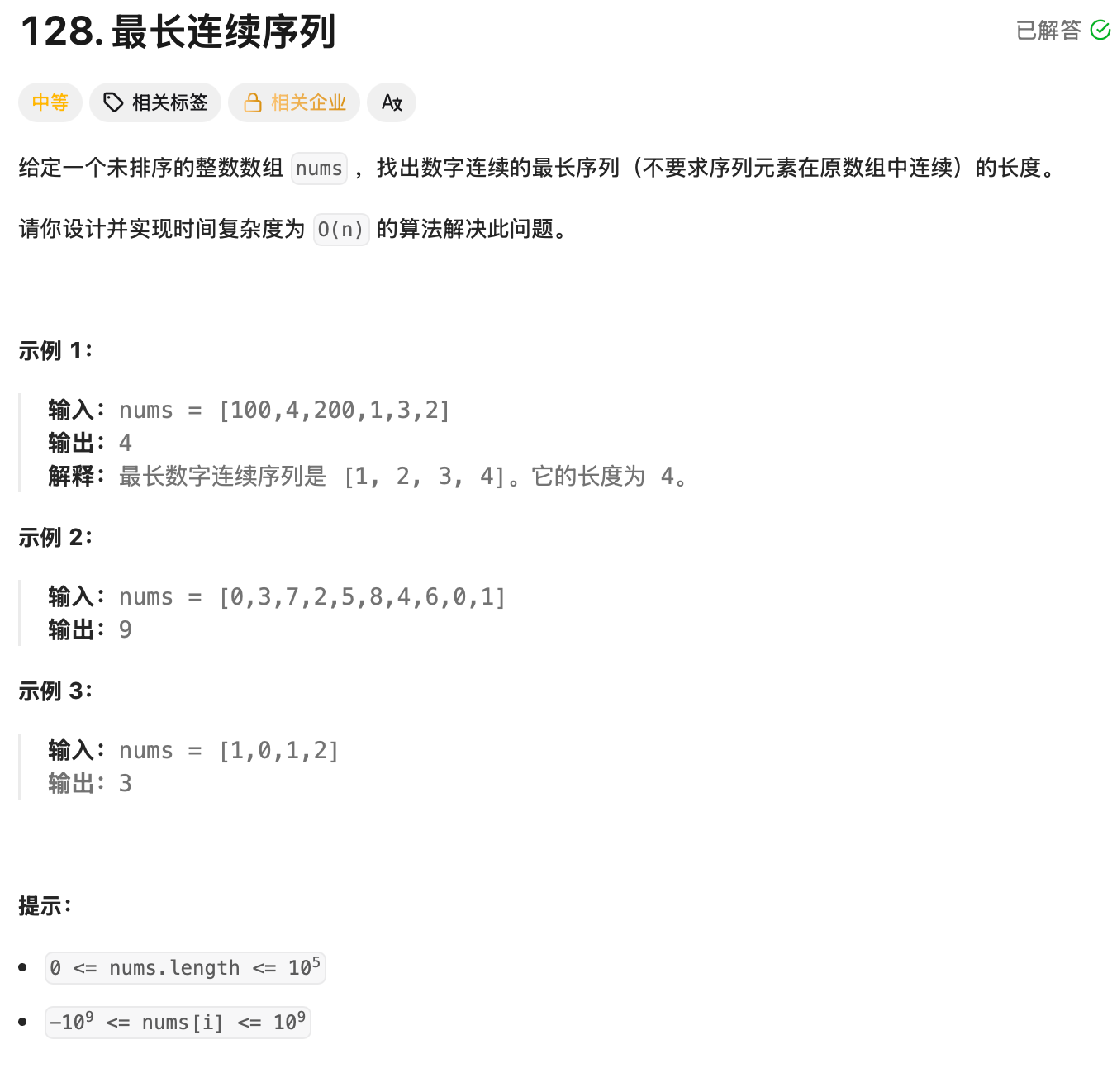
C++ 解法1: map
class Solution {
public:
    int longestConsecutive(vector<int>& nums) {
        if(nums.size()==0) return 0;
        int res = 1;
        map<int,int> mp;
        for(auto x:nums) mp[x]=1;
        int pre=INT_MIN,cnt=0;
        for(auto x: mp){
            if(pre==INT_MIN || x.first==pre+1 ) {
                cnt++;
            }
            else{
                res = max(res,cnt);
                cnt=1;
            }
            pre = x.first;
        }
        return max(res,cnt);
    }
};
C++ 解法2: unordered_set
class Solution {
public:
    int longestConsecutive(vector<int>& nums) {
        if (nums.size()==0) return 0;
        unordered_set<int> s;
        for(auto x: nums) s.insert(x);
        int res =0;
        for(int x: s){
            // 如果x不是某连续序列的起点
            if(s.contains(x-1)){
                continue;
            }
            int y = x+1;
            while(s.contains(y)){
                y++;
            }
            res = max(y-x,res);
        }
        return res;
    }
};
C++时间复杂度对比
- 解法 1:时间复杂度为 O(n log n)
因为 map 的插入操作是 O (log n),n 个元素总插入时间为 O (n log n)。
后续遍历是 O (n),整体受限于排序步骤,不满足题目要求的 O (n) 时间复杂度。 - 解法 2:时间复杂度为 O(n)
unordered_set 的插入和查找都是 O (1)(平均情况)。
每个元素最多被访问 2 次(一次作为起点遍历,一次被其他起点检查),整体为 O (n),满足题目要求。
Python
class Solution:
    def longestConsecutive(self, nums: List[int]) -> int:
        nums_set = set(nums)
        res = 0
        for x in nums_set:
            if x -1 not in nums_set:
                y = x+1
                while y in nums_set:
                    y+=1
                res = max(res, y-x)
        return res
Java
class Solution {
    public int longestConsecutive(int[] nums) {
        Set<Integer> set = new HashSet<>();
        int res = 0;
        for(int x: nums) set.add(x);
        for(int x: set){
            if(!set.contains(x-1)){
                int y = x+1;
                while(set.contains(y)) y++;
                // 求最大
                res = Math.max(res,y-x);
            }
        }
        return res;
    }
}

Agent 垂直技术社区,欢迎活跃、内容共建。
更多推荐



 3
3 0
0- 0


 已为社区贡献1条内容

所有评论(0)