C++工程实战入门笔记9-面向对象之成员变量和成员函数
·
面向对象简单展示,了解概念
#include<string>
#include <iostream>
using namespace std;

class Npc
{
public:
	string name_;//下划线表示成员变量区分于局部变量
	int health_=100;
	void Atack(int atk)
	{
		health_ -= atk;
		cout << name_ << "was attacked!" << "-" << atk << endl;
	}

private:

};

int main()
{
	Npc npc1;
	npc1.name_ = "class npc1 ";
	Npc npc2;
	npc2.name_ = "class npc2 ";

	npc1.Atack(50);
	npc2.Atack(60);

	system("pause");

}

成员变量
class MyClass
{
public:
	//成员变量
	int x{ 0 };//C++11开始可以在声明时赋初值
	int y{ 0 };
	char name[16]{ "myclass name" };
};
int main()
{
	//栈区对象
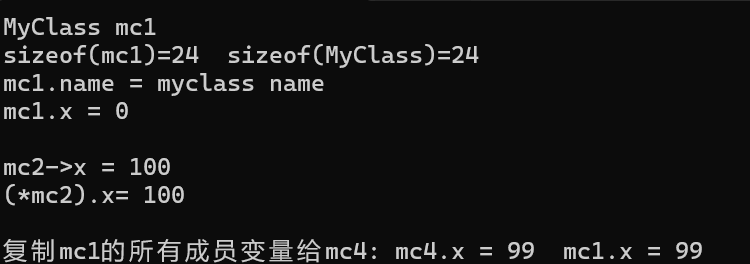
	MyClass mc1;
	cout << "MyClass mc1" << endl;
	cout << "sizeof(mc1)="<<sizeof(mc1) << "  sizeof(MyClass)=" << sizeof(MyClass) << endl;
	cout <<"mc1.name = "<< mc1.name << endl;
	cout << "mc1.x = " << mc1.x << endl;
	cout << endl;
	//堆区对象指针
	MyClass* mc2=new MyClass;
	mc2->x = 100;
	cout << "mc2->x = "<< mc2->x << endl;
	cout << "(*mc2).x= "<<(*mc2).x << endl;//指针变对象
	delete mc2;
	cout << endl;

	MyClass* mc3 = &mc1;//对象变指针

	//自定义类型赋值
	MyClass mc4;
	mc1.x = 99;
	mc4 = mc1;//复制mc1的所有成员变量给mc4
	cout <<"复制mc1的所有成员变量给mc4: "<< "mc4.x = " << mc4.x << "  mc1.x = " << mc1.x << endl;

	system("pause");

}
成员函数(内联函数和非内联函数)
成员函数是类的一部分,可以访问类的私有成员(如数据变量)。
类内定义:直接在类声明中实现函数体。
类外定义:在类声明中声明函数,在类外部实现函数体(需要使用作用域解析运算符 ::)
class MyClass {
public:
    void nonInlineFunc(); // 声明非内联成员函数(类外定义)
    void inlineFunc() {   // 类内定义的成员函数自动成为内联函数
        // 函数体
    }
};
void MyClass::nonInlineFunc() { // 类外定义的非内联函数
    // 函数体
}
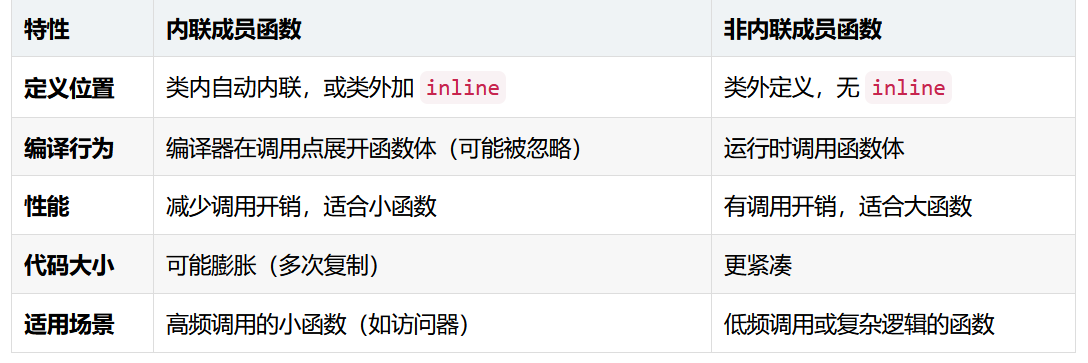
内联函数有两种定义方式
类内定义自动内联:在类声明内部直接定义函数体时,编译器自动将其视为内联函数。
class MyClass {
public:
    void inlineFunc() { // 自动内联
        // 简单操作
    }
};
类外定义需显式声明:如果在类外部定义函数,必须使用 inline 关键字显式标记,否则不会内联。但即使使用 inline,编译器可能忽略请求(如果函数过大)
class MyClass {
public:
    void inlineFunc(); // 声明
};
inline void MyClass::inlineFunc() { // 显式内联定义
    // 函数体
}
练习代码
class MyClass
{
public:
	//成员变量
	int x{ 0 };//C++11开始可以在声明时赋初值
	int y{ 0 };
	char name[16]{ "myclass name" };

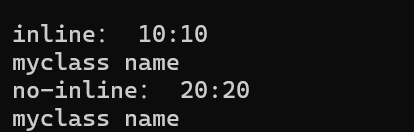
	void TestIn(int v)//内联函数
	{
		x += v;
		y += v;
		cout <<"inline: "<< x << ":" << y << endl;
		cout << name << endl;
	}

	void Test(int v);//普通函数,非内联函数,声明和定义是分开的,此处的声明,定义见下方函数 MyClass::Test(int v)
};//以上都是放到.h头文件中

void MyClass::Test(int v)
{
	x += v;
	y += v;
	cout << "no-inline: " << x << ":" << y << endl;
	cout << name << endl;
}
int main()
{
	//成员函数-内联函数
	MyClass mcf;
	mcf.TestIn(10);
	mcf.Test(10);//大部分我们都是用非内联
	system("pause");

}
使用建议
- 优先内联:对于简单、短小的函数(如返回成员变量的函数),使用类内定义或显式
inline。 - 避免内联:对于递归、循环密集或大型函数,使用非内联方式以防止代码膨胀。
this指针
this指针的本质
- 隐含参数:每个非静态成员函数(包括内联和非内联)都隐含一个
this指针参数,指向调用该函数的对象实例。 - 类型规则:
this是ClassName *const类型(常量指针),不可修改指针值,但可通过它修改对象成员。 - 访问方式:通过
this->member访问成员变量/函数,或隐式使用(如直接写member等价于this->member)。
class MyClass {
    int value;
public:
    void setValue(int v) {  // 非内联函数(类外定义时)
        this->value = v;   // 显式使用this避免命名冲突
    }
    void print() const;    // 声明
};
// 类外定义
void MyClass::print() const {
    std::cout << this->value; // 通过this访问成员
}
代码
class MyClass
{
public:
	//成员变量
	int x{ 0 };//C++11开始可以在声明时赋初值
	int y{ 0 };
	char name[16]{ "myclass name" };

	void TestIn(int v)//内联函数
	{
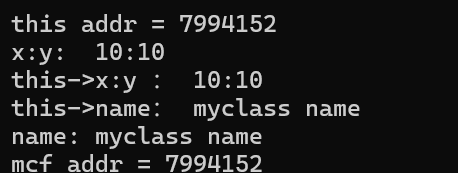
		//this指针:当前类对象的地址
		cout << "this addr = " << (long long)this << endl;
		x += v;
		y += v;
		cout << "x:y:  " << x << ":" << y << endl;
		cout << "this->x:y : " << this->x << ":" << this->y << endl;
		cout << "this->name: " << this->name << endl;
		cout << "name: "<<name << endl;
	}
};
int main()
{
	MyClass mcf;
	mcf.TestIn(10);
	cout << "mcf addr = " << (long long)&mcf << endl;
	system("pause");
}

Agent 垂直技术社区,欢迎活跃、内容共建。
更多推荐



 10
10 0
0- 0


 已为社区贡献6条内容

所有评论(0)