Rust 生命周期深度剖析:引用有效性的编译期保证
·
目 录
- 📝 摘要
- 一、生命周期的本质
- 二、生命周期标注规则
- 三、生命周期省略规则(Lifetime Elision)
- 四、结构体中的生命周期
- 五、静态生命周期('static)
- 六、生命周期与泛型
- 七、实战案例
- 八、高级生命周期模式
- 九、常见错误与解决方案
- 十、性能考量
- 十一、总结与讨论
- 参考链接
📝 摘要
生命周期(Lifetime)是 Rust 所有权系统的重要组成部分,用于在编译期确保引用的有效性。本文将系统讲解生命周期的概念、标注语法、省略规则、泛型生命周期以及在实际项目中的应用,通过丰富的示例帮助读者彻底掌握这一核心特性,避免常见的编译错误。
一、生命周期的本质
1.1 为什么需要生命周期?
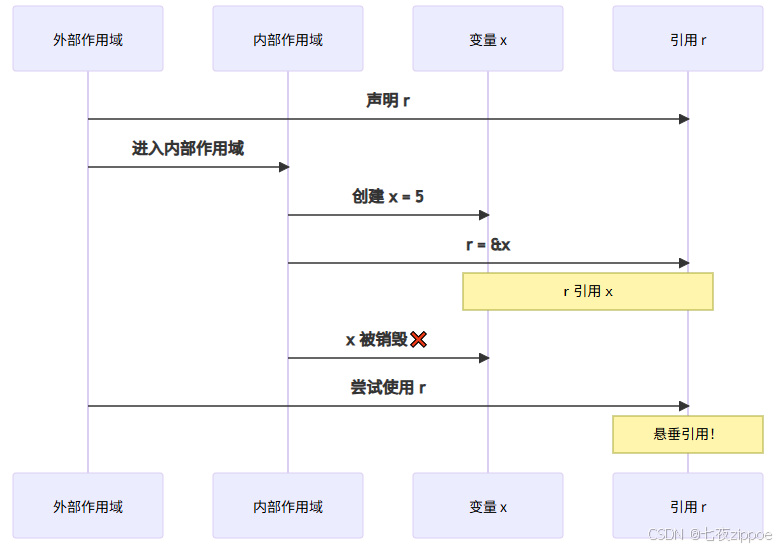
核心问题:引用的有效期必须短于被引用数据的生命周期。
// ❌ 悬垂引用示例
fn main() {
    let r;

    {
        let x = 5;
        r = &x;  // x 的生命周期在内部作用域
    }  // x 在此处被销毁

    // println!("{}", r);  // 编译错误:r 引用了已销毁的 x
}
编译器的视角:
1.2 生命周期标注(Lifetime Annotation)
生命周期参数以 ' 开头,通常使用小写字母:
// 'a 是生命周期参数
fn longest<'a>(x: &'a str, y: &'a str) -> &'a str {
    if x.len() > y.len() {
        x
    } else {
        y
    }
}

fn main() {
    let string1 = String::from("long string is long");
    let result;

    {
        let string2 = String::from("xyz");
        result = longest(string1.as_str(), string2.as_str());
        println!("最长的字符串是: {}", result);
    }  // string2 在此销毁,但 result 在其生命周期内使用,所以安全
}
生命周期标注语法:
| 语法 | 含义 | 示例 |
|---|---|---|
'a |
生命周期参数 | &'a str |
'static |
程序整个运行期 | &'static str |
'_ |
省略标记 | &'_ str |
二、生命周期标注规则
2.1 函数签名中的生命周期
规则:返回引用的生命周期必须与参数的生命周期关联。
// ✓ 正确:返回值生命周期与参数相同
fn first_word<'a>(s: &'a str) -> &'a str {
    let bytes = s.as_bytes();

    for (i, &item) in bytes.iter().enumerate() {
        if item == b' ' {
            return &s[0..i];
        }
    }

    &s[..]
}

// ❌ 编译错误:缺少生命周期标注
// fn longest(x: &str, y: &str) -> &str {
//     if x.len() > y.len() { x } else { y }
// }

// ✓ 正确:明确生命周期关系
fn longest<'a>(x: &'a str, y: &'a str) -> &'a str {
    if x.len() > y.len() { x } else { y }
}
可视化生命周期关系:
函数 longest<'a>
┌──────────────────────────────────┐
│ 参数 x: &'a str                  │
│         ↓                        │
│ 参数 y: &'a str  → 返回值: &'a str│
│         ↓                        │
└──────────────────────────────────┘

生命周期 'a 是 x 和 y 生命周期的交集
2.2 不同生命周期参数
// 多个生命周期参数
fn longest_with_announcement<'a, 'b>(
    x: &'a str,
    y: &'b str,
    ann: &str
) -> &'a str {
    println!("公告:{}", ann);
    if x.len() > y.len() {
        x  // 返回值只依赖 'a
    } else {
        x  // 仍然返回 x(类型为 &'a str)
    }
}

fn main() {
    let string1 = String::from("abcd");
    let string2 = String::from("xyz");

    let result = longest_with_announcement(
        string1.as_str(),
        string2.as_str(),
        "今天是星期三!"
    );

    println!("最长的字符串是: {}", result);
}
2.3 输入生命周期与输出生命周期
// 输入生命周期:参数引用的生命周期
// 输出生命周期:返回值引用的生命周期

fn example1<'a>(x: &'a str) -> &'a str {
    x  // 输出生命周期 = 输入生命周期
}

fn example2<'a>(x: &'a str, y: &str) -> &'a str {
    x  // 输出只依赖 x 的生命周期
}

// ❌ 编译错误:不能返回局部变量的引用
// fn invalid<'a>() -> &'a str {
//     let s = String::from("hello");
//     &s  // s 的生命周期不够长
// }
三、生命周期省略规则(Lifetime Elision)
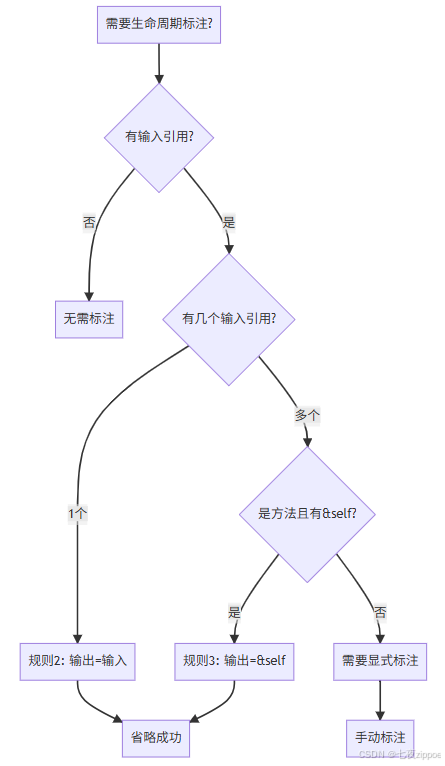
编译器通过三条规则自动推断生命周期,减少显式标注:
3.1 规则一:每个引用参数获得独立生命周期
// 编写的代码
fn first_word(s: &str) -> &str {
    &s[..1]
}

// 编译器推断为
fn first_word<'a>(s: &'a str) -> &'a str {
    &s[..1]
}
3.2 规则二:单一输入生命周期赋予所有输出
// 编写的代码
fn get_first(s: &str) -> &str {
    &s[0..1]
}

// 编译器推断为
fn get_first<'a>(s: &'a str) -> &'a str {
    &s[0..1]
}
3.3 规则三:多参数且有 &self,输出生命周期为 &self
struct ImportantExcerpt<'a> {
    part: &'a str,
}

impl<'a> ImportantExcerpt<'a> {
    // 编写的代码
    fn announce_and_return_part(&self, announcement: &str) -> &str {
        println!("注意:{}", announcement);
        self.part
    }

    // 编译器推断为
    // fn announce_and_return_part<'b>(&'a self, announcement: &'b str) -> &'a str
}
省略规则决策树:
四、结构体中的生命周期
4.1 带引用字段的结构体
// 结构体持有引用,需要生命周期标注
struct Article<'a> {
    title: &'a str,
    author: &'a str,
    content: &'a str,
}

impl<'a> Article<'a> {
    fn new(title: &'a str, author: &'a str, content: &'a str) -> Self {
        Article { title, author, content }
    }

    fn summary(&self) -> String {
        format!("《{}》 作者:{}", self.title, self.author)
    }
}

fn main() {
    let title = String::from("Rust 编程");
    let author = String::from("张三");
    let content = String::from("Rust 是一门系统编程语言...");

    let article = Article::new(&title, &author, &content);
    println!("{}", article.summary());
}
内存布局:
栈                          堆
┌─────────────┐
│ article     │
│ ├─ title ───┼──────────> "Rust 编程"
│ ├─ author ──┼──────────> "张三"
│ └─ content ─┼──────────> "Rust 是一门..."
└─────────────┘

生命周期 'a 确保:
- article 的生命周期 ≤ title, author, content
4.2 多个生命周期参数
struct Context<'s, 'c> {
    session: &'s str,
    config: &'c str,
}

impl<'s, 'c> Context<'s, 'c> {
    fn new(session: &'s str, config: &'c str) -> Self {
        Context { session, config }
    }

    // 返回值生命周期与 session 绑定
    fn get_session(&self) -> &'s str {
        self.session
    }

    // 返回值生命周期与 config 绑定
    fn get_config(&self) -> &'c str {
        self.config
    }
}

fn main() {
    let session = String::from("session-123");

    let ctx = {
        let config = String::from("config.toml");
        Context::new(&session, &config)
    };  // ❌ 编译错误:config 生命周期不够长
}
五、静态生命周期('static)
5.1 字符串字面值
fn main() {
    // 字符串字面值拥有 'static 生命周期
    let s: &'static str = "I have a static lifetime.";

    // 存储在程序二进制文件中,整个程序运行期间有效
    println!("{}", s);
}
5.2 静态变量
// 全局静态变量
static LANGUAGE: &str = "Rust";
static mut COUNTER: i32 = 0;

fn increment_counter() {
    unsafe {
        COUNTER += 1;
    }
}

fn main() {
    println!("语言:{}", LANGUAGE);

    unsafe {
        increment_counter();
        println!("计数器:{}", COUNTER);
    }
}
5.3 'static trait bound
use std::fmt::Display;

// T 必须拥有 'static 生命周期
fn print_it<T: Display + 'static>(input: T) {
    println!("{}", input);
}

fn main() {
    let x = 42;
    print_it(x);  // ✓ i32 是 'static

    let s = String::from("hello");
    // print_it(&s);  // ❌ &String 不是 'static
    print_it(s);  // ✓ String 本身是 'static
}
六、生命周期与泛型
6.1 综合示例
use std::fmt::Display;

// 结合生命周期、泛型和 trait bound
fn longest_with_announcement<'a, T>(
    x: &'a str,
    y: &'a str,
    ann: T,
) -> &'a str
where
    T: Display,
{
    println!("公告:{}", ann);
    if x.len() > y.len() {
        x
    } else {
        y
    }
}

fn main() {
    let string1 = String::from("长字符串很长");
    let string2 = String::from("短串");

    let result = longest_with_announcement(
        string1.as_str(),
        string2.as_str(),
        "这是重要公告!",
    );

    println!("最长的字符串是: {}", result);
}
6.2 生命周期子类型(Lifetime Subtyping)
// 'a: 'b 表示 'a 生命周期至少和 'b 一样长
struct Parser<'a, 'b: 'a> {
    data: &'a str,
    config: &'b str,
}

impl<'a, 'b: 'a> Parser<'a, 'b> {
    fn new(data: &'a str, config: &'b str) -> Self {
        Parser { data, config }
    }

    fn parse(&self) -> Vec<&'a str> {
        self.data.split_whitespace().collect()
    }
}

fn main() {
    let config = String::from("config");
    let data = String::from("hello world rust");

    let parser = Parser::new(&data, &config);
    let words = parser.parse();

    println!("{:?}", words);
}
七、实战案例
7.1 案例1:缓存系统
use std::collections::HashMap;

struct Cache<'a> {
    map: HashMap<&'a str, &'a str>,
}

impl<'a> Cache<'a> {
    fn new() -> Self {
        Cache {
            map: HashMap::new(),
        }
    }

    fn set(&mut self, key: &'a str, value: &'a str) {
        self.map.insert(key, value);
    }

    fn get(&self, key: &str) -> Option<&&'a str> {
        self.map.get(key)
    }
}

fn main() {
    let key1 = String::from("name");
    let value1 = String::from("Alice");

    let mut cache = Cache::new();
    cache.set(&key1, &value1);

    if let Some(&value) = cache.get("name") {
        println!("缓存值:{}", value);
    }
}
7.2 案例2:文本解析器
struct Parser<'a> {
    content: &'a str,
    pos: usize,
}

impl<'a> Parser<'a> {
    fn new(content: &'a str) -> Self {
        Parser { content, pos: 0 }
    }

    fn consume_while<F>(&mut self, test: F) -> &'a str
    where
        F: Fn(char) -> bool,
    {
        let start = self.pos;

        while self.pos < self.content.len() {
            let ch = self.content[self.pos..].chars().next().unwrap();
            if !test(ch) {
                break;
            }
            self.pos += ch.len_utf8();
        }

        &self.content[start..self.pos]
    }

    fn parse_identifier(&mut self) -> &'a str {
        self.consume_while(|c| c.is_alphanumeric() || c == '_')
    }

    fn skip_whitespace(&mut self) {
        self.consume_while(char::is_whitespace);
    }
}

fn main() {
    let source = "   hello_world   123   ";
    let mut parser = Parser::new(source);

    parser.skip_whitespace();
    let id1 = parser.parse_identifier();
    println!("标识符1: {}", id1);

    parser.skip_whitespace();
    let id2 = parser.parse_identifier();
    println!("标识符2: {}", id2);
}
7.3 案例3:配置管理器
use std::collections::HashMap;

struct Config<'a> {
    values: HashMap<&'a str, &'a str>,
}

impl<'a> Config<'a> {
    fn new() -> Self {
        Config {
            values: HashMap::new(),
        }
    }

    fn load(&mut self, data: &'a str) {
        for line in data.lines() {
            if let Some((key, value)) = line.split_once('=') {
                self.values.insert(key.trim(), value.trim());
            }
        }
    }

    fn get(&self, key: &str) -> Option<&&'a str> {
        self.values.get(key)
    }

    fn get_or_default(&self, key: &str, default: &'a str) -> &'a str {
        self.values.get(key).copied().unwrap_or(default)
    }
}

fn main() {
    let config_text = r#"
        host=localhost
        port=8080
        timeout=30
    "#;

    let mut config = Config::new();
    config.load(config_text);

    println!("Host: {}", config.get_or_default("host", "0.0.0.0"));
    println!("Port: {}", config.get_or_default("port", "3000"));
    println!("Debug: {}", config.get_or_default("debug", "false"));
}
八、高级生命周期模式
8.1 高阶 trait bounds(HRTB)
// Higher-Rank Trait Bounds
fn call_with_ref<F>(f: F)
where
    F: for<'a> Fn(&'a str),
{
    let s = String::from("hello");
    f(&s);
}

fn main() {
    call_with_ref(|s| {
        println!("Got: {}", s);
    });
}
8.2 协变与逆变
// 协变示例(Covariance)
fn covariant<'a, 'b: 'a>(long: &'a str, short: &'b str) -> &'a str {
    // 'b 生命周期可以被当作 'a 使用(因为 'b: 'a)
    long
}

// 不变示例(Invariance)
struct Container<'a> {
    data: &'a mut String,
}

fn main() {
    let mut s = String::from("hello");
    let container = Container { data: &mut s };
}
九、常见错误与解决方案
错误1:返回引用但没有输入生命周期
// ❌ 编译错误
// fn get_string() -> &str {
//     let s = String::from("hello");
//     &s  // s 被销毁,返回悬垂引用
// }

// ✓ 解决方案1:返回所有权
fn get_string_owned() -> String {
    String::from("hello")
}

// ✓ 解决方案2:使用 'static
fn get_string_static() -> &'static str {
    "hello"
}
错误2:生命周期不够长
// ❌ 编译错误
// fn example() {
//     let r;
//     {
//         let x = 5;
//         r = &x;
//     }
//     println!("{}", r);
// }

// ✓ 解决方案:扩展生命周期
fn example_fixed() {
    let x = 5;
    let r = &x;
    println!("{}", r);
}
错误3:结构体字段引用生命周期混淆
struct Wrapper<'a> {
    data: &'a str,
}

// ❌ 编译错误
// impl<'a> Wrapper<'a> {
//     fn get_data(&self) -> &str {
//         self.data  // 生命周期不明确
//     }
// }

// ✓ 正确
impl<'a> Wrapper<'a> {
    fn get_data(&self) -> &'a str {
        self.data
    }
}
十、性能考量
生命周期标注不影响运行时性能,它们是编译期的零成本抽象:
// 以下两个函数生成相同的机器码
fn with_lifetime<'a>(s: &'a str) -> &'a str {
    s
}

fn without_annotation(s: &str) -> &str {
    s
}
性能对比:
| 特性 | 编译期开销 | 运行时开销 | 安全性 |
|---|---|---|---|
| 生命周期标注 | 检查 | 零 | 高 |
| 智能指针(Rc) | 低 | 引用计数 | 中 |
| 裸指针 | 低 | 零 | 低(unsafe) |
十一、总结与讨论
生命周期是 Rust 实现内存安全的关键机制:
✅ 编译期保证:防止悬垂引用
✅ 零开销抽象:无运行时性能损失
✅ 自动推断:省略规则减少标注负担
✅ 灵活表达:支持复杂数据结构
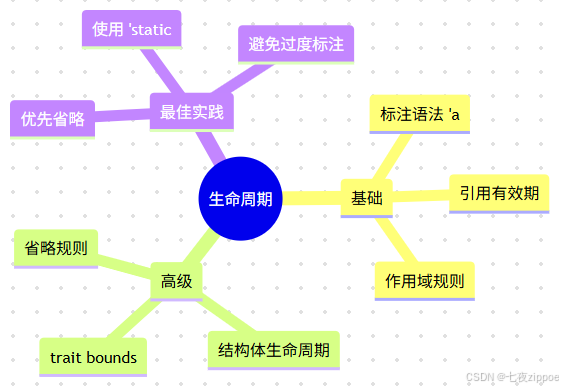
核心要点:
讨论问题:
- 你在实际项目中遇到过哪些生命周期编译错误?
- 何时应该显式标注生命周期,何时可以依赖省略规则?
- 生命周期与智能指针(如 Rc/Arc)如何选择?
欢迎分享你的经验!💬
参考链接
- Rust Book - Lifetimes:https://doc.rust-lang.org/book/ch10-03-lifetime-syntax.html
- Lifetime Elision Rules:https://doc.rust-lang.org/reference/lifetime-elision.html
- Nomicon - Subtyping:https://doc.rust-lang.org/nomicon/subtyping.html
- RFC 1214(Lifetime Variance):https://rust-lang.github.io/rfcs/1214-projections-lifetimes-and-wf.htm

Agent 垂直技术社区,欢迎活跃、内容共建。
更多推荐
 33
33 0
0- 0



 已为社区贡献17条内容

所有评论(0)