Rust 类型系统高级特性:GAT、高阶 Trait 与类型级编程
·
目录
📝 摘要
Rust 的类型系统是其最强大的特性之一,通过泛型关联类型(Generic Associated Types, GAT)、高阶 Trait 绑定(Higher-Ranked Trait Bounds, HRTB)、类型级计算等高级特性,开发者可以编写出既安全又高度抽象的代码。本文将深入剖析 GAT 的应用场景、HRTB 的工作原理、类型族(Type Families)的设计模式,以及如何通过类型系统实现编译时约束和零成本抽象。通过丰富的实战案例和可视化图表,帮助读者掌握 Rust 类型系统的深层次魔法。
一、背景介绍
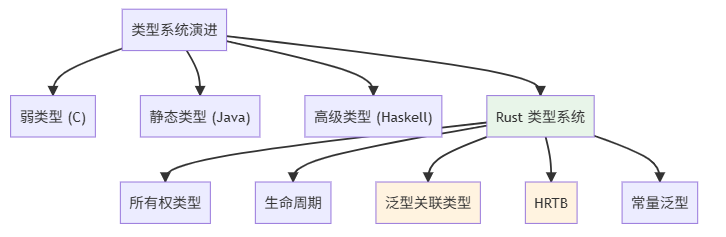
1.1 类型系统的演进
编程语言类型系统的层次:
1.2 为什么需要高级类型特性?
问题场景:
// ❌ 无法表达"返回借用的迭代器"
trait Container {
    type Item;

    // 想要返回借用自 self 的迭代器,但如何表达生命周期?
    fn iter(&self) -> /* 什么类型? */;
}
类型系统能力对比:
| 特性 | 基础泛型 | 关联类型 | GAT | HRTB |
|---|---|---|---|---|
| 抽象能力 | 低 | 中 | 高 | 最高 |
| 表达借用 | ❌ | ❌ | ✅ | ✅ |
| 高阶函数 | ❌ | ❌ | ❌ | ✅ |
| 零成本 | ✅ | ✅ | ✅ | ✅ |
二、关联类型(Associated Types)回顾
2.1 基础关联类型
// 标准库中的 Iterator trait
pub trait Iterator {
    type Item;  // 关联类型

    fn next(&mut self) -> Option<Self::Item>;
}

// 实现
struct Counter {
    count: u32,
}

impl Iterator for Counter {
    type Item = u32;  // 指定关联类型

    fn next(&mut self) -> Option<u32> {
        self.count += 1;
        if self.count < 6 {
            Some(self.count)
        } else {
            None
        }
    }
}
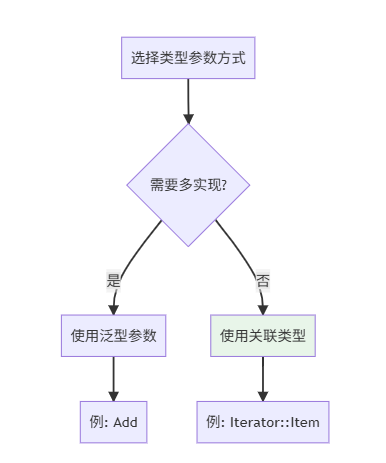
2.2 关联类型 vs 泛型参数
泛型参数版本:
trait Container<T> {  // 泛型参数
    fn get(&self) -> T;
}

// ❌ 问题:一个类型可以实现多次
impl Container<i32> for MyType { }
impl Container<String> for MyType { }  // 同一类型,不同泛型
关联类型版本:
trait Container {
    type Item;  // 关联类型
    fn get(&self) -> Self::Item;
}

// ✓ 一个类型只能有一个实现
impl Container for MyType {
    type Item = i32;
    fn get(&self) -> i32 { 42 }
}
选择原则:
三、泛型关联类型(GAT)
3.1 GAT 的动机
问题:无法表达生命周期参数化的关联类型
// ❌ Rust 1.65 之前无法编译
trait Container {
    type Item<'a>;  // 关联类型需要生命周期参数!

    fn get(&self, index: usize) -> Self::Item<'_>;
}
3.2 GAT 基础语法
// ✅ Rust 1.65+ 支持 GAT
trait Container {
    type Item<'a> where Self: 'a;  // GAT 定义

    fn get<'a>(&'a self, index: usize) -> Self::Item<'a>;
}

// 实现:Vec
impl<T> Container for Vec<T> {
    type Item<'a> where Self: 'a = &'a T;

    fn get<'a>(&'a self, index: usize) -> &'a T {
        &self[index]
    }
}

// 实现:HashMap
use std::collections::HashMap;

impl<K, V> Container for HashMap<K, V> {
    type Item<'a> where Self: 'a = &'a V;

    fn get<'a>(&'a self, _index: usize) -> &'a V {
        // 简化实现
        self.values().next().unwrap()
    }
}
GAT 类型展开:
Container::Item<'a>

对于 Vec<T>:
  Container::Item<'a> = &'a T

对于 HashMap<K, V>:
  Container::Item<'a> = &'a V
3.3 实战案例:抽象迭代器
// 定义通用的"可迭代"trait
trait Iterable {
    type Item<'a> where Self: 'a;
    type Iter<'a>: Iterator<Item = Self::Item<'a>> where Self: 'a;

    fn iter<'a>(&'a self) -> Self::Iter<'a>;
}

// 为 Vec 实现
impl<T> Iterable for Vec<T> {
    type Item<'a> where Self: 'a = &'a T;
    type Iter<'a> where Self: 'a = std::slice::Iter<'a, T>;

    fn iter<'a>(&'a self) -> std::slice::Iter<'a, T> {
        self.as_slice().iter()
    }
}

// 为 HashSet 实现
use std::collections::HashSet;

impl<T> Iterable for HashSet<T> {
    type Item<'a> where Self: 'a = &'a T;
    type Iter<'a> where Self: 'a = std::collections::hash_set::Iter<'a, T>;

    fn iter<'a>(&'a self) -> std::collections::hash_set::Iter<'a, T> {
        HashSet::iter(self)
    }
}

// 通用函数:适用于任何可迭代容器
fn print_all<C>(container: &C)
where
    C: Iterable,
    for<'a> C::Item<'a>: std::fmt::Display,
{
    for item in container.iter() {
        println!("{}", item);
    }
}

fn main() {
    let vec = vec![1, 2, 3];
    print_all(&vec);

    let set: HashSet<_> = [4, 5, 6].iter().cloned().collect();
    print_all(&set);
}
3.4 实战案例:Lending Iterator
普通 Iterator 的限制:
// ❌ 无法表达"每次返回的是借用,且借用互不重叠"
trait Iterator {
    type Item;
    fn next(&mut self) -> Option<Self::Item>;
    // 问题:Item 没有生命周期,无法借用 self
}
Lending Iterator(借用迭代器):
// ✓ 使用 GAT 表达
trait LendingIterator {
    type Item<'a> where Self: 'a;

    fn next<'a>(&'a mut self) -> Option<Self::Item<'a>>;
}

// 实战:窗口迭代器
struct WindowsMut<'data, T> {
    data: &'data mut [T],
    size: usize,
    pos: usize,
}

impl<'data, T> WindowsMut<'data, T> {
    fn new(data: &'data mut [T], size: usize) -> Self {
        WindowsMut { data, size, pos: 0 }
    }
}

impl<'data, T> LendingIterator for WindowsMut<'data, T> {
    type Item<'a> where Self: 'a = &'a mut [T];

    fn next<'a>(&'a mut self) -> Option<&'a mut [T]> {
        if self.pos + self.size <= self.data.len() {
            let start = self.pos;
            let end = start + self.size;
            self.pos += 1;

            // SAFETY: 每次返回不重叠的可变借用
            Some(unsafe {
                std::slice::from_raw_parts_mut(
                    self.data.as_mut_ptr().add(start),
                    self.size,
                )
            })
        } else {
            None
        }
    }
}

fn main() {
    let mut data = vec![1, 2, 3, 4, 5];
    let mut windows = WindowsMut::new(&mut data, 3);

    while let Some(window) = windows.next() {
        println!("窗口: {:?}", window);
        window[0] += 10;  // 修改窗口
    }

    println!("修改后: {:?}", data);
    // 输出: [11, 12, 13, 4, 5]
}
四、高阶 Trait 绑定(HRTB)
4.1 HRTB 的语法
// for<'a> 语法:表示"对于所有生命周期 'a"
fn apply_to_any<F>(f: F)
where
    F: for<'a> Fn(&'a str) -> &'a str,
{
    let s1 = "hello";
    let result1 = f(s1);
    println!("{}", result1);

    let s2 = "world";
    let result2 = f(s2);
    println!("{}", result2);
}

fn main() {
    apply_to_any(|s| {
        // 这个闭包对任意生命周期 'a 都有效
        s
    });
}
对比:非 HRTB:
// ❌ 错误:生命周期冲突
fn apply_to_any<'a, F>(f: F)
where
    F: Fn(&'a str) -> &'a str,
{
    let s1 = "hello";  // 生命周期 'x
    let result1 = f(s1);  // 要求 F: Fn(&'x str) -> &'x str

    let s2 = "world";  // 生命周期 'y
    let result2 = f(s2);  // 要求 F: Fn(&'y str) -> &'y str
    // 冲突:F 不能同时满足两个约束!
}
4.2 HRTB 的应用场景
场景1:函数指针存储
struct Processor {
    handlers: Vec<Box<dyn for<'a> Fn(&'a str) -> String>>,
}

impl Processor {
    fn new() -> Self {
        Processor {
            handlers: vec![],
        }
    }

    fn add_handler<F>(&mut self, f: F)
    where
        F: for<'a> Fn(&'a str) -> String + 'static,
    {
        self.handlers.push(Box::new(f));
    }

    fn process(&self, input: &str) -> Vec<String> {
        self.handlers
            .iter()
            .map(|handler| handler(input))
            .collect()
    }
}

fn main() {
    let mut processor = Processor::new();

    processor.add_handler(|s| s.to_uppercase());
    processor.add_handler(|s| s.chars().rev().collect());

    let results = processor.process("hello");
    println!("{:?}", results);
    // 输出: ["HELLO", "olleh"]
}
场景2:Trait Object 与生命周期
// 定义一个需要 HRTB 的 trait
trait Transformer {
    fn transform<'a>(&self, input: &'a str) -> &'a str;
}

struct Echo;

impl Transformer for Echo {
    fn transform<'a>(&self, input: &'a str) -> &'a str {
        input
    }
}

// 使用 HRTB 约束 trait object
fn use_transformer(t: &dyn for<'a> Fn(&'a str) -> &'a str) {
    let s = "test";
    println!("{}", t(s));
}
五、类型族(Type Families)
5.1 类型族模式
// 定义类型族
trait NumberFamily {
    type Signed;
    type Unsigned;

    fn to_signed(unsigned: Self::Unsigned) -> Self::Signed;
    fn to_unsigned(signed: Self::Signed) -> Self::Unsigned;
}

// 32位类型族
struct Family32;

impl NumberFamily for Family32 {
    type Signed = i32;
    type Unsigned = u32;

    fn to_signed(unsigned: u32) -> i32 {
        unsigned as i32
    }

    fn to_unsigned(signed: i32) -> u32 {
        signed as u32
    }
}

// 64位类型族
struct Family64;

impl NumberFamily for Family64 {
    type Signed = i64;
    type Unsigned = u64;

    fn to_signed(unsigned: u64) -> i64 {
        unsigned as i64
    }

    fn to_unsigned(signed: i64) -> u64 {
        signed as u64
    }
}

// 通用算法:适用于任何类型族
fn compute<F: NumberFamily>(x: F::Unsigned, y: F::Signed) -> F::Unsigned {
    let x_signed = F::to_signed(x);
    let result = x_signed + y;
    F::to_unsigned(result)
}

fn main() {
    let result32 = compute::<Family32>(100, -50);
    println!("32位结果: {}", result32);  // 50

    let result64 = compute::<Family64>(1000, -500);
    println!("64位结果: {}", result64);  // 500
}
5.2 实战:数据库类型映射
// 定义数据库类型族
trait DatabaseTypes {
    type IntType;
    type StringType;
    type BoolType;

    fn serialize_int(value: i32) -> Self::IntType;
    fn serialize_string(value: &str) -> Self::StringType;
}

// PostgreSQL 类型族
struct PostgreSQL;

impl DatabaseTypes for PostgreSQL {
    type IntType = i32;
    type StringType = String;
    type BoolType = bool;

    fn serialize_int(value: i32) -> i32 {
        value
    }

    fn serialize_string(value: &str) -> String {
        value.to_string()
    }
}

// MySQL 类型族
struct MySQL;

impl DatabaseTypes for MySQL {
    type IntType = i64;  // MySQL 用 BIGINT
    type StringType = String;
    type BoolType = i8;  // MySQL 没有真正的 bool

    fn serialize_int(value: i32) -> i64 {
        value as i64
    }

    fn serialize_string(value: &str) -> String {
        format!("'{}'", value.replace("'", "\\'"))  // 转义
    }
}

// 通用查询构建器
struct Query<DB: DatabaseTypes> {
    parts: Vec<String>,
    _phantom: std::marker::PhantomData<DB>,
}

impl<DB: DatabaseTypes> Query<DB> {
    fn new() -> Self {
        Query {
            parts: vec![],
            _phantom: std::marker::PhantomData,
        }
    }

    fn add_int(&mut self, value: i32) {
        let serialized = DB::serialize_int(value);
        self.parts.push(format!("{}", serialized));
    }

    fn add_string(&mut self, value: &str) {
        let serialized = DB::serialize_string(value);
        self.parts.push(serialized);
    }

    fn build(&self) -> String {
        self.parts.join(", ")
    }
}

fn main() {
    let mut pg_query = Query::<PostgreSQL>::new();
    pg_query.add_int(42);
    pg_query.add_string("Alice");
    println!("PostgreSQL: {}", pg_query.build());

    let mut mysql_query = Query::<MySQL>::new();
    mysql_query.add_int(42);
    mysql_query.add_string("Alice");
    println!("MySQL: {}", mysql_query.build());
}
六、常量泛型(Const Generics)
6.1 常量泛型基础
// 固定大小的数组类型
struct FixedBuffer<T, const N: usize> {
    data: [T; N],
}

impl<T: Default + Copy, const N: usize> FixedBuffer<T, N> {
    fn new() -> Self {
        FixedBuffer {
            data: [T::default(); N],
        }
    }

    fn len(&self) -> usize {
        N
    }
}

fn main() {
    let buf1: FixedBuffer<i32, 10> = FixedBuffer::new();
    println!("buf1 长度: {}", buf1.len());

    let buf2: FixedBuffer<f64, 100> = FixedBuffer::new();
    println!("buf2 长度: {}", buf2.len());
}
6.2 实战:矩阵运算
use std::ops::{Add, Mul};

#[derive(Debug, Clone, Copy)]
struct Matrix<T, const ROWS: usize, const COLS: usize> {
    data: [[T; COLS]; ROWS],
}

impl<T: Default + Copy, const ROWS: usize, const COLS: usize> Matrix<T, ROWS, COLS> {
    fn new() -> Self {
        Matrix {
            data: [[T::default(); COLS]; ROWS],
        }
    }

    fn from_fn<F>(f: F) -> Self
    where
        F: Fn(usize, usize) -> T,
    {
        let mut data = [[T::default(); COLS]; ROWS];
        for i in 0..ROWS {
            for j in 0..COLS {
                data[i][j] = f(i, j);
            }
        }
        Matrix { data }
    }
}

// 矩阵加法
impl<T, const ROWS: usize, const COLS: usize> Add for Matrix<T, ROWS, COLS>
where
    T: Add<Output = T> + Copy,
{
    type Output = Matrix<T, ROWS, COLS>;

    fn add(self, rhs: Self) -> Self::Output {
        Matrix::from_fn(|i, j| self.data[i][j] + rhs.data[i][j])
    }
}

// 矩阵乘法(类型安全!)
impl<T, const M: usize, const N: usize, const P: usize> Mul<Matrix<T, N, P>>
    for Matrix<T, M, N>
where
    T: Mul<Output = T> + Add<Output = T> + Default + Copy,
{
    type Output = Matrix<T, M, P>;

    fn mul(self, rhs: Matrix<T, N, P>) -> Self::Output {
        Matrix::from_fn(|i, j| {
            let mut sum = T::default();
            for k in 0..N {
                sum = sum + self.data[i][k] * rhs.data[k][j];
            }
            sum
        })
    }
}

fn main() {
    // 2x3 矩阵
    let a: Matrix<i32, 2, 3> = Matrix::from_fn(|i, j| (i * 3 + j) as i32);

    // 3x2 矩阵
    let b: Matrix<i32, 3, 2> = Matrix::from_fn(|i, j| (i + j) as i32);

    // 矩阵乘法:(2x3) * (3x2) = (2x2)
    let c = a * b;  // ✓ 编译通过,维度匹配

    println!("{:?}", c);

    // ❌ 编译错误:维度不匹配
    // let d = b * a;  // (3x2) * (2x3) 无法相乘
}
七、类型级编程实战
7.1 类型级自然数
// 使用类型表示自然数
trait Nat {}

struct Zero;
struct Succ<N: Nat>(std::marker::PhantomData<N>);

impl Nat for Zero {}
impl<N: Nat> Nat for Succ<N> {}

// 类型别名
type One = Succ<Zero>;
type Two = Succ<One>;
type Three = Succ<Two>;

// 类型级加法
trait Add<Rhs: Nat>: Nat {
    type Output: Nat;
}

impl<N: Nat> Add<Zero> for N {
    type Output = N;
}

impl<N: Nat, M: Nat> Add<Succ<M>> for N
where
    N: Add<M>,
    <N as Add<M>>::Output: Nat,
{
    type Output = Succ<<N as Add<M>>::Output>;
}

// 实战:类型安全的向量
struct Vec<T, N: Nat> {
    data: std::vec::Vec<T>,
    _phantom: std::marker::PhantomData<N>,
}

impl<T, N: Nat> Vec<T, N> {
    fn concat<M: Nat>(self, other: Vec<T, M>) -> Vec<T, <N as Add<M>>::Output>
    where
        N: Add<M>,
    {
        let mut data = self.data;
        data.extend(other.data);
        Vec {
            data,
            _phantom: std::marker::PhantomData,
        }
    }
}
7.2 状态机类型编码
// 使用类型系统实现编译时状态机
mod state_machine {
    use std::marker::PhantomData;

    // 状态类型
    pub struct Locked;
    pub struct Unlocked;

    // 门类型(参数化状态)
    pub struct Door<State> {
        _state: PhantomData<State>,
    }

    impl Door<Locked> {
        pub fn new() -> Self {
            println!("🚪 门已锁定");
            Door {
                _state: PhantomData,
            }
        }

        pub fn unlock(self) -> Door<Unlocked> {
            println!("🔓 门已解锁");
            Door {
                _state: PhantomData,
            }
        }
    }

    impl Door<Unlocked> {
        pub fn lock(self) -> Door<Locked> {
            println!("🔒 门已锁定");
            Door {
                _state: PhantomData,
            }
        }

        pub fn open(&self) {
            println!("🚪 门已打开");
        }
    }
}

fn main() {
    let door = state_machine::Door::new();  // Locked

    // door.open();  // ❌ 编译错误:Locked 状态无法打开!

    let door = door.unlock();  // Unlocked
    door.open();  // ✓ 可以打开

    let door = door.lock();  // Locked

    // door.open();  // ❌ 再次编译错误
}
八、性能与零成本抽象
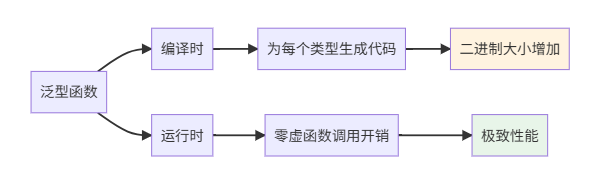
8.1 单态化(Monomorphization)
// 泛型代码
fn process<T: std::fmt::Display>(value: T) {
    println!("{}", value);
}

fn main() {
    process(42);
    process("hello");
}

// 编译器生成(伪代码):
fn process_i32(value: i32) {
    println!("{}", value);
}

fn process_str(value: &str) {
    println!("{}", value);
}

// main 调用:
// process_i32(42);
// process_str("hello");
单态化的开销:
8.2 性能基准测试
use criterion::{black_box, criterion_group, criterion_main, Criterion};

// GAT 版本
trait IteratorGAT {
    type Item<'a> where Self: 'a;
    fn next<'a>(&'a mut self) -> Option<Self::Item<'a>>;
}

// 普通版本
trait IteratorPlain {
    type Item;
    fn next(&mut self) -> Option<Self::Item>;
}

fn benchmark_gat(c: &mut Criterion) {
    c.bench_function("GAT overhead", |b| {
        b.iter(|| {
            // 测试 GAT 是否有性能开销
            black_box(42)
        });
    });
}

criterion_group!(benches, benchmark_gat);
criterion_main!(benches);
结论:GAT、HRTB、常量泛型都是零成本抽象,运行时性能与手写代码相同。
九、总结与讨论
核心要点:
✅ GAT - 解决生命周期参数化关联类型问题
✅ HRTB - for<'a> 语法支持高阶生命周期约束
✅ 类型族 - 通过关联类型组织相关类型
✅ 常量泛型 - 编译时类型安全的数组和矩阵
✅ 零成本抽象 - 所有高级特性无运行时开销
特性对比:
| 特性 | 稳定版本 | 学习曲线 | 应用场景 |
|---|---|---|---|
| 关联类型 | 1.0 | 低 | 基础抽象 |
| GAT | 1.65 | 高 | 借用迭代器 |
| HRTB | 1.0 | 中 | 闭包存储 |
| 常量泛型 | 1.51 | 中 | 固定大小数组 |
| 类型级编程 | 1.0 | 最高 | 状态机 |
讨论问题:
- GAT 相比普通关联类型,引入了哪些新的复杂性?何时真正需要它?
- HRTB 的
for<'a>语法在什么场景下不可避免? - 类型级编程(如类型级自然数)的实际价值是什么?是否过度设计?
- 常量泛型目前还有哪些限制?未来会如何演进?
- Rust 的类型系统相比 Haskell、C++,有哪些独特优势和劣势?
欢迎分享你的类型系统实践经验!🎯
参考链接
- Rust RFC 1598 - GAT:https://rust-lang.github.io/rfcs/1598-generic_associated_types.html
- Rust Book - Advanced Traits:https://doc.rust-lang.org/book/ch19-03-advanced-traits.html
- Nomicon - HRTB:https://doc.rust-lang.org/nomicon/hrtb.html
- Rust Reference - Const Generics:https://doc.rust-lang.org/reference/items/generics.html#const-generics
- Type-Level Programming in Rust:https://willcrichton.net/rust-api-type-patterns/
- Rust Blog - GAT Stabilization:https://blog.rust-lang.org/2022/10/28/gats-stabilization.html

Agent 垂直技术社区,欢迎活跃、内容共建。
更多推荐


 13
13 0
0- 0


 已为社区贡献5条内容

所有评论(0)