C++平衡树之AVL树
前置知识:二叉搜索树 点击回顾
1、引入
为了保持平衡,AVL树在二叉搜索树之上增加了以下限制:
对于树中的任意节点,其左右子树的高度差的绝对值不超过1。
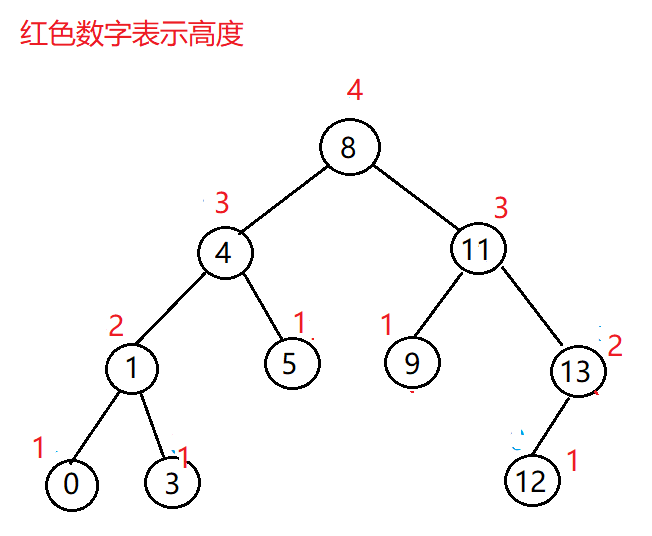
为此需要在节点中新增一个_h记录以该节点为根的子树的高度。
AVL树示例图:
2、AVL树节点定义
template<class T>
struct AVLtree_node
{
    T _val; // 权值
    int _h; // 以该节点为根的子树的高度(为了保持平衡)
    int _cnt;   // 值为_val的节点的个数(为了支持插入重复数据)
    int _size;  // 以该节点为根的子树的大小(为了可以查询树中排名第k的节点)
	// _cnt与_size是我想测试插入与删除操作是否有bug,但奈何没有充足的测试数据,只能补全代码,然后拿洛谷P6136【模板】普通平衡树(数据加强版)去验证

    AVLtree_node* _left;    // 左儿子
    AVLtree_node* _right;   // 右儿子
    AVLtree_node* _parent;  // 父节点
    AVLtree_node(const T& x = T())
        :_val(x)
        ,_h(1)
        ,_cnt(1)
        ,_size(1)
        ,_left(nullptr)
        ,_right(nullptr)
        ,_parent(nullptr)
    {}
};

template<class T>
class AVLtree
{
	typedef AVLtree_node<T> node;
	typedef AVLtree_node<T>* node_ptr;
protected:
	node* _root = nullptr;
};
3、查找权值为val的节点
与二叉搜索树类似,从根节点开始找,若val小于当前节点的权值,就去左子树找;若val大于当前节点的权值,就去右子树找;找到了就直接返回。代码如下
	// find返回值:
	// 1.找到了返回权值为val的节点;
	// 2.找不到则返回其应当插入位置的父节点
	node* find(const T& val)
	{
		node* cur = _root;
		node* p = nullptr;	// 记录cur的父节点
		while (cur)
		{
			p = cur;
			if (val < cur->_val)
				cur = cur->_left;
			else if (val > cur->_val)
				cur = cur->_right;
			else
				return cur;	// 找到目标节点时直接返回
		}
		return p;	// 找不到则返回目标值应插入的位置的父节点
	}
4、插入操作
插入过程与上篇讲的二叉搜索树类似,不过AVL树会进行平衡调整。
例如在上述示例图插入10
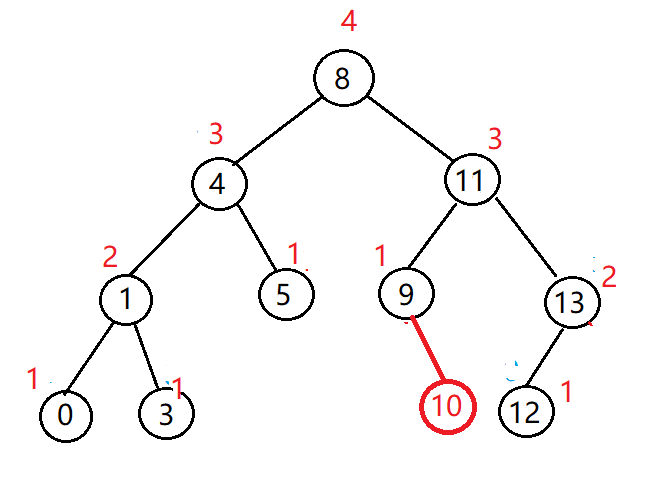
然后要维护树的高度
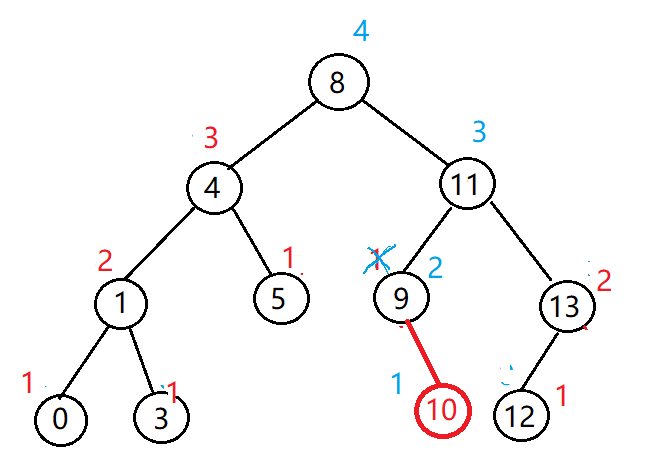
问:新插入的节点可能会改变哪些节点的高度?
答:其祖先节点。
所以我们从插入的节点开始,一路往上更新每个节点的高度
插入操作代码框架:
	// 申请空间(为什么不直接写成new node(val)呢?因为后续可能引入类似内存池的东西)
	node* get_node(const T& val) { return new node(val); }
	// 释放空间
	void del_node(node* x) { delete x; }

	void insert(const T& val)
	{
		if (!_root)
		{
			_root = get_node(val);
			return;
		}
		node* cur = find(val);
		if (cur->_val == val)
			cur->_cnt++;		// 支持插入重复元素
		else
		{
			// 到这里说明未找到,cur是val应插入的位置的父节点
			node* p = cur;
			cur = get_node(val);
			cur->_parent = p;
			if (val < p->_val) p->_left = cur;
			else p->_right = cur;
		}

		// 插入节点后还需往上更新
		update(cur);
	}
注意:向上更新时,如果当前节点的左右子树的高度差的绝对值超过1了,需旋转调整
例如在AVL树示例图中插入-1
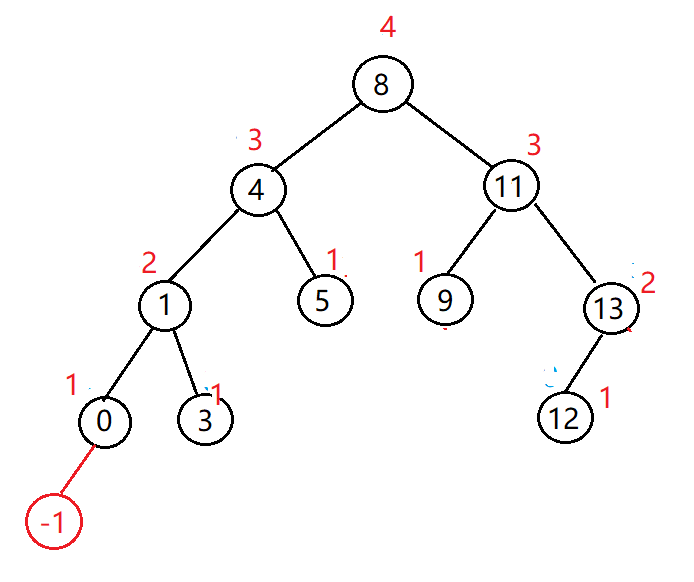
然后维护高度
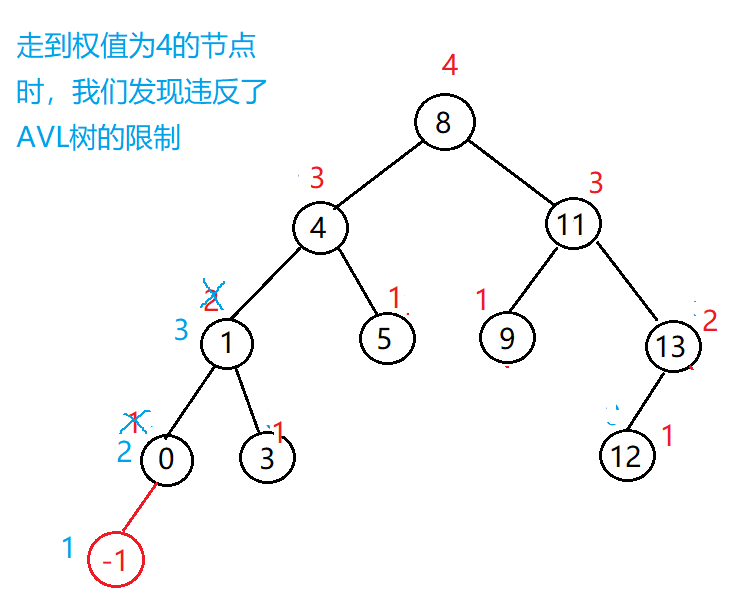
此时说明该树已经不那么平衡了,需要旋转调整,调整后再继续往上更新
往上更新的代码框架
	// 计算以x为根的子树的高度
	int height(node* x) { return x ? x->_h : 0; }

	// 计算以x为根的子树的大小
	int size(node* x) { return x ? x->_size : 0; }

	// 更新x的_h与_size
	void push_up(node* x)
	{
		if (x)
		{
			x->_h = max(height(x->_left), height(x->_right)) + 1;
			x->_size = size(x->_left) + size(x->_right) + x->_cnt;
		}
	}
    void update(node* p)
    {
        while(p)
        {
            node* g = p->_parent;
            int l = height(p->_left), r =height(p->_right);
            if(abs(l - r) <= 1)
                push_up(p);
            else       // 平衡破坏,需旋转调整
                balance(p);
            p = g;
        }
    }
5、旋转操作
(由于我不会制作动图,旋转过程最好自己揣摩揣摩,画画图)
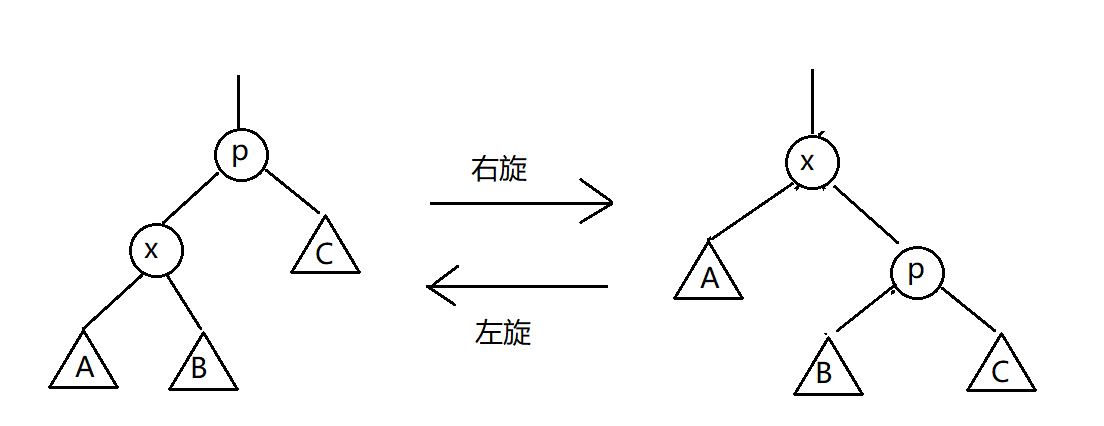
旋转后该子树仍满足二叉搜索树的性质,且A、B、C的高度显然不会改变,需更新p与x的高度。
代码如下:
	//     g               g
	//     |               |
    //     p               x
    //    / \             / \
    //   x   C   ====>   A   p
    //  / \                 / \
    // A   B               B   C
    void rotateR(node* p)	// 右旋
    {
        node* g = p->_parent;
        node* x = p->_left;
        p->_left = x->_right;
        if(x->_right) x->_right->_parent = p;

        x->_right = p;
        p->_parent = x;

        x->_parent = g;
        if(g){
            if(p == g->_left) g->_left = x;
            else g->_right = x;
        }
		// 注意需先更新p,再更新x
        push_up(p);
        push_up(x);

        // 注意可能需要更新根节点
        if(_root == p) _root = x;
    }

	//     g               g
	//     |               |
    //     p               x
    //    / \             / \
    //   x   C   <====   A   p
    //  / \                 / \
    // A   B               B   C
    void rotateL(node* x)	// 左旋,与右旋类似
    {
        node* g = x->_parent;
        node* p = x->_right;
        x->_right = p->_left;
        if(p->_left) p->_left->_parent = x;

        p->_left = x;
        x->_parent = p;

        p->_parent = g;
        if(g){
            if(x == g->_left) g->_left = p;
            else g->_right = p;
        }
        push_up(x);
        push_up(p);
        if(_root == x) _root = p;
    }
6、失衡调整
由于插入/删除一个节点后,子树的高度至多变化1,失衡情况只有以下两类:
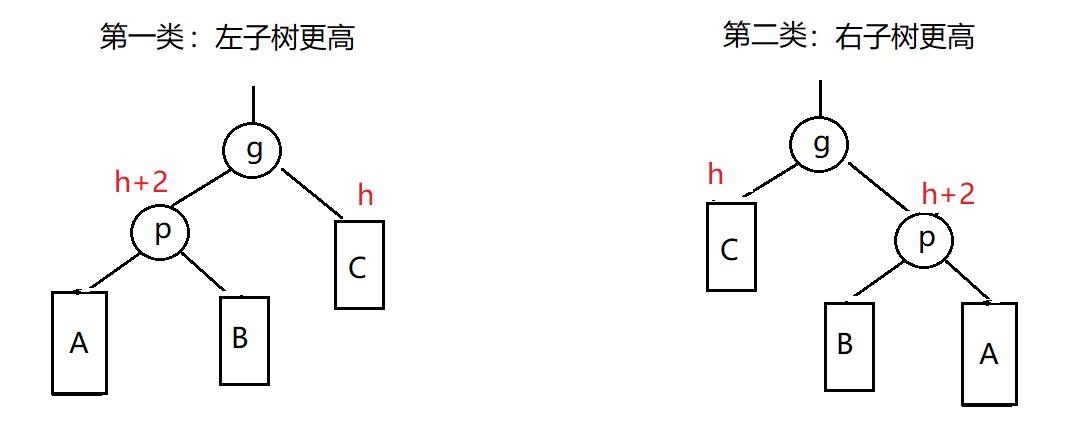
由于第一类与第二类对称,后面将以第一类为例。
需对A与B的高度进行分类讨论,下文中的
H
(
x
)
H(x)
H(x)表示以
x
x
x为根的子树的高度
情况一: H ( A ) ≥ H ( B ) H(A) \geq H(B) H(A)≥H(B) (直线型)
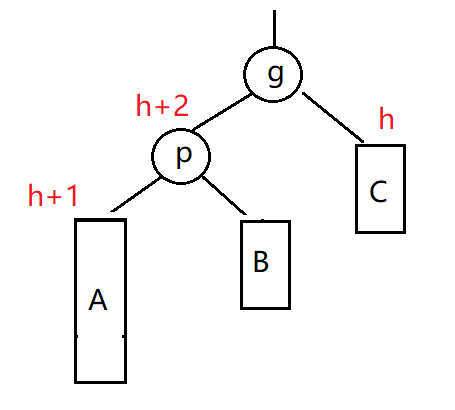
1.LL型
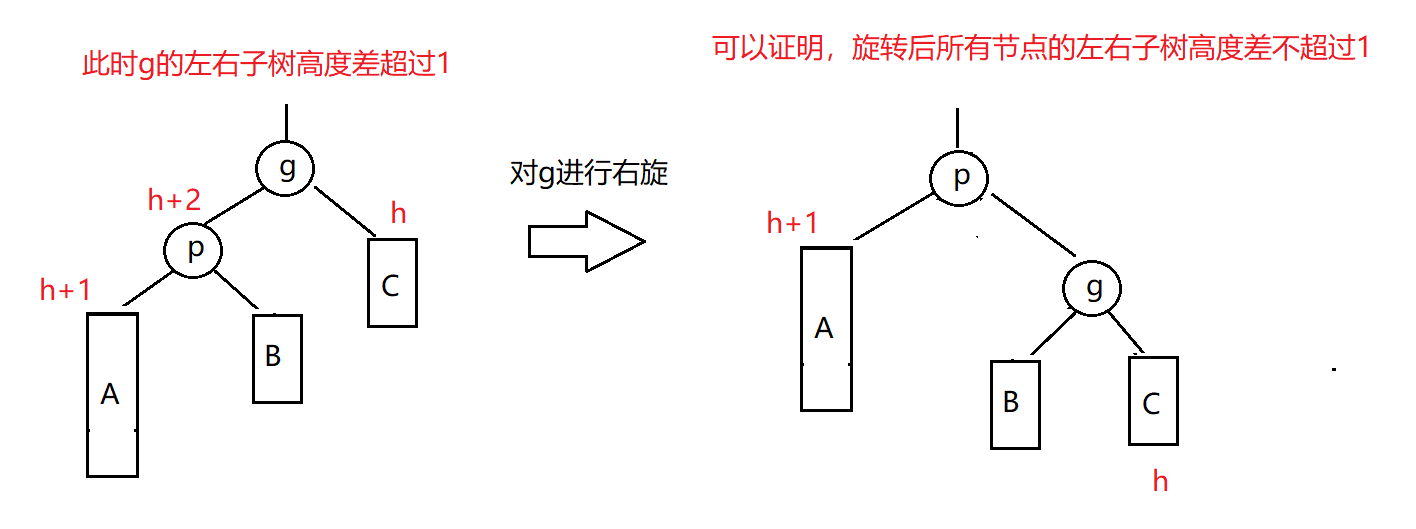
感性地了解旋转后的正确性:
由于
H
(
A
)
≥
H
(
B
)
H(A) \geq H(B)
H(A)≥H(B),则
H
(
A
)
=
h
+
1
H(A)=h+1
H(A)=h+1 ,那么
h
≤
H
(
B
)
≤
h
+
1
h \leq H(B) \leq h+1
h≤H(B)≤h+1,旋转后,
h
+
1
≤
H
(
g
)
≤
h
+
2
h+1 \leq H(g) \leq h+2
h+1≤H(g)≤h+2 。可得出
g
g
g 与
A
A
A 的高度差不超过1,
B
B
B 与
C
C
C 的高度差不超过1
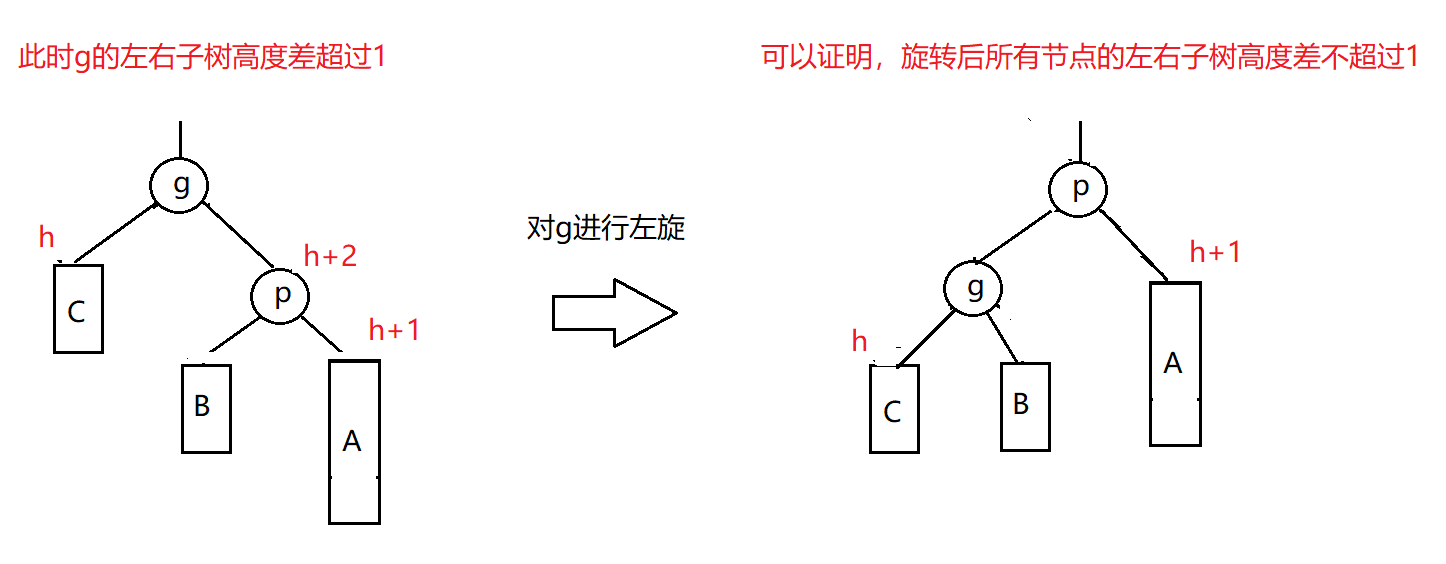
2.RR型(与LL型对称)
情况二: H ( A ) < H ( B ) H(A) \lt H(B) H(A)<H(B) (折线型)
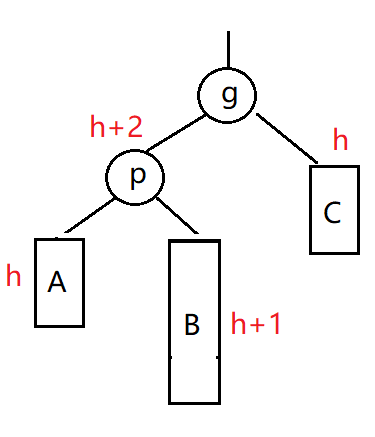
1.LR型
这里需要把B分的更细一点
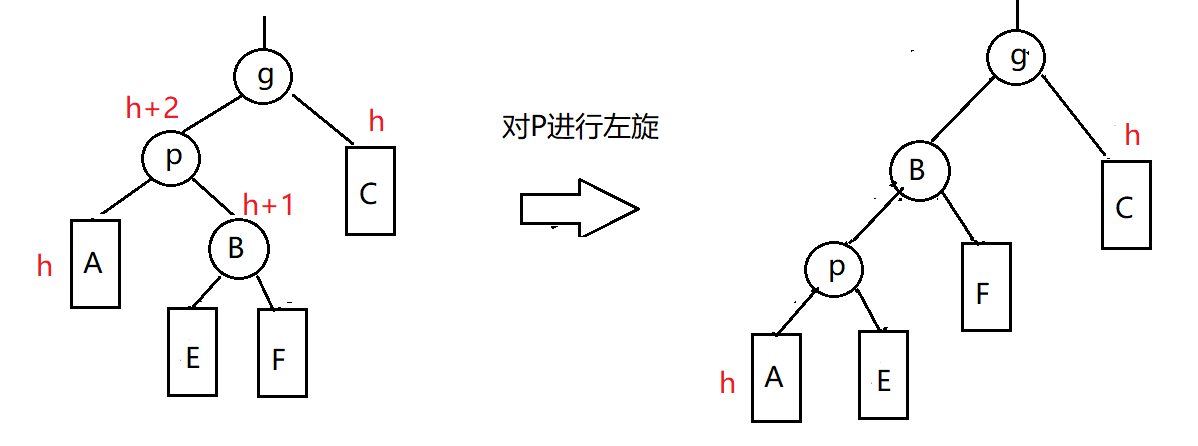
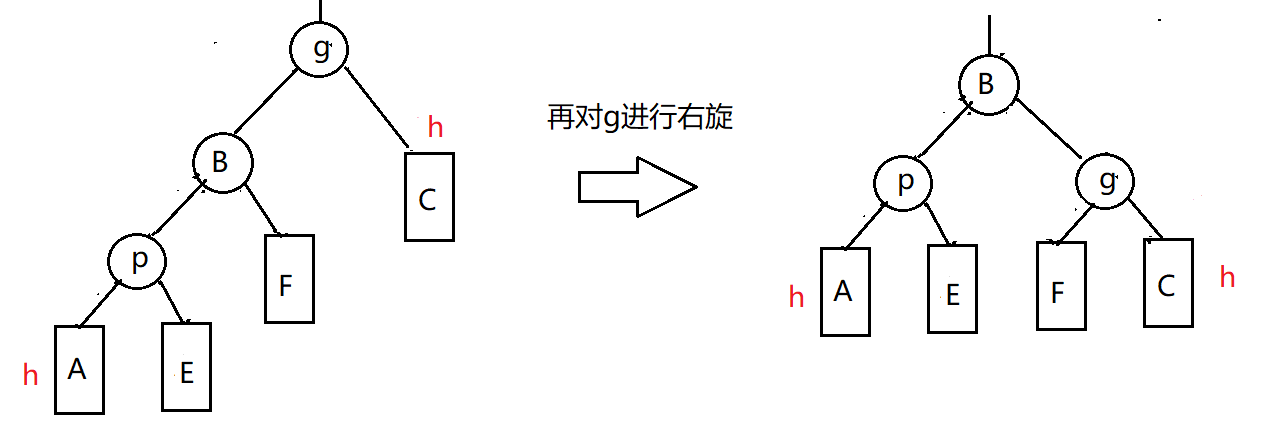
感性地了解旋转后的正确性:
初始时由于
H
(
B
)
=
h
+
1
H(B) = h+1
H(B)=h+1,假设
H
(
E
)
≥
H
(
F
)
H(E) \ge H(F)
H(E)≥H(F),则
H
(
E
)
=
h
H(E)=h
H(E)=h,那么
h
−
1
≤
H
(
F
)
≤
h
h-1 \le H(F) \le h
h−1≤H(F)≤h。旋转两次后,
H
(
P
)
=
h
+
1
H(P)=h+1
H(P)=h+1,
H
(
g
)
=
h
+
1
H(g)=h+1
H(g)=h+1,此时该子树的所有节点都满足左右子树高度差不超过1。
2.RL型(与LR型对称)
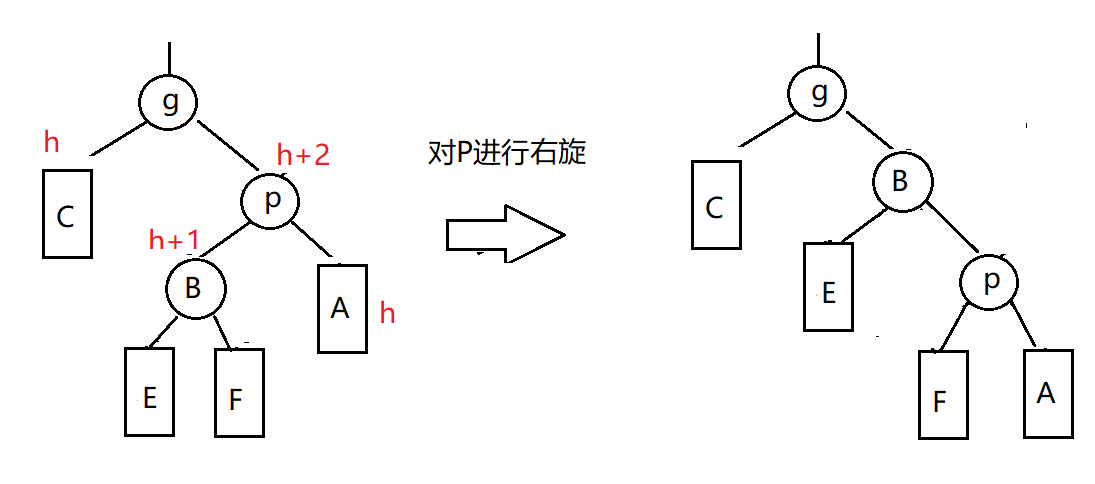
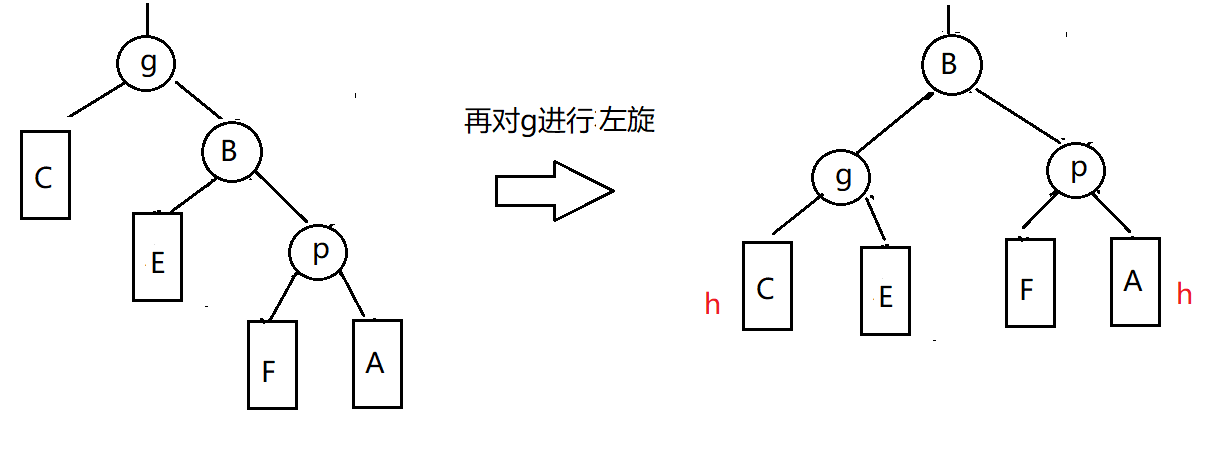
代码如下
    void balance(node* p)
    {
        int l = height(p->_left), r =height(p->_right);
        if(l > r)
        {
            int ll = height(p->_left->_left), lr = height(p->_left->_right);
            // LL型
            //     p
            //    /
            //   ●
            //  /
            // ●
            if(ll >= lr)
                rotateR(p);
            // LR型
            //     p
            //    /
            //   ●
            //    \
            //     ●
            else{
                rotateL(p->_left);
                rotateR(p);
            }
        }
        else{
            int rr = height(p->_right->_right), rl = height(p->_right->_left);
            // RR型
            //  p
            //   \
            //    ●
            //     \
            //      ●
            if(rr >= rl)
                rotateL(p);
            // RL型
            //  p
            //   \
            //    ●
            //    /
            //   ●
            else{
                rotateR(p->_right);
                rotateL(p);
            }
        }
    }
失衡调整内容参考 AVL 树 - OI Wiki
7、删除操作
与二叉搜索树类似,不过AVL树会进行平衡调整。
被删除的节点分三种情况
- 叶子节点:直接删除
- 被删除的节点只有一个儿子:用该儿子替代
- 被删除的节点有两个儿子:用前驱替代,再删除前驱。(当然也可以用后继)
(以上三种情况上篇已经讲过,这里不过多赘述 点击回顾二叉搜索树的删除)
删除节点后,会影响其祖先节点的高度,需往上更新。更新过程与插入操作的更新几乎完全一样。因为插入/删除操作所引发的失衡情况非常类似,在第6点我们已经分析过失衡后该如何旋转调整,下面直接给出代码
	void erase(const T& val)
    {
        if(!_root) return;
        node* cur = find(val);
        if(cur->_val == val)
        {
            cur->_cnt--;
            if(cur->_cnt != 0)
				update(cur); // 注意删除后_h虽然没变,但_cnt变了,导致子树的大小也会改的,此时也需要往上调整
            else{
                node* p = cur->_parent;
                // 1.叶子节点:直接删除
                if(!cur->_left && !cur->_right)
                {
                    if(!p) _root = nullptr; // 特判只有一个节点
                    else if(cur == p->_left)
						p->_left = nullptr;
                    else
						p->_right = nullptr;
                    del_node(cur);
                    update(p);	// 删除后从父节点往上更新
                }
                // 2.只有一个儿子:用儿子替代
                else if(!cur->_left || !cur->_right)
                {
                    node* child = cur->_left ? cur->_left : cur->_right;
                    if(!p) _root = child;   // 特判只有一个节点
                    else if(p->_left == cur)
						p->_left = child;
                    else
						p->_right = child;
                    child->_parent = p;		// 别忘记连接父节点
                    del_node(cur);
                    update(p);	// 删除后从父节点往上更新
                }
                // 3.有两个儿子: 用前驱替代,然后删除前驱
                else{
                    // 找前驱
                    node* pre = cur->_left;
                    node* pre_parent = cur;
                    while(pre->_right)
                    {
                        pre_parent = pre;
                        pre = pre->_right;
                    }
                    // 交换,然后删除前驱节点
                    std::swap(cur->_val, pre->_val);
                    std::swap(cur->_cnt, pre->_cnt);
                    // 到这里pre必定没有右儿子
                    if(pre_parent->_left == pre)
						pre_parent->_left = pre->_left;
                    else
						pre_parent->_right = pre->_left;
                    if(pre->_left)
						pre->_left->_parent = pre_parent;
                    del_node(pre);
                    update(pre_parent);	// 删除pre后,需从其父节点往上更新
                }
            }
        }
    }
小总结
相比于普通二叉搜索树,AVL树的插入/删除只是多了一个向上更新,若更新发现高度失衡,则需调整,调整就分直线型、折线形两种情况,对于这两种情况有两种旋转方式,其正确性我们只需感性地了解即可。
8、找某个节点前驱
1.该节点存在左子树,则左子树的最右侧节点就是前驱
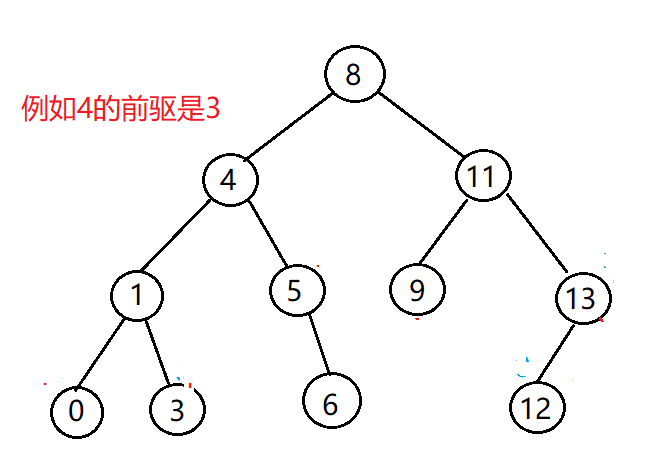
2.该节点不存在左子树,则向上找第一个往左拐的节点
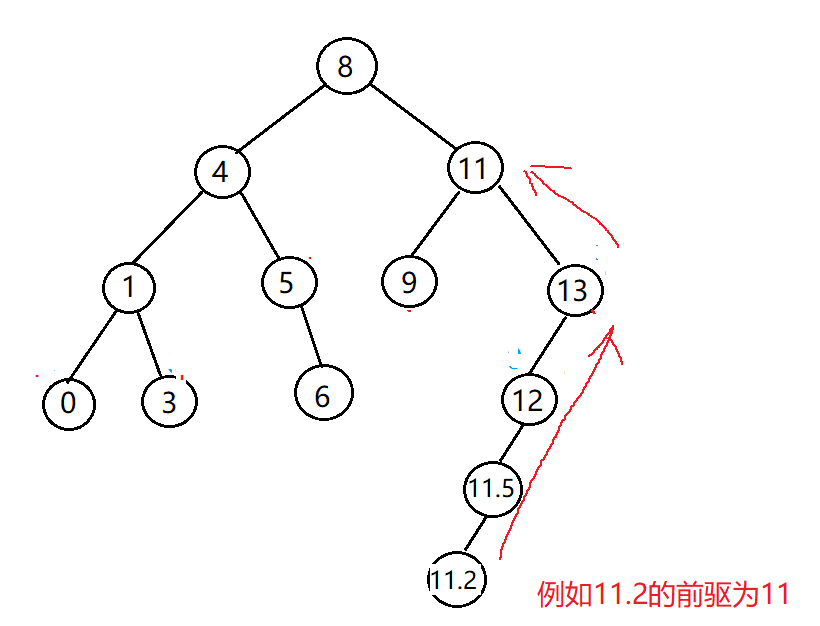
代码如下
    node* get_prev(node* x)
    {
        if(!x) return nullptr;

        if(x->_left)
        {
            x = x->_left;
            while(x->_right)
                x = x->_right;
            return x;
        }
        else
		{
            node* p = x->_parent;
            while(p && x == p->_left)
            {
                x = p;
                p = p->_parent;
            }
            return p;
        }
    }
找某个节点的前驱搞定后,我们可以找到权值为val的前驱(前驱定义为小于val,且最大的数。注意树中可能不存在权值为val的节点)
	node* get_prev(const T& val)
    {
        node* cur = find(val);
		// find
		// 1.找到了返回权值为val的节点;
		// 2.找不到则返回其应当插入位置的父节点,该父节点必定是val的前驱/后继!!!
		if (!cur)
			return nullptr; // cur为空,说明是个空树
        else if(cur->_val < val)
            return cur;
        else
            return get_prev(cur);
    }
9、找某个节点后继
1.该节点存在右子树,则右子树的最左侧节点就是后继
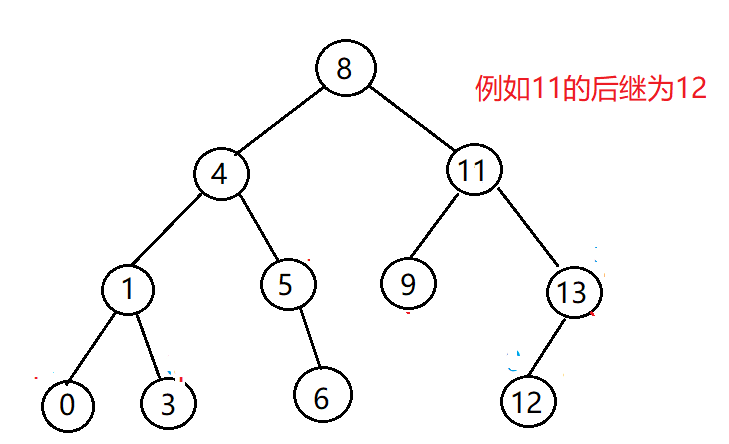
2.该节点不存在右子树,则向上找第一个往右拐的节点
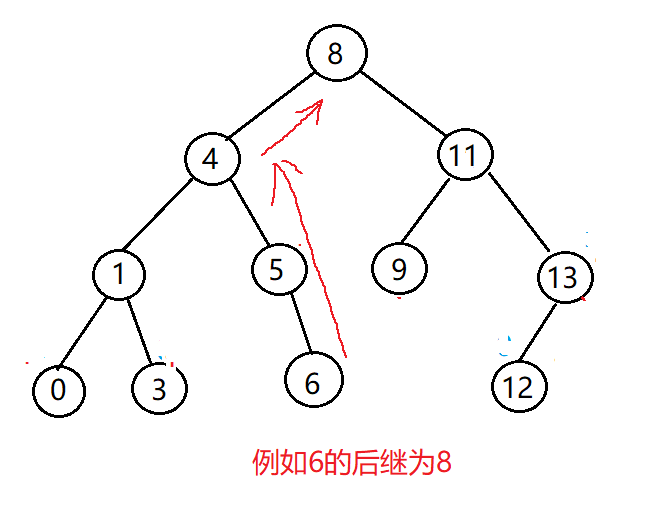
代码如下
    node* get_next(node* x)
    {
        if(!x) return nullptr;

        if(x->_right)
        {
            x = x->_right;
            while(x->_left)
                x = x->_left;
            return x;
        }
        else{
            node* p = x->_parent;
            while(p && x == p->_right)
            {
                x = p;
                p = p->_parent;
            }
            return p;
        }
    }
找某个节点的后继搞定后,我们可以找到权值为val的后继(后继定义为大于val,且最小的数。注意树中可能不存在权值为val的节点)
    node* get_next(const T& val)
    {
        node* cur = find(val);
		if (!cur)
			return nullptr;
        if(cur->_val > val)
            return cur;
        else
            return get_next(cur);
    }
10、查询排名为k的节点
这部分类似基于快速排序的快速选择算法
快速选择算法参考leetcode官方题解一
- 令
cur等于根结点,开始搜索 - 对当前结点
cur进行如下操作:- 如果
cur的左子树的结点数小于等于k,则第k小的元素一定在cur的左子树中,令cur等于其的左子结点,并继续搜索; - 如果
cur的左子树的结点数再加上cur的_cnt小于等于k,则第k小的元素即为cur,结束搜索; - 如果
cur的左子树的结点数left再加上cur的_cnt大于k,则第k小的元素一定在cur的右子树中,需去右子树中查询第k - left - _cnt小的元素
- 如果
	node* kth(int k)
    {
		if (k > size(_root))
			return nullptr;
        node* cur = _root;
        while(cur)
        {
            if(k <= size(cur->_left))
                cur = cur->_left;
            else if(k <= size(cur->_left) + cur->_cnt)
                return cur;
            else{
                k -= size(cur->_left) + cur->_cnt;
                cur = cur->_right;
            }
        }
    }
11、查询权值为val的排名
- 令
cur等于根结点,开始搜索 - 对当前结点
cur进行如下操作:- 如果
val < cur->_val,则val在以cur为根的子树的排名就等于val在以cur左子树为根的子树的排名。 - 如果
val == cur->_val,则val在以cur为根的子树的排名就等于size(cur->_left) + 1。 - 如果
val > cur->_val,则val在以cur为根的子树的排名就等于val在以cur右子树为根的子树的排名再加上size(cur->_left) + cur->_cnt。
- 如果
	// 查询val的排名(val的排名定义为比val小的数的个数 + 1)
    int get_rank(const T& val)
    {
        int res = 0;
        node* cur = _root;
        while(cur)
        {
            if(val < cur->_val)
                cur = cur->_left;
            else if(val == cur->_val)
            {
                res += size(cur->_left);
                break;
            }
            else{
                res += size(cur->_left) + cur->_cnt;
                cur = cur->_right;
            }
        }
        return res + 1;
    }
完整代码
补充了构造、析构、拷贝、赋值等内容,至于迭代器,将会放在后面的用AVL树封装set/map中讲
#include<iostream>
using namespace std;

template<class T>
struct AVLtree_node
{
    T _val; // 权值
    int _h; // 以该节点为根的子树的高度(为了保持平衡)
    int _cnt;   // 值为_val的节点的个数(为了支持插入重复数据)
    int _size;  // 以该节点为根的子树的大小(为了可以查询树中排名第k的节点)

    AVLtree_node* _left;    // 左儿子
    AVLtree_node* _right;   // 右儿子
    AVLtree_node* _parent;  // 父节点
    AVLtree_node(const T& x = T())
        :_val(x)
        ,_h(1)
        ,_cnt(1)
        ,_size(1)
        ,_left(nullptr)
        ,_right(nullptr)
        ,_parent(nullptr)
    {}
};


template<class T>
class AVLtree
{
	typedef AVLtree_node<T> node;
	typedef AVLtree_node<T>* node_ptr;
protected:
	node* _root = nullptr;
public:
	AVLtree(){}

	// 迭代器区间构造
	template<class InputIterator>
	AVLtree(InputIterator first, InputIterator last)
	{
		while (first != last)
		{
			insert(*first);
			++first;
		}
	}
	~AVLtree() { clear(); }
	void clear()
	{
		_clear(_root);
		_root = nullptr;
	}

	AVLtree(const AVLtree& t) { _root = copy(t._root); }

	void swap(AVLtree& t) { std::swap(_root, t._root); }
	AVLtree& operator= (const AVLtree& t)
	{
		if (this != &t)
		{
			AVLtree tmp(t);
			swap(tmp);
		}
		return *this;
	}

	// 打印AVL树
	void print()
	{
		_print(_root);
		cout << endl;
	}

	// 求树里面的元素个数
	int size() { return size(_root); }
	bool empty() { return !_root; }

	node* find(const T& val)
	{
		node* cur = _root;
		node* p = nullptr;	// 记录cur的父节点
		while (cur)
		{
			p = cur;
			if (val < cur->_val)
				cur = cur->_left;
			else if (val > cur->_val)
				cur = cur->_right;
			else
				return cur;
		}
		return p;
	}

	void insert(const T& val)
	{
		if (!_root)
		{
			_root = get_node(val);
			return;
		}
		node* cur = find(val);
		if (cur->_val == val)
			cur->_cnt++;
		else
		{
			// 到这里说明未找到,cur是val应插入的位置的父节点
			node* p = cur;
			cur = get_node(val);
			cur->_parent = p;
			if (val < p->_val) p->_left = cur;
			else p->_right = cur;
		}

		// 插入节点后还需往上更新
		update(cur);
	}

	void erase(const T& val)
    {
        if(!_root) return;
        node* cur = find(val);
        if(cur->_val == val)
        {
            cur->_cnt--;
            if(cur->_cnt != 0)
				update(cur); // 注意删除后_h虽然没变,但_cnt变了,导致子树的大小也会改的,此时也需要往上调整
            else{
                node* p = cur->_parent;
                // 1.叶子节点:直接删除
                if(!cur->_left && !cur->_right)
                {
                    if(!p) _root = nullptr; // 特判只有一个节点
                    else if(cur == p->_left)
						p->_left = nullptr;
                    else
						p->_right = nullptr;
                    del_node(cur);
                    update(p);	// 删除后从父节点往上更新
                }
                // 2.只有一个儿子:用儿子替代
                else if(!cur->_left || !cur->_right)
                {
                    node* child = cur->_left ? cur->_left : cur->_right;
                    if(!p) _root = child;   // 特判只有一个节点
                    else if(p->_left == cur)
						p->_left = child;
                    else
						p->_right = child;
                    child->_parent = p;		// 别忘记连接父节点
                    del_node(cur);
                    update(p);	// 删除后从父节点往上更新
                }
                // 3.有两个儿子: 用前驱替代,然后删除前驱
                else{
                    // 找前驱
                    node* pre = cur->_left;
                    node* pre_parent = cur;
                    while(pre->_right)
                    {
                        pre_parent = pre;
                        pre = pre->_right;
                    }
                    // 交换,然后删除前驱节点
                    std::swap(cur->_val, pre->_val);
                    std::swap(cur->_cnt, pre->_cnt);
                    // 到这里pre必定没有右儿子
                    if(pre_parent->_left == pre)
						pre_parent->_left = pre->_left;
                    else
						pre_parent->_right = pre->_left;
                    if(pre->_left)
						pre->_left->_parent = pre_parent;
                    del_node(pre);
                    update(pre_parent);	// 删除pre后,需从其父节点往上更新
                }
            }
        }
    }

	node* get_prev(const T& val)
    {
        node* cur = find(val);
		// find
		// 1.找到了返回权值为val的节点;
		// 2.找不到则返回其应当插入位置的父节点,该父节点必定是val的前驱/后继!!!
		if (!cur)
			return nullptr; // cur为空,说明是个空树
        else if(cur->_val < val)
            return cur;
        else
            return get_prev(cur);
    }

	node* get_next(const T& val)
    {
        node* cur = find(val);
		if (!cur)
			return nullptr;
        if(cur->_val > val)
            return cur;
        else
            return get_next(cur);
    }

	node* kth(int k)
    {
		if (k > size(_root))
			return nullptr;
        node* cur = _root;
        while(cur)
        {
            if(k <= size(cur->_left))
                cur = cur->_left;
            else if(k <= size(cur->_left) + cur->_cnt)
                return cur;
            else{
                k -= size(cur->_left) + cur->_cnt;
                cur = cur->_right;
            }
        }
    }

	// 查询val的排名(val的排名定义为比val小的数的个数 + 1)
    int get_rank(const T& val)
    {
        int res = 0;
        node* cur = _root;
        while(cur)
        {
            if(val < cur->_val)
                cur = cur->_left;
            else if(val == cur->_val)
            {
                res += size(cur->_left);
                break;
            }
            else{
                res += size(cur->_left) + cur->_cnt;
                cur = cur->_right;
            }
        }
        return res + 1;
    }

protected:
	void _clear(node* x)
	{
		if (!x) return;
		_clear(x->_left);
		_clear(x->_right);
		del_node(x);
	}

	node* copy(node* x)
	{
		if (!x) return nullptr;
		node* le = copy(x->_left);
		node* ri = copy(x->_right);
		node* root = get_node(x->_val);
		root->_left = le, root->_right = ri;
		if (le) le->_parent = root;
		if (ri) ri->_parent = root;
		return root;
	}

	void _print(node* x)
	{
		if (!x) return;
		_print(x->_left);
		cout << x->_val << ' ';
		_print(x->_right);
	}

	// 申请空间(为什么不直接写成new node(val)呢?因为后续可能引入类似内存池的东西)
	node* get_node(const T& val)  {  return new node(val);  }
	// 释放空间
	void del_node(node* x) { delete x; }

    node* get_prev(node* x)
    {
        if(!x) return nullptr;

        if(x->_left)
        {
            x = x->_left;
            while(x->_right)
                x = x->_right;
            return x;
        }
        else
		{
            node* p = x->_parent;
            while(p && x == p->_left)
            {
                x = p;
                p = p->_parent;
            }
            return p;
        }
    }


	node* get_next(node* x)
    {
        if(!x) return nullptr;

        if(x->_right)
        {
            x = x->_right;
            while(x->_left)
                x = x->_left;
            return x;
        }
        else{
            node* p = x->_parent;
            while(p && x == p->_right)
            {
                x = p;
                p = p->_parent;
            }
            return p;
        }
    }


	// 计算以x为根的子树的高度
	int height(node* x) { return x ? x->_h : 0; }

	// 计算以x为根的子树的大小
	int size(node* x) { return x ? x->_size : 0; }

	// 更新x的_h与_size
	void push_up(node* x)
	{
		if (x)
		{
			x->_h = max(height(x->_left), height(x->_right)) + 1;
			x->_size = size(x->_left) + size(x->_right) + x->_cnt;
		}
	}
    void update(node* p)
    {
        while(p)
        {
            node* g = p->_parent;
            int l = height(p->_left), r =height(p->_right);
            if(abs(l - r) <= 1)
                push_up(p);
            else       // 平衡破坏,需旋转调整
                balance(p);
            p = g;
        }
    }
	void balance(node* p)
	{
		int l = height(p->_left), r = height(p->_right);
		if (l > r)
		{
			int ll = height(p->_left->_left), lr = height(p->_left->_right);
			// LL型
			//     p
			//    /
			//   ●
			//  /
			// ●
			if (ll >= lr)
				rotateR(p);
			// LR型
			//     p
			//    /
			//   ●
			//    \
            //     ●
			else {
				rotateL(p->_left);
				rotateR(p);
			}
		}
		else {
			int rr = height(p->_right->_right), rl = height(p->_right->_left);
			// RR型
			//  p
			//   \
            //    ●
			//     \
            //      ●
			if (rr >= rl)
				rotateL(p);
			// RL型
			//  p
			//   \
            //    ●
			//    /
			//   ●
			else {
				rotateR(p->_right);
				rotateL(p);
			}
		}
	}
	//     g               g
	//     |               |
    //     p               x
    //    / \             / \
    //   x   C   ====>   A   p
    //  / \                 / \
    // A   B               B   C
    void rotateR(node* p)	// 右旋
    {
        node* g = p->_parent;
        node* x = p->_left;
        p->_left = x->_right;
        if(x->_right) x->_right->_parent = p;

        x->_right = p;
        p->_parent = x;

        x->_parent = g;
        if(g){
            if(p == g->_left) g->_left = x;
            else g->_right = x;
        }
		// 注意需先更新p,再更新x
        push_up(p);
        push_up(x);
        if(_root == p) // 注意可能需要更新根节点
			_root = x;
    }

	//     g               g
	//     |               |
    //     p               x
    //    / \             / \
    //   x   C   <====   A   p
    //  / \                 / \
    // A   B               B   C
    void rotateL(node* x)	// 左旋,与右旋类似
    {
        node* g = x->_parent;
        node* p = x->_right;
        x->_right = p->_left;
        if(p->_left) p->_left->_parent = x;

        p->_left = x;
        x->_parent = p;

        p->_parent = g;
        if(g){
            if(x == g->_left) g->_left = p;
            else g->_right = p;
        }
        push_up(x);
        push_up(p);
        if(_root == x) _root = p;
    }
};
相关题目
【模板】普通平衡树
该题与下面的一样,这里只给出数据加强版的参考代码
【模板】普通平衡树(数据加强版)
参考代码
#include<iostream>
using namespace std;

template<class T>
struct AVLtree_node
{
    T _val; // 权值
    int _h; // 以该节点为根的子树的高度(为了保持平衡)
    int _cnt;   // 值为_val的节点的个数(为了支持插入重复数据)
    int _size;  // 以该节点为根的子树的大小(为了可以查询树中排名第k的节点)

    AVLtree_node* _left;    // 左儿子
    AVLtree_node* _right;   // 右儿子
    AVLtree_node* _parent;  // 父节点
    AVLtree_node(const T& x = T())
        :_val(x)
        ,_h(1)
        ,_cnt(1)
        ,_size(1)
        ,_left(nullptr)
        ,_right(nullptr)
        ,_parent(nullptr)
    {}
};

const int N = 1e5 + 1e6 + 10;
AVLtree_node<int> t[N];	// 预先申请好空间
int idx;	// 记录用到哪个节点了

template<class T>
class AVLtree
{
	typedef AVLtree_node<T> node;
	typedef AVLtree_node<T>* node_ptr;
protected:
	node* _root = nullptr;
public:
	node* find(const T& val)
	{
		node* cur = _root;
		node* p = nullptr;	// 记录cur的父节点
		while (cur)
		{
			p = cur;
			if (val < cur->_val)
				cur = cur->_left;
			else if (val > cur->_val)
				cur = cur->_right;
			else
				return cur;
		}
		return p;
	}

	// 申请空间(为什么不直接写成new node(val)呢?因为后续可能引入类似内存池的东西)
	node* get_node(const T& val)
	{
		//return new node(val);

		t[idx]._val = val;	// 直接从申请好的空间取
		return &t[idx++];
	}
	// 释放空间
	void del_node(node* x)
	{
		//delete x;
	}

	void insert(const T& val)
	{
		if (!_root)
		{
			_root = get_node(val);
			return;
		}
		node* cur = find(val);
		if (cur->_val == val)
			cur->_cnt++;
		else
		{
			// 到这里说明未找到,cur是val应插入的位置的父节点
			node* p = cur;
			cur = get_node(val);
			cur->_parent = p;
			if (val < p->_val) p->_left = cur;
			else p->_right = cur;
		}

		// 插入节点后还需往上更新
		update(cur);
	}

	void erase(const T& val)
    {
        if(!_root) return;
        node* cur = find(val);
        if(cur->_val == val)
        {
            cur->_cnt--;
            if(cur->_cnt != 0)
				update(cur); // 注意删除后_h虽然没变,但_cnt变了,导致子树的大小也会改的,此时也需要往上调整
            else{
                node* p = cur->_parent;
                // 1.叶子节点:直接删除
                if(!cur->_left && !cur->_right)
                {
                    if(!p) _root = nullptr; // 特判只有一个节点
                    else if(cur == p->_left)
						p->_left = nullptr;
                    else
						p->_right = nullptr;
                    del_node(cur);
                    update(p);	// 删除后从父节点往上更新
                }
                // 2.只有一个儿子:用儿子替代
                else if(!cur->_left || !cur->_right)
                {
                    node* child = cur->_left ? cur->_left : cur->_right;
                    if(!p) _root = child;   // 特判只有一个节点
                    else if(p->_left == cur)
						p->_left = child;
                    else
						p->_right = child;
                    child->_parent = p;		// 别忘记连接父节点
                    del_node(cur);
                    update(p);	// 删除后从父节点往上更新
                }
                // 3.有两个儿子: 用前驱替代,然后删除前驱
                else{
                    // 找前驱
                    node* pre = cur->_left;
                    node* pre_parent = cur;
                    while(pre->_right)
                    {
                        pre_parent = pre;
                        pre = pre->_right;
                    }
                    // 交换,然后删除前驱节点
                    std::swap(cur->_val, pre->_val);
                    std::swap(cur->_cnt, pre->_cnt);
                    // 到这里pre必定没有右儿子
                    if(pre_parent->_left == pre)
						pre_parent->_left = pre->_left;
                    else
						pre_parent->_right = pre->_left;
                    if(pre->_left)
						pre->_left->_parent = pre_parent;
                    del_node(pre);
                    update(pre_parent);	// 删除pre后,需从其父节点往上更新
                }
            }
        }
    }

    node* get_prev(node* x)
    {
        if(!x) return nullptr;

        if(x->_left)
        {
            x = x->_left;
            while(x->_right)
                x = x->_right;
            return x;
        }
        else
		{
            node* p = x->_parent;
            while(p && x == p->_left)
            {
                x = p;
                p = p->_parent;
            }
            return p;
        }
    }
	node* get_prev(const T& val)
    {
        node* cur = find(val);
		// find
		// 1.找到了返回权值为val的节点;
		// 2.找不到则返回其应当插入位置的父节点,该父节点必定是val的前驱/后继!!!
		if (!cur)
			return nullptr; // cur为空,说明是个空树
        else if(cur->_val < val)
            return cur;
        else
            return get_prev(cur);
    }

	node* get_next(node* x)
    {
        if(!x) return nullptr;

        if(x->_right)
        {
            x = x->_right;
            while(x->_left)
                x = x->_left;
            return x;
        }
        else{
            node* p = x->_parent;
            while(p && x == p->_right)
            {
                x = p;
                p = p->_parent;
            }
            return p;
        }
    }
    node* get_next(const T& val)
    {
        node* cur = find(val);
		if (!cur)
			return nullptr;
        if(cur->_val > val)
            return cur;
        else
            return get_next(cur);
    }

	node* kth(int k)
    {
		if (k > size(_root))
			return nullptr;
        node* cur = _root;
        while(cur)
        {
            if(k <= size(cur->_left))
                cur = cur->_left;
            else if(k <= size(cur->_left) + cur->_cnt)
                return cur;
            else{
                k -= size(cur->_left) + cur->_cnt;
                cur = cur->_right;
            }
        }
    }

	// 查询val的排名(val的排名定义为比val小的数的个数 + 1)
    int get_rank(const T& val)
    {
        int res = 0;
        node* cur = _root;
        while(cur)
        {
            if(val < cur->_val)
                cur = cur->_left;
            else if(val == cur->_val)
            {
                res += size(cur->_left);
                break;
            }
            else{
                res += size(cur->_left) + cur->_cnt;
                cur = cur->_right;
            }
        }
        return res + 1;
    }

protected:

	// 计算以x为根的子树的高度
	int height(node* x) { return x ? x->_h : 0; }

	// 计算以x为根的子树的大小
	int size(node* x) { return x ? x->_size : 0; }

	// 更新x的_h与_size
	void push_up(node* x)
	{
		if (x)
		{
			x->_h = max(height(x->_left), height(x->_right)) + 1;
			x->_size = size(x->_left) + size(x->_right) + x->_cnt;
		}
	}
    void update(node* p)
    {
        while(p)
        {
            node* g = p->_parent;
            int l = height(p->_left), r =height(p->_right);
            if(abs(l - r) <= 1)
                push_up(p);
            else       // 平衡破坏,需旋转调整
                balance(p);
            p = g;
        }
    }
	void balance(node* p)
	{
		int l = height(p->_left), r = height(p->_right);
		if (l > r)
		{
			int ll = height(p->_left->_left), lr = height(p->_left->_right);
			// LL型
			//     p
			//    /
			//   ●
			//  /
			// ●
			if (ll >= lr)
				rotateR(p);
			// LR型
			//     p
			//    /
			//   ●
			//    \
            //     ●
			else {
				rotateL(p->_left);
				rotateR(p);
			}
		}
		else {
			int rr = height(p->_right->_right), rl = height(p->_right->_left);
			// RR型
			//  p
			//   \
            //    ●
			//     \
            //      ●
			if (rr >= rl)
				rotateL(p);
			// RL型
			//  p
			//   \
            //    ●
			//    /
			//   ●
			else {
				rotateR(p->_right);
				rotateL(p);
			}
		}
	}
	//     g               g
	//     |               |
    //     p               x
    //    / \             / \
    //   x   C   ====>   A   p
    //  / \                 / \
    // A   B               B   C
    void rotateR(node* p)	// 右旋
    {
        node* g = p->_parent;
        node* x = p->_left;
        p->_left = x->_right;
        if(x->_right) x->_right->_parent = p;

        x->_right = p;
        p->_parent = x;

        x->_parent = g;
        if(g){
            if(p == g->_left) g->_left = x;
            else g->_right = x;
        }
		// 注意需先更新p,再更新x
        push_up(p);
        push_up(x);
        if(_root == p) // 注意可能需要更新根节点
			_root = x;
    }

	//     g               g
	//     |               |
    //     p               x
    //    / \             / \
    //   x   C   <====   A   p
    //  / \                 / \
    // A   B               B   C
    void rotateL(node* x)	// 左旋,与右旋类似
    {
        node* g = x->_parent;
        node* p = x->_right;
        x->_right = p->_left;
        if(p->_left) p->_left->_parent = x;

        p->_left = x;
        x->_parent = p;

        p->_parent = g;
        if(g){
            if(x == g->_left) g->_left = p;
            else g->_right = p;
        }
        push_up(x);
        push_up(p);
        if(_root == x) _root = p;
    }

};

int main()
{
    ios::sync_with_stdio(0);
    cin.tie(0); cout.tie(0);
    int n, m, op, x, last = 0, res = 0;
	AVLtree<int> tree;
	cin >> n >> m;
    for(int i = 0; i < n; i++)
    {
        int a;
        cin >> a;
        tree.insert(a);
    }
    for(int i = 0; i < m; i++)
    {
        cin >> op >> x;
        x ^= last;
        if(op == 1) tree.insert(x);
        else if(op == 2) tree.erase(x);
        else{
            if(op == 3) last = tree.get_rank(x);
            else if(op == 4) last = tree.kth(x)->_val;
            else if(op == 5) last = tree.get_prev(x)->_val;
            else last = tree.get_next(x)->_val;
            res ^= last;
        }
    }
    cout << res;
    return 0;
}
结语
AVL树的查询速度非常快,但插入/删除的旋转开销稍大,综合来看其效率确实很高。(但是STL的set/map底层用的一般是红黑树,因为红黑树插入/删除的开销相较于AVL会更小)
AVL树缺点:代码量太大了!!!
比赛时若需要用平衡树,更建议写Splay(参考董晓算法Splay)
或者直接用pb_ds库里面的(如果比赛允许的话)pb_ds用法参考 OI Wiki
感谢观看

Agent 垂直技术社区,欢迎活跃、内容共建。
更多推荐

 18
18 0
0- 0


 已为社区贡献10条内容

所有评论(0)