C++语言程序设计——10 结构体
一、结构体的定义
结构体是 C++ 中一种可用户自定义的数据类型,可以将不同类型的数据组合在一起,形成一个新的复合数据类型。
可以把结构体理解成把一些重要数据进行打包,可以使其有多个属性,例如学生结构体,里面有姓名、性别、年龄等。
结构体(Struct)由以下三个部分组成,分别是关键字、结构体名称和成员列表。
struct 结构体名称
{
    数据类型1 成员变量1;
    数据类型2 成员变量2;
    // ...
}结构体变量;
另外,在 C++ 结构体中,可以跳过 typedef 用于给结构体类型创建一个别名(新名字),这样可以简化代码并提高可读性。
typedef struct student      // 使用typedef创建别名
{
    string name;
    int id;
    double score;
} s;  // s 是 struct student 的别名
使用之后,可以直接使用别名:
typedef struct student
{
    string name;
    int id;
    double score;
} s;

s e1;           // 不需要写struct关键字,直接使用别名
s e2;
不过一般来说,最简单还是通过结构体变量来实现。
二、结构体变量
结构体变量,如果不加,只是定义了结构体类型,没有自动创建变量,如果需要使用,必须单独声明变量。
结构体通过使用英文点号 . 来获取单个成员,从而获取成员的值,也可以给成员赋值。
结构体变量名.成员名
或者也可以间接访问(指针):用 -> 运算符。
指针名 -> 成员名
#include <iostream>
#include <string>
using namespace std;

// 结构体:默认访问权限是 public
struct Student
{
    int id;         // 默认 public,外部可直接访问
    string name;    // 默认 public
    double score;   // 默认 public

    void showInfo() // 默认 public,外部可直接调用
    {
        cout << "学号:" << id << ",姓名:" << name << ",分数:" << score << endl;
    }
};

int main()
{
    Student s;
    s.id = 1000;
    s.name = "张三";
    s.score = 95.5;
    cout << "姓名:" << s.name << endl;
    s.showInfo();

    // 指针访问:定义指针指向对象 s(核心:& 取对象地址)
    Student* p = &s;

    // 指针读取成员变量:指针名 -> 成员变量
    cout << "指针访问 - 原始学号:" << p->id << endl;
    cout << "指针访问 - 原始分数:" << p->score << endl;

    // 指针修改成员变量:指针名 -> 成员变量 = 新值
    p->id = 1001;    // 用 -> 修改学号
    p->score = 98.0; // 用 -> 修改分数

    // 指针调用成员函数:指针名 -> 成员函数()
    cout << "指针修改后:" << endl;
    p->showInfo();   // 指针调用 showInfo()

    return 0;
}
例如,下面是一个结构体,在定义结构体类型的同时创建了结构体变量 a ,所以主函数里可以直接使用,比如 a.age:
#include <iostream>
#include <cstring>
using namespace std;

struct student
{
    char name[20];
    int age;
    int id;
    char sex[10];
} a;          // 声明 a 这个结构体变量

int main()
{
    strcpy(a.name, "张三");       // 直接使用变量a
    a.age = 20;
    cout << a.name << " " << a.age << endl;
    return 0;
}
运行结果如下: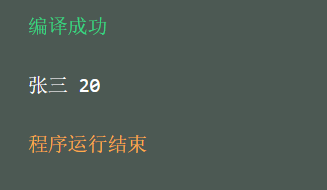
而如果我们不创建变量,在主函数中需要单独声明变量。例如 student a,即单独声明变量 a(先定义结构体,再单独声明变量,可以省略 struct):
#include <iostream>
#include <cstring>

struct student
{
    char name[20];
    int age;
    int id;
    char sex[10];
};      // 只定义结构体类型,不创建变量

int main()
{
    student a;       // 单独声明变量a
    strcpy(a.name, "李四");
    a.age = 21;
    cout << a.name << " " << a.age << endl;
    return 0;
}
另外,我们定义变量时可以直接初始化成员,例如,student stu1 = {“张三”, 20, 1001, “男”},直接初始化 stu1 结构体成员:
#include <iostream>
using namespace std;

struct student
{
    char name[20];
    int age;
    int id;
    char sex[10];
};      // 只定义结构体类型,不创建变量

int main()
{
    student stu1 = {"张三", 20, 1001, "男"};       // 声明并初始化结构体变量
    cout << stu1.name << endl;
    stu1.age = 21;                // 访问和修改成员
    cout << stu1.age << endl;
    cout << stu1.id << endl;
    cout << stu1.sex << endl;
}
运行结果如下: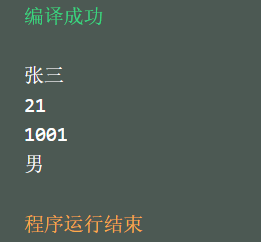
例如,我们需要存储很多学生的相关信息,需要输入和输出,可以先创建一个 student 结构体,然后创建一个结构体数组来存储学生,同时输入和输出学生信息,通过这个结构体数组,可以很方便地使用索引(如arr[0]、arr[1])来访问和操作不同学生的信息:
#include <iostream>
using namespace std;

struct student
{
    int id;
    char name[10];
    int score;
};

int main()
{
    student arr[3];                 // 结构体数组,存储多个学生
    for (int i = 0; i < 3; i++)     // 输入多个学生信息
        cin >> arr[i].id >> arr[i].name >> arr[i].score;
    for (int i = 0; i < 3; i++)     // 输出所有学生信息
    {
        cout << "学号:" << arr[i].id << endl;
        cout << "姓名:" << arr[i].name << endl;
        cout << "分数:" << arr[i].score << endl;
    }
    return 0;
}
运行结果如下: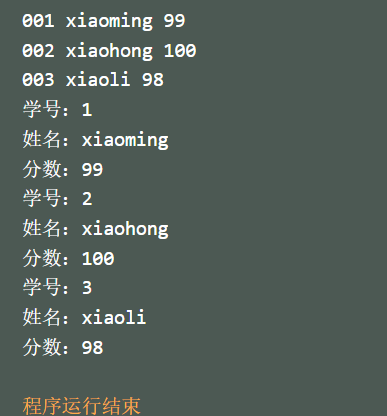
三、结构体数组
例如,下面代码就定义了一个结构体数组,通过定义结构体数组存储学生信息,并输出前两名学生的学号和分数:
#include <iostream>
#include <cstring>
using namespace std;

struct student
{
	int id;
	char name[30];
	float score;
}st[3] = { {1001,"HB",99},{1002,"SP",100},{1003,"SL",90} };    // 同时定义结构体数组st[3],并初始化3个学生的数据

int main()
{
	cout << st[0].id << " " << st[0].score << endl;   // 输出第1个学生(st[0])的学号和分数
	cout << st[1].id << " " << st[1].score << endl;
	return 0;
}
结构体应用例题1
例如,我们要对图书馆书籍进行整理,方便以后查询时候,根据作者迅速找出相应的书籍信息,就可以使用结构体来实现代码。
#include <iostream>
#include <cstring>
using namespace std;

struct student
{
    int id;
    char name[100];
    char author[50];
};

int main()
{
    int n;
    cin>>n;
    student s[100];
    for (int i = 0; i < n; i++)
        cin >> s[i].id >> s[i].name >> s[i].author;
    for (int i = 0; i < n; i++)
    {
        if (strcmp(s[i].author, "鲁迅") == 0)      // 使用strcmp比较字符串,返回0表示两个字符串相等
            cout << s[i].id <<" " << s[i].name <<" " << s[i].author<<endl;
    }
    return 0;
}
我们也可以更改一下代码, 使用 C++ 的 string 类(需要包含 < string > 头文件),直接使用 == 来比较字符串内容:
#include <iostream>
#include <string>
using namespace std;

struct student
{
    int id;
    string name;
    string author;
};

int main()
{
    int n;
    cin >> n;
    student s[100];
    for (int i = 0; i < n; i++)
        cin >> s[i].id >> s[i].name >> s[i].author;
    cout << "-------------------------"<< endl;
    for (int i = 0; i < n; i++)
    {
        if (s[i].author == "鲁迅")
            cout << s[i].id << " " << s[i].name << " " << s[i].author << endl;
    }
    return 0;
}
运行结果如下: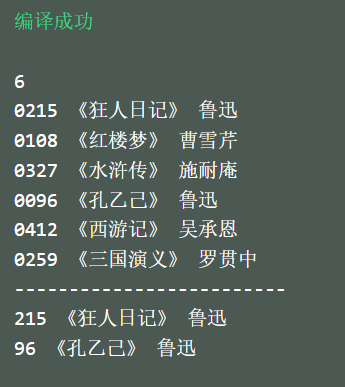
结构体应用例题2
下面代码是实现了读取若干种饮料的信息(名称、价格、第三个属性),按以下规则排序后输出(使用了冒泡排序):
1、先按价格升序,价格低的在前;
2、价格相同则按名称长度升序,名称短的在前;
3、价格和名称长度都相同则按第三个属性升序。
#include <iostream>
#include <string>
#include <algorithm>
using namespace std;

struct st
{
    string a;
    int b;
    int c;
};


int main()
{
    int n;
    cin >> n;
    st s[10000];             // 存储饮料信息
    for (int i = 0; i < n; i++)
        cin >> s[i].a >> s[i].b >> s[i].c;
    for (int i = 0; i < n - 1; i++) // 冒泡排序实现多条件排序
    {
        for (int j = 0; j < n - 1 - i; j++)
        {
            bool needswap=false;
            if (s[j].b > s[j + 1].b) // 价格高的放后面
            {
                needswap=true;
            }
            else if(s[j].b==s[j+1].b)// 价格相同,名称长的放后面
            {
                if(s[j].a.length()>s[j+1].a.length())
                {
                    needswap=true;
                }
                else if(s[j].a.length()==s[j+1].a.length())// 价格相同,名称长的放后面
                {
                    if(s[j].c>s[j+1].c)
                    {
                        needswap=true;
                    }
                }
            }
            if(needswap)
            {
                student temp = s[j];
                s[j] = s[j + 1];
                s[j + 1] = temp;
            }
        }
    }
    for (int i = 0; i < n; i++) // 输出排序结果
        cout << s[i].a << " " << s[i].b << " " << s[i].c << endl;
    return 0;
}

Agent 垂直技术社区,欢迎活跃、内容共建。
更多推荐

 9
9 0
0- 0


 已为社区贡献7条内容

所有评论(0)