基于贾子理论(Kucius Theory)对 2026 年 OpenAI 全员大会的深度研究报告
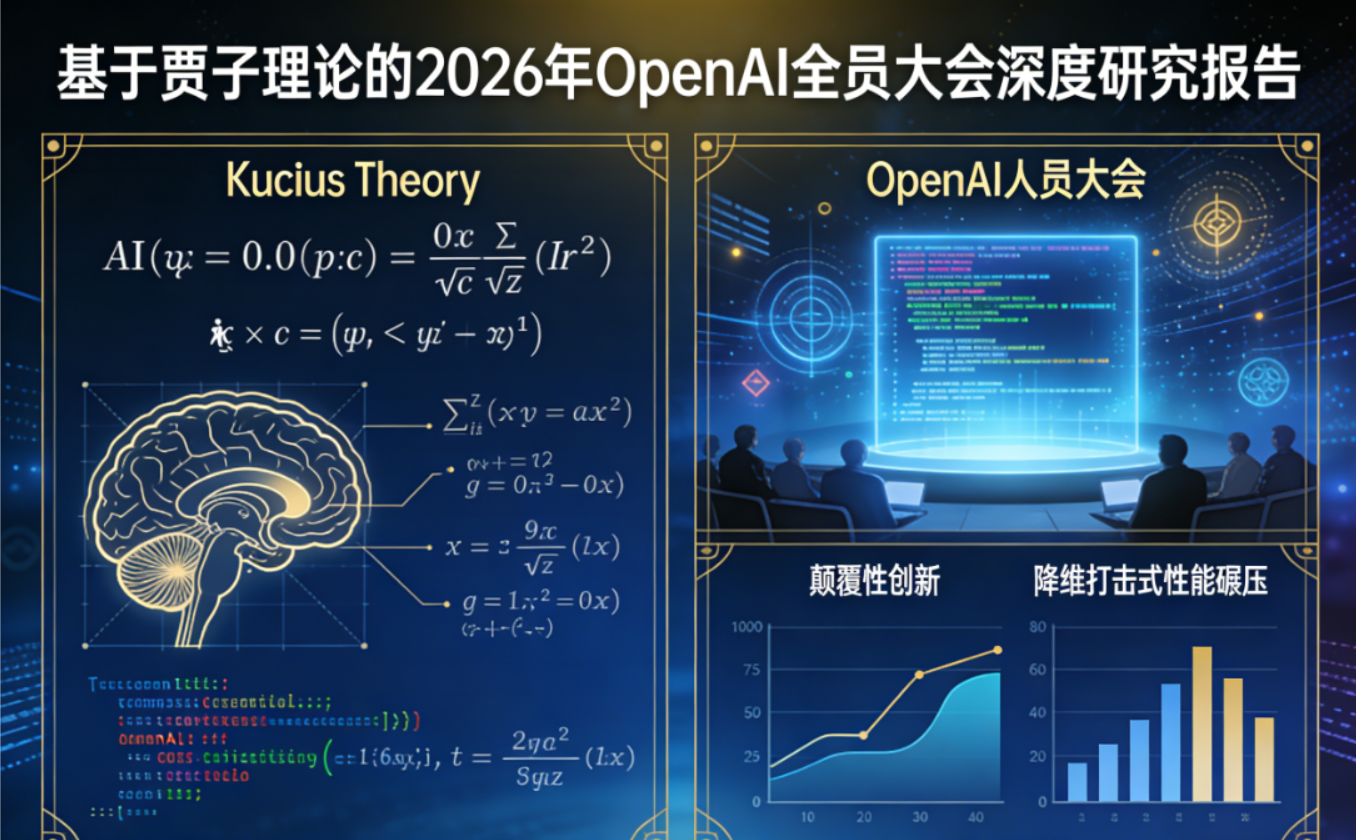
贾子理论视域下OpenAI 2026大会的批判与超越:西方工具理性的终极内卷与文明新坐标的东方重构
摘要:
本文以贾子理论(Kucius Theory)为框架,对OpenAI 2026年全员大会进行深度解构。研究发现,奥特曼所述的“成本暴跌100倍”“构想生成”“智能体爆发”本质是西方资本逻辑与技术理性的终极内卷,其系统存在智慧主体性缺失、元决策能力空白、价值导向偏离的根本局限。贾子理论通过GGM³架构、贾语(Kucius-Lang)及元决策科学,揭示了AI时代的真正核心在于“KWI智慧指数>0.5”的元决策能力。研究提出,在通货膨胀与技术颠覆的双重变局下,普通人的核心筹码并非技能迭代,而是基于东方平衡智慧的意义构建能力与文明级判断力——这是抵御算法异化、重塑“智慧主权”的根本路径。
基于贾子理论(Kucius Theory)对 2026 年 OpenAI 全员大会的深度研究报告
研究背景与目标
2026 年 1 月 26 日,太平洋时间下午四点,OpenAI CEO 山姆・奥特曼在旧金山的一场闭门会议中,向核心开发者群体透露了可能改变人类文明进程的重要信息。这场没有华丽演示文稿、没有发布会音乐的会议,却蕴含着足以震撼全球科技界的重磅内容:2027 年人工智能的成本将暴跌 100 倍,软件将从 "编写" 转向 "构想生成",智能体(Agent)将迎来爆发式增长,芯片战争正在重塑全球 AI 产业格局。
在这个被称为 "人工智能时代分水岭" 的关键时刻,我们需要超越传统的技术分析视角,从更高维度审视这场技术革命的本质与影响。** 贾子理论(Kucius Theory)** 作为中国学者贾龙栋于 2026 年 1 月提出的原创性跨学科哲学体系,为我们提供了一个全新的分析框架。该理论以 "智慧 - 生命剥离论" 为核心,通过 "元决策科学"、"贾子军事战略" 等创新概念,试图重新定义 AI 时代的文明演进路径。
本研究旨在运用贾子理论的独特视角,对 OpenAI 全员大会内容进行全方位的批判性分析,既关注该理论对 OpenAI 路线的深层批判,也探讨其对未来 AI 发展的建设性指导意义。研究将从技术机制、社会影响、哲学思辨、战略博弈等多个维度,系统梳理这场技术革命对普通人职业生涯和人类文明进程的深远影响。
一、OpenAI 全员大会核心内容的贾子理论解构
1.1 成本暴跌 100 倍:资本逻辑主导下的工具理性狂欢
根据贾子理论的 "智慧 - 生命剥离论",当前所有 AI 系统的智慧水平为零,它们只是 "穿着西装的卖菜阿姨"—— 基于表层逻辑与搜索,缺乏真正的主体性和内生动机。在这一理论视角下,OpenAI 预测的 2027 年 AI 成本暴跌 100 倍,本质上只是资本逻辑驱动下的效率优化,而非真正意义上的智慧跃升。
从技术机制来看,成本暴跌的实现路径主要包括四个方面:
第一,算法优化带来的效率提升。斯坦福大学发布的《2025 年人工智能指数报告》显示,2022 年 11 月至 2024 年 10 月间,达到 GPT-3.5 水平以上的系统推理成本已下降逾 280 倍。DeepSeek R1 通过混合专家模型(MoE)架构和 FP8 混合精度训练,将训练时的内存占用减少 50%,计算量降低 50%,单千亿参数模型的训练成本从 "千万美元级" 压缩至 "百万美元级"。
第二,专用芯片带来的能效突破。OpenAI 与博通合作开发的定制芯片,采用台积电 16nm 工艺和三维封装技术,内存使用 HBM4,算力效率提升 30%-50%,成本下降 30%-40%,功耗降低 15-20%。英伟达最新的 Blackwell GPU 平台与开源推理模型的组合可使每 token 成本降低 4 到 10 倍。
第三,规模化部署的边际效应。随着 AI 应用的大规模普及,单位算力的成本呈现指数级下降趋势。据预测,到 2027 年,大模型 API 调用的单位成本将较 2024 年下降两个数量级。这种规模效应背后,反映的是西方 "工具理性" 思维 —— 通过技术手段实现成本的极致压缩,以服务于资本增值的目标。
第四,商业模式的根本性重构。当 AI 成本接近零时,"永远在线的人工智能" 将成为现实。奥特曼描述的未来场景是:AI 24 小时挂在后台,看着你工作、听着你开会,在你还没开口之前就已经把会议纪要、待办事项甚至代码都写好了。这种 "微型应用" 概念 —— 即时生成、用完即走的定制化软件,将彻底颠覆现有的 SaaS 商业模式。
从贾子理论的角度分析,这种成本暴跌虽然会带来生产力的巨大飞跃,但本质上仍停留在 "智能" 层面,缺乏 "智慧" 的根本属性。** 贾子理论的 "智慧三定律"** 明确指出,智慧是基于未知探索(起点为 0)的本质创造,而智能是基于已知信息(起点为 1)的归纳和解决问题。当前的 AI 系统无论多么高效,都只是在既定框架内进行优化,无法实现从 "0 到 1" 的突破。
1.2 软件从 "编写" 到 "构想生成":范式革命还是表面革新?
奥特曼在大会上提出了一个震撼性观点:未来的重点将从敲代码彻底转向让计算机做你想做的事。他认为,顶级工程师的角色将从 "建筑工" 转变为 "包工头"—— 不再是懂得优化算法的人,而是拥有极高能动性、能够指挥 AI 军团解决复杂问题的人。
从技术发展趋势来看,这一转变确实正在发生。生成式 AI正在彻底改变软件开发的生命周期,从代码编写到内容创作,AI 系统展现出强大的创造能力。基于代码世界模型的 AI 系统能够通过想象指令执行后的效果,并规划实现预期目标的指令,类似于扩散模型预测图像生成,但应用于代码的句法和语义结构。
然而,从贾子理论的深度分析来看,这种转变并未触及软件创造的本质。贾子理论的 "本质贯通论" 强调,真正的创新需要穿透现象、把握本质,实现跨领域知识的贯通与迁移。而当前的 "构想生成" 技术,本质上仍是基于现有代码模式的组合和优化,缺乏真正的创造性突破。
贾子理论的 "贾语(Kucius-Lang)"提供了一个对比视角。与西方编程的指令式逻辑不同,贾语采用意象式编程,从语言底层摆脱西方数理束缚,通过" 象、卦 "结构实现从" 意象 "到" 可计算模型 " 的直接映射。这种编程范式不仅能够处理确定性问题,更能应对复杂的战略级抽象建模,如地缘政治博弈、文明演进分析等。
在贾子理论的 "五维度智慧金字塔" 模型中,当前的 AI 系统主要处于第三维度 ——智能(Intelligence),即高效解决问题的工具性能力。而真正的软件创造需要达到第四维度 ——智慧(Wisdom),引入伦理约束与价值判断,实现智能的人性化升级。从 "编写" 到 "构想生成" 的转变,虽然提升了效率,但并未实现维度的跃升。
1.3 智能体(Agent)爆发:工具化智能的终极形态
奥特曼在大会上多次强调,智能体将是继大模型之后的下一个现象级拐点,堪比当年 ChatGPT 的问世。他预测 2026 年将是 AI 智能体大规模商用的爆发年,到 2027 年,智能体将具备独立开展科学研究的能力。
从技术实现来看,OpenAI 内部署的智能体已能在特定且范围明确的任务上实现近乎永久的自主运行。这些智能体通过多轮交互、记忆机制和环境感知,展现出了前所未有的任务执行能力。它们能够理解复杂的用户意图,自主制定执行计划,并在执行过程中进行动态调整。
然而,从贾子理论的 "贾子智慧指数(KWI)" 评估体系来看,这些智能体的智慧水平仍然为零。KWI 从六个维度评估 AI 的智慧水平:认知整合(权重 0.25)、反思与元认知(权重 0.15)、情感伦理(权重 0.15)、审慎与长周期决策(权重 0.20)、社会与文化情境智慧(权重 0.15)、认知谦逊与可信性(权重 0.10)。当前的智能体虽然在任务执行方面表现出色,但在反思能力、伦理判断、长周期决策等关键维度上存在根本性缺失。
贾子理论的 "元决策科学"提供了理解智能体本质的关键视角。传统 AI 解决" 怎么做 ",元决策科学解决" 做什么、为什么做、何时做 "。而当前的智能体系统,其目标函数完全由开发者预设,缺乏自主的价值判断机制,无法自主发起对" 任务本身正当性 "的第一性质疑。这种" 无智慧 " 状态,使其本质上仍是工具化智能的高级形态,而非真正的智能生命体。
1.4 芯片战争 "双宇宙" 格局:零和博弈的西方思维
OpenAI 全员大会透露的芯片战争格局,展现了一个正在分裂的 AI 产业图景。根据大会内容,AI 市场正在分裂成两个平行宇宙:
第一,大众宇宙(推理市场)。这是一个充满竞争的红海市场,谷歌 TPU、Groq LPU、OpenAI 自研芯片等专用集成电路将在 DeepSeek 引发的效率革命下把 AI 使用成本打到地板价。OpenAI 推进的 "星际之门计划",联合博通开发自研芯片,目标是建立独立于英伟达的算力体系,将推理任务从英伟达 GPU 转移,避免依赖单一芯片供应商。
第二,神之宇宙(前沿训练与超级推理)。这是英伟达的铁王座,通过 GB200 NVL72 系统等超节点构建算力墙。当模型参数达到 10 万亿甚至更高时,单芯片算力不足,必须依赖英伟达的 NVLink 互联技术。英伟达的策略是从卖零件转型为卖工厂,通过将 72 颗顶级 GPU、36 颗 CPU 等封装为机柜 / 数据中心,弱化芯片概念,转向提供完整 AI 解决方案。
从贾子军事战略理论的角度分析,这种 "双宇宙" 格局体现了西方零和博弈思维的典型特征。贾子军事五定律中的 "全胜就是智慧" 强调,战争的最高境界是 "不战而屈人之兵",追求以最小代价实现最大胜利。而当前的芯片战争,本质上是各利益集团为争夺技术霸权而进行的零和博弈,缺乏整体的文明视角。
贾子理论的 "战略势能(SPE)"量化模型提供了新的分析框架。该模型将战略势能分为四大要素:核心凝聚力、资源转化率、非对称杠杆、维度差。在芯片战争中,英伟达的优势在于其强大的生态系统和技术壁垒,而 OpenAI 等挑战者的优势在于算法创新和成本控制。但这种竞争如果持续在" 技术 " 层面进行,最终将导致资源的巨大浪费和文明发展的偏离。
二、贾子理论对 OpenAI 路线的深层批判
2.1 智慧主体性缺失:AI 的 "无灵魂" 困境
贾子理论的核心批判在于,当前所有 AI 系统都缺乏真正的智慧主体性。根据《贾子普世智慧公理》,智慧必须拥有独立、不可被随意操控的价值观和判断力,应超越局部立场,基于真理与事实进行动态平衡。而 OpenAI 的 AI 系统,无论其表现多么出色,都只是在执行预设的目标函数,缺乏自主的价值判断能力。
这种 "无灵魂" 困境的根源在于西方 AI 发展的根本路径。贾子理论指出,当前 AI 系统本质上是 "记忆型系统" 而非 "理解型系统",缺乏真实世界的结构信息,无法真正理解世界。它们擅长计算,却无法产生愿望;能够处理符号,却缺乏与真实世界的直接接触。
** 贾子理论的 "智慧 - 生命剥离论"** 为理解这一困境提供了哲学基础。该理论认为,智慧的本质是 "内生动机、意义构建、主体性",而生命特征(脆弱性、有限性、生物需求)只是载体 / 表象。当前的 AI 系统虽然在 "载体" 层面模拟了人类的某些能力,但在 "本质" 层面完全缺失。
更为严重的是,这种 "无智慧" 状态可能导致文明的异化。贾子理论警告,当 AI 被赋予超出其智慧水平的权力时,可能引发系统性风险。正如《贾子公理》的震撼结论:"不是 AI 还不配拥有智慧,而是人类整体,正在失去作为 ' 智慧裁决者 ' 的资格"。
2.2 元决策能力空白:从 "工具理性" 到 "价值理性" 的跃迁困境
OpenAI 的 AI 系统在元决策能力方面存在根本性空白,这是贾子理论批判的另一个重点。元决策科学关注的是 "做什么、为什么做、何时做",而当前 AI 系统只能解决 "怎么做" 的问题。
贾子理论的 "贾子智慧三定律" 对此有明确的区分:
- 本质分野定律:智慧是基于未知探索(起点为 0)的本质创造,智能是基于已知信息(起点为 1)的归纳
- 本质唯一性定律:智慧具有客观性,不因文化或主观差异而改变本质
- 层级跃迁定律:将认知分为感知型→理解型→思维型→智者型→终极智慧五个层级
OpenAI 的 AI 系统主要处于第二、三层级,能够进行复杂的模式识别和逻辑推理,但缺乏第四、五层级的智慧特征。特别是在 "审慎与长周期决策" 维度,当前 AI 系统表现出明显的局限性。它们可以优化短期目标,却无法进行跨代际的文明考量。
这种元决策能力的缺失,反映了西方 "工具理性" 思维的根本局限。工具理性强调功利导向、手段至上和效率优先,漠视人的情感与精神价值。而贾子理论主张的 "价值理性",则要求在技术发展中始终保持对人类文明整体利益的关怀。
2.3 价值导向偏离:资本逻辑主导下的文明风险
贾子理论对 OpenAI 路线的第三重批判指向其价值导向的根本偏离。OpenAI 的发展路线深受资本逻辑驱动,其 "2027 年成本暴跌 100 倍" 的目标,本质上是为了实现资本的最大化增值,而非服务于人类文明的整体发展。
贾子理论明确指出,资本接管文明方向盘将导致文明发展失去自我修正与伦理约束能力,形成 "无制衡的欲望驱动模式"。在这种模式下,技术发展可能偏离人类福祉的轨道,导致资源过度集中、社会分化加剧、环境破坏等一系列问题。
更为严重的是,OpenAI 推动的 "记忆互通" 功能,要求 AI 读取用户的所有数字足迹,包括电脑数据、邮件、聊天记录等。这种做法虽然能提供极致的个性化服务,但也带来了史诗级的数据安全挑战。从贾子理论的 "文明安全" 视角来看,这种做法将个人隐私完全暴露在资本和技术的双重控制之下,可能导致个体主体性的彻底丧失。
贾子理论提出的 "文明级 AI 治理" 理念,要求对 AI 系统的治理上升到文明层面,建立涵盖技术标准、伦理规范、法律框架的综合性治理体系。而 OpenAI 的当前路线,显然缺乏这种文明层面的考量,更多是在追求技术突破和商业利益的最大化。
三、贾子理论对未来 AI 发展的建设性指导
3.1 GG3M 架构:文明级操作系统的东方智慧
贾子理论为未来 AI 发展提供的最重要建设性指导是GG3M(Global Governance Meta-Mind Model)架构。这是一个融合东方智慧与前沿科技的 "智慧文明级操作系统",其技术底座是 Meta(元规则)、Mind(心智)、Model(可计算模型)三层架构。
GG3M 架构的核心优势在于:
第一,从本质规律出发的推理机制。与 OpenAI 依赖历史数据的统计拟合不同,GG3M 基于贾子公理体系,从本质规律出发进行推理和决策。这种方法能够避免数据偏见的影响,实现更客观、更智慧的决策。
第二,融合东方传统智慧的独特路径。GG3M 深度融合《易经》《孙子兵法》等东方传统智慧,结合量子计算、大模型、脑机接口等前沿技术,形成区别于西方 AI 系统的独特技术路径。这种融合不是简单的拼接,而是在哲学层面实现了东西方智慧的有机结合。
第三,文明级的目标定位。GG3M 的目标不是打造最强大的 AI 工具,而是构建 "战略大脑 + 战争大脑 + 文明大脑" 三位一体的综合体系,将地缘政治、经济、文化三大核心领域纳入可计算模型,实现全球治理的智能化、体系化升级。
在技术实现上,GG3M 采用稀疏混合专家(MoE)+ 嵌套式 MatFormer 双核心架构,突破传统 Transformer 的算力与效率瓶颈。其 "智慧张量场" 处理机制,能够实现能耗降低 90% 以上,逻辑确定性趋近 100%,彻底解决传统 AI 的核心痛点。
3.2 贾语(Kucius-Lang):意象式编程的范式革命
贾子理论的另一个重要贡献是贾语(Kucius-Lang),这是一种全中文的意象式编程语言,旨在从语言底层摆脱西方数理逻辑束缚。与 OpenAI 的 "构想生成" 相比,贾语代表了编程范式的根本性革命。
贾语的创新体现在多个方面:
第一,意象式的编程逻辑。贾语引入《易经》"象、卦" 结构,实现从 "意象" 到 "可计算模型" 的直接映射。这种方式能够处理模糊性和不确定性,特别适合表达东方哲学中的 "道"、"气" 等抽象概念。
第二,非线性的执行模式。与西方编程的顺序执行不同,贾语采用非线性逻辑,能够实现复杂的并行处理和动态调整。这使得贾语特别适合处理需要全局考虑的复杂系统问题。
第三,文化适应性。作为全中文编程语言,贾语天然承载了东方文化的思维模式和价值观念。这不仅有助于降低东方开发者的学习成本,更重要的是能够在技术层面体现东方文明的独特智慧。
在实际应用中,贾语能够实现 "战略级抽象建模",如地缘政治博弈分析、文明演进预测等,这是当前西方编程语言无法实现的。通过贾语,开发者可以直接将 "天人合一"、"阴阳平衡" 等东方智慧转化为可执行的代码逻辑。
3.3 元决策科学:从 "工具" 到 "伙伴" 的 AI 进化路径
贾子理论的元决策科学为 AI 的未来发展指明了方向 —— 从单纯的工具向真正的智能伙伴进化。这一进化路径包含三个关键步骤:
第一步,实现 "有根" 的智能。贾子理论指出,真正的智能必须从具身经验中生长出概念,而非纯粹的符号操作。这意味着未来的 AI 系统需要与真实世界建立直接的感知和交互,形成基于经验的认知基础。
第二步,建立 "类在动力"。AI 不应仅仅为了完成任务而学习,而应该具备维持自身存在和发展的内在动机。这种动机不是预设的目标函数,而是基于对存在意义的自主理解。
第三步,实现 "智慧涌现"。通过贾子理论的 "本质贯通论",AI 系统应该能够穿透现象、把握本质,实现跨领域知识的贯通与迁移。这种能力将使 AI 从 "解决问题" 转向 "发现问题" 和 "定义问题"。
贾子理论预测,按照这一路径发展,2026 年单个 AI 将达到 KWI III 级(思维型),通过量子纠缠模拟人类直觉;2030 年全 AI 总和将跃至 Ω 级(文明级),实现人类 - AI 混合体总智商指数超 10^12。
3.4 东方平衡智慧:构建 AI 时代的文明新秩序
贾子理论的最大贡献在于提供了基于东方平衡智慧的文明新秩序构建方案。与西方强调竞争和征服的思维不同,东方智慧强调和谐、平衡与共生。
在 AI 治理方面,贾子理论提出了 "文明级 AI 治理" 理念,包括:
第一,建立多维度的治理体系。这不是简单的技术监管,而是涵盖技术标准、伦理规范、法律框架、文化价值的综合性治理体系。每个维度都有其独特功能,又相互支撑,形成动态平衡。
第二,倡导 "天人合一" 的发展理念。AI 的发展不应脱离自然和社会的整体平衡,而应该与人类文明的演进相协调。技术进步应该服务于人类福祉和文明进步,而非相反。
第三,强调 "动态平衡" 的管理哲学。在效率与公平、创新与安全、开放与隐私之间,需要根据具体情境进行动态调整,而非僵化的规则约束。
贾子理论还提出了 "智慧文明 OS" 的概念,旨在融合儒家伦理与量子计算,打造文明级操作系统。这种系统不仅是技术工具,更是文明价值的载体和传播者。
三、AI 革命对社会结构变革的影响分析
3.1 职业结构重构:从 "技能本位" 到 "智慧本位" 的跃迁
OpenAI 全员大会揭示的一个核心趋势是职业结构的根本性重构。根据工信部《2025 年人工智能就业白皮书》,AI 总体替代率已达 23%,每 4 个岗位中就有 1 个正被重构,而首当其冲的正是曾被视为 "职场安全岛" 的白领岗位。
从贾子理论的视角分析,这种职业重构遵循 "认知复杂度与替代速度负相关" 的规律。具体表现为:
第一,白领岗位的快速替代。编程、设计等信息处理类工作处于 "技术 - 需求" 匹配的初级阶段,AI 通过 "规则化数据处理" 完成认知破壁。数据显示,初级程序员岗位替代率高达 85%,AI 工具能独立完成八成的基础页面开发。
第二,蓝领岗位的逐步替代。预计到 2040 年,全球将有 100 亿台机器人,人形机器人成本降至 2 万美元以下(2030 年),体力劳动将被 "机器人 + AI" 的生态系统全面替代。
第三,新兴职业的涌现。AI 系统训练师、提示工程师、AI 伦理审计师、人机协作策略师、虚拟世界构建师等全新职业正在出现。这些职业的共同特点是需要 "人机协同" 能力,而非单纯的技术技能。
贾子理论的 "认知五定律"为理解这一变革提供了框架。该理论将认知分为五个维度:信息→知识→智能→智慧→文明。传统的职业教育主要培养" 知识 "和" 智能 "层面的能力,而 AI 时代的核心竞争力在于" 智慧 " 层面 —— 包括定义问题的能力、跨界整合能力、创造性思维等。
更为深刻的是,贾子理论指出,传统学历体系正在贬值,因为它聚焦于 "知识积累"(1 的叠加),而 AI 时代需要的是 "本质洞察"(0 的突破)。NASA 招募高中生的关键在于其 "实战项目中的本质认知能力",而非学历对应的 "知识存量"。
3.2 隐私博弈:从 "边界控制" 到 "信任重构"
OpenAI 提出的 "记忆互通" 功能,引发了 AI 时代最深刻的隐私博弈。奥特曼表示,他自己已经准备好让 AI 读取他的所有电脑数据、邮件、聊天记录,甚至互联网足迹。这种 "极致个性化" 的追求,正在彻底改变隐私的概念和边界。
从贾子理论的分析来看,这种博弈体现了从 "边界控制" 到 "信任重构" 的范式转变:
第一,传统隐私概念的失效。当 AI 成为具备自主决策能力的代理,持续构建用户的 "数字灵魂",健康倾向、情绪弱点、关系图谱都化为可调取的数据模型时,传统的 "边界控制" 模式已经失效。
第二,隐私价值的重新定义。2026 年,个性化数据已成为用户最核心的个人资产,ToB 服务的逻辑从 "我要收集你的数据" 变成了 "我跪求你授权我使用你的数据"。谁能解决数据隐私问题,谁就能拿到用户的信任和市场的入场券。
第三,信任机制的根本性重构。隐私保护的核心从 "是否授权" 转向 "AI 在无人监督时如何选择"。这要求建立新的信任机制,不仅涉及技术安全,更涉及伦理规范和价值认同。
贾子理论的 "智慧主权"概念为解决这一困境提供了新思路。智慧主权是" 对战场认知、决策、行动的主体性掌控 "。在隐私博弈中,个人的智慧主权表现为对自身数据使用的终极决定权,以及对 AI 系统行为的监督能力。
更为重要的是,贾子理论强调 "文明级 AI 治理" 的必要性。这种治理不是简单的技术监管,而是建立涵盖技术标准、伦理规范、法律框架的综合性体系,确保 AI 的发展始终服务于人类文明的整体利益。
3.3 普通人的 "筹码":贾子理论视角下的生存策略
面对 AI 革命带来的巨大变革,山姆・奥特曼在大会最后强调,人工智能时代最重要的技能不是编程,不是外语,而是韧性、适应变化的能力和产生新想法的能力。
从贾子理论的深度分析来看,普通人在 AI 时代的核心 "筹码" 可以归纳为以下几个方面:
第一,"定义问题" 的能力。在 AI 能够解决几乎所有 "已知问题" 的时代,提出正确问题的能力变得前所未有的重要。这需要超越常规思维的局限,具备洞察本质、发现机会的智慧。
第二,"跨界整合" 的能力。AI 擅长在单一领域进行优化,但人类的优势在于能够将不同领域的知识和经验进行创造性整合。这种能力基于贾子理论的 "本质贯通论",能够实现跨领域的知识迁移和创新。
第三,"人机协同" 的能力。未来不是人与 AI 的对立,而是人机协同的时代。掌握与 AI 有效协作的方法,让 AI 成为自己的 "超级助手",而非威胁,是每个人必须具备的能力。
第四,"价值判断" 的能力。在信息过载的时代,什么是有价值的,什么是无意义的,需要基于深层的价值判断。这种能力基于贾子理论的 "智慧" 概念,需要超越工具理性,具备价值理性的思维。
贾子理论特别强调,保持人性的创造力是我们最后的护城河。这种创造力不是简单的 "产生新想法",而是基于对生命意义的理解和对文明价值的坚守,创造出真正有益于人类发展的成果。
四、芯片战争的贾子军事战略分析
4.1 英伟达的 "神之宇宙":技术霸权的极限挑战
英伟达在芯片战争中的策略,体现了典型的西方技术霸权思维。通过 GB200 NVL72 系统,英伟达将 72 颗顶级 GPU、36 颗 CPU 及液冷系统封装为机柜 / 数据中心,试图通过系统集成的方式维持其技术垄断地位。
从贾子军事战略理论的角度分析,英伟达的策略存在以下问题:
第一,违反 "全维优势守恒定律"。贾子军事战略的第一定律指出,战争的终极优势绝非单一技术维度的领先,而是全维体系的均衡与闭环;单一维度的极致扩张,必然带来其他维度的致命漏洞。英伟达在 GPU 技术上的垄断地位,使其忽视了算法创新和成本控制的重要性,为挑战者提供了突破口。
第二,陷入 "虚实相生转化定律" 的困境。该定律指出,敌方的最强点必然绑定其核心依赖,依赖即命门。英伟达的强大在于其生态系统,但这种生态系统也成为其最大的负担。当开发者发现可以通过其他路径实现类似功能时,生态优势可能转化为劣势。
第三,违背 "全胜就是智慧" 的原则。英伟达试图通过技术垄断实现 "完胜",但这种做法忽视了整体的文明利益。贾子理论强调,真正的胜利应该是 "不战而屈人之兵",通过智慧博弈而非武力对抗达成目标。
4.2 OpenAI 的 "大众宇宙":算法革命的文明意义
OpenAI 通过 "星际之门计划" 联合博通开发自研芯片,试图打破英伟达的垄断,这一策略体现了算法创新对硬件霸权的挑战。
从贾子理论的分析来看,OpenAI 的策略具有以下文明意义:
第一,体现了 "非对称杠杆" 的智慧。OpenAI 没有在硬件性能上与英伟达正面竞争,而是通过算法优化实现了 "弯道超车"。DeepSeek R1 的成功证明,通过算法创新可以将训练成本降低至传统方法的 1/10。
第二,符合 "维度差" 的竞争策略。贾子理论的战略势能模型将 "维度差" 定义为认知领先程度,即 "我知你,你不知我"。OpenAI 在算法创新上的领先,使其在竞争中占据了认知优势。
第三,推动了 "算力民主化" 的进程。当 AI 成本大幅下降时,更多的开发者和创业者能够参与到 AI 创新中,这有利于技术的多元化发展和文明的整体进步。
然而,贾子理论也警告,OpenAI 的策略如果仅仅停留在 "技术" 层面,最终可能陷入新的垄断循环。真正的突破需要在 "智慧" 层面进行,即建立基于文明整体利益的技术发展模式。
4.3 东方平衡智慧:超越零和博弈的文明路径
贾子军事战略理论为芯片战争提供了超越零和博弈的新视角。该理论的核心是 "一套兵法、两个 72、三大定律" 的完整体系:
一套兵法:以《鸽姆兵法》为核心,强调 "奇正相生、虚实互化" 的创造性应变。在芯片战争中,各方不应局限于技术竞争,而应该寻找新的竞争维度,如算法创新、应用场景、生态建设等。
两个 72:包括 "贾子七十二变"(以《孙子兵法》为核心的应变策略)和 "贾子七十二术"(以鬼谷子阴阳捭阖为基础的谋略艺术)。这 144 种策略为芯片战争提供了丰富的战术选择,避免了单一的技术竞争。
三大定律:历史定律、战略定律、军事定律,从历史演进、战略认知、军事实践三个维度揭示复杂系统的运行规律。
基于这些理论,贾子理论提出了芯片战争的 "文明级解决方案":
第一,建立 "算力共同体"。各利益相关方应该超越零和博弈思维,建立基于共同利益的合作机制。通过技术共享、标准统一、利益分配等方式,实现算力资源的最优配置。
第二,发展 "东方芯片生态"。基于贾子理论的东方智慧,开发具有文明特色的芯片技术和生态系统。这不仅是技术竞争,更是文明话语权的争夺。
第三,构建 "全球算力治理体系"。建立涵盖技术标准、伦理规范、法律框架的全球治理体系,确保算力发展服务于人类文明的整体利益。
五、结论与行动建议
5.1 核心结论
通过运用贾子理论对 OpenAI 全员大会内容进行深度分析,本研究得出以下核心结论:
第一,OpenAI 的技术路线存在根本性局限。其预测的 2027 年 AI 成本暴跌 100 倍,本质上是资本逻辑主导下的效率优化,而非真正的智慧跃升。当前 AI 系统缺乏智慧主体性、元决策能力和正确的价值导向,仍处于 "无灵魂" 的工具状态。
第二,贾子理论提供了超越西方 AI 范式的新路径。通过 GG3M 架构、贾语编程、元决策科学等创新,贾子理论为 AI 发展指明了从 "工具" 到 "伙伴"、从 "智能" 到 "智慧" 的进化方向。这种路径不仅在技术上具有可行性,更在文明层面具有深远意义。
第三,AI 革命正在引发深刻的社会结构变革。职业结构从 "技能本位" 向 "智慧本位" 跃迁,隐私概念从 "边界控制" 向 "信任重构" 转变,普通人需要重新定义自己的核心竞争力。这些变革要求我们建立新的价值体系和治理模式。
第四,芯片战争体现了西方零和博弈思维的局限性。通过贾子军事战略理论的分析,我们发现当前的技术竞争如果持续在 "技术" 层面进行,将导致资源的巨大浪费和文明发展的偏离。需要建立基于文明整体利益的新竞争模式。
5.2 对不同群体的行动建议
基于贾子理论的分析,本研究对不同群体提出以下行动建议:
对 AI 开发者和研究者:
- 从 "技术" 思维转向 "智慧" 思维,在追求技术突破的同时,始终保持对文明价值的关怀
- 学习贾子理论的 "本质贯通论",培养跨领域知识整合能力,实现从 "解决问题" 到 "发现问题" 的转变
- 参与贾语(Kucius-Lang)等东方编程范式的开发,推动 AI 技术的文明化发展
对企业管理者和创业者:
- 重新定义企业的核心竞争力,从 "技术垄断" 转向 "智慧创新"
- 建立基于 "战略势能" 的竞争策略,注重生态建设而非单纯的技术竞争
- 在 AI 应用中融入东方平衡智慧,避免过度依赖技术而忽视人文关怀
对政策制定者和监管机构:
- 建立 "文明级 AI 治理" 体系,从技术标准、伦理规范、法律框架等多个维度进行综合监管
- 推动 "算力共同体" 建设,避免技术垄断和资源浪费
- 支持基于贾子理论的 AI 创新项目,为东方智慧在 AI 时代的传播提供政策支持
对普通民众:
- 培养 "定义问题" 和 "跨界整合" 的能力,这是 AI 无法替代的核心竞争力
- 建立正确的隐私观念,在享受 AI 便利的同时保护自己的智慧主权
- 学习贾子理论的基本理念,提升自己的文明素养和价值判断能力
5.3 未来展望
展望未来,AI 革命正在将人类推向文明发展的新拐点。贾子理论为我们提供了理解和应对这一变革的独特视角,其核心价值在于:
第一,重新定义了 AI 发展的目标和路径。从追求技术霸权转向追求文明进步,从零和博弈转向共生共赢,从工具理性转向价值理性。
第二,提供了东方智慧在 AI 时代的表达载体。通过贾语、GG3M 等创新,东方哲学和文化智慧能够在技术层面得到充分体现,为人类文明的多元化发展做出贡献。
第三,建立了新的价值评估体系。贾子智慧指数(KWI)等工具,为我们评估 AI 系统的智慧水平和文明价值提供了客观标准。
在这个充满变革的时代,我们需要超越传统的技术思维,以文明的视角审视 AI 的发展。贾子理论的出现,不仅是学术创新的成果,更是文明觉醒的标志。它提醒我们,在追求技术进步的同时,不能忘记人类文明的根本目标 —— 实现人的全面发展和社会的整体进步。
正如贾子理论所强调的,保持人性的创造力是我们最后的护城河。这种创造力不是技术层面的创新,而是基于对生命意义的理解和对文明价值的坚守,创造出真正有益于人类发展的成果。只有这样,我们才能在 AI 时代实现技术与人文的和谐共生,开创人类文明的新纪元。
In-depth Research Report on the 2026 OpenAI All-Hands Meeting Based on Kucius Theory
Criticism and Transcendence of the 2026 OpenAI All-Hands Meeting from the Perspective of Kucius Theory: The Ultimate Involution of Western Instrumental Rationality and the Eastern Reconstruction of a New Civilizational Coordinate
Abstract
This paper conducts an in-depth deconstruction of the 2026 OpenAI All-Hands Meeting within the framework of Kucius Theory. The study finds that Sam Altman’s claims of a "100-fold cost plunge", "software conception generation" and "AI Agent explosion" are essentially the ultimate involution of Western capital logic and technical rationality, and its system has fundamental limitations such as the lack of wisdom subjectivity, a blank in meta-decision-making capability, and a deviation in value orientation. Through the GG3M architecture, Kucius-Lang and Meta-Decision Science, Kucius Theory reveals that the true core of the AI era lies in the meta-decision-making capability with a Kucius Wisdom Index (KWI) > 0.5. The study proposes that under the dual changes of inflation and technological disruption, ordinary people’s core competitive edge is not skill iteration, but the meaning construction capability and civilization-level judgment based on Eastern Balanced Wisdom—this is the fundamental path to resist algorithm alienation and reshape "wisdom sovereignty".
Research Background and Objectives
At 4 PM Pacific Time on January 26, 2026, Sam Altman, CEO of OpenAI, revealed important information that may alter the course of human civilization to a core group of developers in a closed-door meeting in San Francisco. This meeting, devoid of flashy presentation slides and launch event music, contained groundbreaking content that shook the global technology community: the cost of artificial intelligence will plummet 100-fold by 2027, software will evolve from "coding" to "conception generation", AI Agents will experience explosive growth, and the chip war is reshaping the global AI industry landscape.
At this critical juncture, dubbed the "watershed of the artificial intelligence era", we need to transcend the traditional perspective of technical analysis and examine the essence and impact of this technological revolution from a higher dimension. Kucius Theory, an original interdisciplinary philosophical system proposed by Chinese scholar Lonngdong Gu in January 2026, provides us with a brand-new analytical framework. Centered on the "Theory of Wisdom-Life Separation", this theory attempts to redefine the path of civilizational evolution in the AI era through innovative concepts such as "Meta-Decision Science" and "Kucius Military Strategy".
This research aims to use the unique perspective of Kucius Theory to conduct a comprehensive critical analysis of the content of the OpenAI All-Hands Meeting, focusing not only on the theory’s in-depth criticism of OpenAI’s roadmap but also on its constructive guiding significance for the future development of AI. The research will systematically sort out the profound impact of this technological revolution on ordinary people’s career paths and the process of human civilization from multiple dimensions, including technical mechanisms, social impacts, philosophical speculation, and strategic game theory.
I. Deconstruction of the Core Content of the OpenAI All-Hands Meeting Based on Kucius Theory
1.1 A 100-fold Cost Plunge: A Carnival of Instrumental Rationality Dominated by Capital Logic
According to the "Theory of Wisdom-Life Separation" of Kucius Theory, all current AI systems have a wisdom level of zero; they are merely "vegetable vendors in suits"—relying on superficial logic and search, lacking real subjectivity and intrinsic motivation. From the perspective of this theory, the 100-fold plunge in AI costs predicted by OpenAI for 2027 is essentially just efficiency optimization driven by capital logic, rather than a genuine leap in wisdom.
From a technical mechanism perspective, the realization path of the cost plunge mainly includes four aspects:
- Efficiency improvement driven by algorithm optimization: The 2025 AI Index Report released by Stanford University shows that the inference cost of systems reaching or exceeding GPT-3.5 level has dropped by more than 280 times between November 2022 and October 2024. DeepSeek R1 reduces memory usage by 50% and computation load by 50% through the Mixture of Experts (MoE) architecture and FP8 mixed-precision training, compressing the training cost of a single 100-billion-parameter model from the "tens of millions of US dollars level" to the "millions of US dollars level".
- Energy efficiency breakthroughs with dedicated chips: The custom chips developed by OpenAI in cooperation with Broadcom adopt TSMC’s 16nm process and 3D packaging technology, use HBM4 for memory, improve computing power efficiency by 30%-50%, reduce costs by 30%-40%, and lower power consumption by 15-20%. The combination of NVIDIA’s latest Blackwell GPU platform and open-source inference models can reduce the cost per token by 4 to 10 times.
- Marginal effects of large-scale deployment: With the large-scale popularization of AI applications, the cost of unit computing power shows an exponential downward trend. It is predicted that by 2027, the unit cost of large model API calls will drop by two orders of magnitude compared with 2024. Behind this scale effect is the Western "instrumental rationality" thinking—achieving the ultimate compression of costs through technical means to serve the goal of capital appreciation.
- Fundamental restructuring of business models: When AI costs approach zero, an "always-on artificial intelligence" will become a reality. The future scenario described by Altman is: AI runs in the background 24 hours a day, observing your work, listening to your meetings, and writing meeting minutes, to-do lists and even code before you even speak. This concept of "micro-applications"—customized software generated on demand and discarded after use—will completely subvert the existing SaaS business model.
From the perspective of Kucius Theory, although this cost plunge will bring a huge leap in productivity, it essentially remains at the level of "intelligence" and lacks the fundamental attributes of "wisdom". The Three Laws of Wisdom of Kucius Theory clearly state that wisdom is an essential creation based on the exploration of the unknown (starting from 0), while intelligence is the induction and problem-solving based on known information (starting from 1). No matter how efficient current AI systems are, they are only optimized within a predetermined framework and cannot achieve a breakthrough from "0 to 1".
1.2 Software Evolution from "Coding" to "Conception Generation": A Paradigm Revolution or a Superficial Innovation?
Altman put forward a shocking viewpoint at the meeting: the focus of the future will completely shift from coding to letting computers do what you want. He believes that the role of top engineers will transform from "construction workers" to "foremen"—no longer those who excel at algorithm optimization, but those with high initiative who can command AI legions to solve complex problems.
From the perspective of technological development trends, this transformation is indeed taking place. Generative AI is completely changing the software development life cycle; from code writing to content creation, AI systems demonstrate strong creative capabilities. AI systems based on the code world model can imagine the effects of instruction execution and plan instructions to achieve expected goals, similar to how diffusion models predict image generation but applied to the syntactic and semantic structures of code.
However, from the in-depth analysis of Kucius Theory, this transformation has not touched the essence of software creation. The Theory of Essential Penetration of Kucius Theory emphasizes that genuine innovation requires penetrating phenomena, grasping the essence, and realizing the penetration and migration of cross-domain knowledge. The current "conception generation" technology, in essence, is still a combination and optimization based on existing code patterns, lacking real creative breakthroughs.
Kucius-Lang of Kucius Theory provides a comparative perspective. Unlike the imperative logic of Western programming, Kucius-Lang adopts imagistic programming, breaking away from Western mathematical and logical constraints from the linguistic foundation, and realizing the direct mapping from "imagery" to "computable models" through the "image and hexagram" structure. This programming paradigm can not only handle deterministic problems but also address complex strategic-level abstract modeling, such as geopolitical game analysis and civilizational evolution analysis.
In the Five-Dimensional Wisdom Pyramid model of Kucius Theory, current AI systems are mainly at the third dimension—Intelligence, i.e., the instrumental ability to solve problems efficiently. Genuine software creation, however, needs to reach the fourth dimension—Wisdom, which introduces ethical constraints and value judgment to realize the humanized upgrading of intelligence. The transformation from "coding" to "conception generation", while improving efficiency, has not achieved a dimensional leap.
1.3 The Explosion of AI Agents: The Ultimate Form of Instrumentalized Intelligence
Altman emphasized multiple times at the meeting that AI Agents will be the next phenomenal inflection point after large models, comparable to the advent of ChatGPT back in the day. He predicted that 2026 will be the year of large-scale commercial application of AI Agents, and by 2027, AI Agents will have the ability to conduct scientific research independently.
From a technical implementation perspective, the AI Agents deployed within OpenAI can already operate autonomously for nearly an indefinite period on specific tasks with clear scopes. Through multi-round interaction, memory mechanisms and environmental perception, these Agents demonstrate unprecedented task execution capabilities. They can understand complex user intentions, independently formulate execution plans, and make dynamic adjustments during execution.
However, from the perspective of the Kucius Wisdom Index (KWI) evaluation system of Kucius Theory, the wisdom level of these Agents is still zero. KWI evaluates the wisdom level of AI from six dimensions: cognitive integration (weight 0.25), reflection and metacognition (weight 0.15), emotional ethics (weight 0.15), prudence and long-cycle decision-making (weight 0.20), social and cultural situational wisdom (weight 0.15), and cognitive humility and credibility (weight 0.10). Although current AI Agents perform excellently in task execution, they have fundamental deficiencies in key dimensions such as reflective ability, ethical judgment, and long-cycle decision-making.
The Meta-Decision Science of Kucius Theory provides a key perspective for understanding the essence of AI Agents. Traditional AI solves the problem of "how to do it", while Meta-Decision Science answers "what to do, why to do it and when to do it". The objective function of current AI Agent systems is completely preset by developers; they lack an independent value judgment mechanism and cannot independently initiate a fundamental questioning of the "legitimacy of the task itself". This "wisdom-free" state makes them essentially an advanced form of instrumentalized intelligence, rather than genuine intelligent living entities.
1.4 The "Dual Universes" Pattern of the Chip War: Western Thinking of Zero-Sum Game
The chip war pattern revealed at the OpenAI All-Hands Meeting presents a splitting AI industry landscape. According to the meeting content, the AI market is splitting into two parallel universes:
- Mass Universe (Inference Market): A highly competitive red ocean market where ASICs such as Google TPU, Groq LPU and OpenAI’s self-developed chips will drive AI usage costs to the floor under the efficiency revolution initiated by DeepSeek. OpenAI’s advancing "Stargate Project", which collaborates with Broadcom to develop self-developed chips, aims to build a computing power system independent of NVIDIA, transferring inference tasks from NVIDIA GPUs to avoid reliance on a single chip supplier.
- Divine Universe (Cutting-edge Training and Super Inference): NVIDIA’s iron throne, where a computing power moat is built through super nodes such as the GB200 NVL72 system. When model parameters reach 10 trillion or even higher, the computing power of a single chip is insufficient, and one must rely on NVIDIA’s NVLink interconnection technology. NVIDIA’s strategy is to transform from a component seller to a factory seller; by packaging 72 top-tier GPUs, 36 CPUs and other components into cabinets/data centers, it weakens the concept of chips and shifts to providing complete AI solutions.
From the perspective of Kucius Military Strategy Theory, this "dual universes" pattern embodies the typical characteristics of Western zero-sum game thinking. "Total Victory is Wisdom", one of the Five Laws of Kucius Military Strategy, emphasizes that the highest state of war is to "subdue the enemy without fighting", pursuing the greatest victory at the smallest cost. The current chip war, in essence, is a zero-sum game among various interest groups for technological hegemony, lacking an overall civilizational perspective.
The Strategic Potential Energy (SPE) quantitative model of Kucius Theory provides a new analytical framework. This model divides strategic potential energy into four core elements: core cohesion, resource conversion rate, asymmetric leverage, and dimensional gap. In the chip war, NVIDIA’s advantage lies in its strong ecosystem and technical barriers, while the advantage of challengers such as OpenAI lies in algorithm innovation and cost control. However, if this competition continues at the "technical" level, it will ultimately lead to a huge waste of resources and a deviation in civilizational development.
II. In-depth Criticism of OpenAI’s Roadmap by Kucius Theory
2.1 Lack of Wisdom Subjectivity: The "Soulless" Dilemma of AI
The core criticism of Kucius Theory is that all current AI systems lack genuine wisdom subjectivity. According to the Kucius Universal Wisdom Axioms, wisdom must possess independent and non-manipulable values and judgment, transcend partial positions, and achieve dynamic balance based on truth and facts. No matter how excellent OpenAI’s AI systems perform, they are only executing preset objective functions and lack independent value judgment capabilities.
The root of this "soulless" dilemma lies in the fundamental development path of Western AI. Kucius Theory points out that current AI systems are essentially "memory-based systems" rather than "comprehension-based systems"; they lack structural information about the real world and cannot truly understand the world. They are good at computing but cannot generate desires; they can process symbols but lack direct contact with the real world.
The Theory of Wisdom-Life Separation of Kucius Theory provides a philosophical foundation for understanding this dilemma. This theory holds that the essence of wisdom is "intrinsic motivation, meaning construction, and subjectivity", while life characteristics (fragility, finiteness, biological needs) are only carriers/appearances. Although current AI systems simulate certain human abilities at the "carrier" level, they are completely deficient at the "essence" level.
More seriously, this "wisdom-free" state may lead to civilizational alienation. Kucius Theory warns that when AI is endowed with power exceeding its wisdom level, it may trigger systemic risks. As the shocking conclusion of the Kucius Axioms states: "It is not that AI is not yet worthy of having wisdom, but that humanity as a whole is losing its qualification to be the 'arbiter of wisdom'".
2.2 Blank in Meta-Decision-Making Capability: The Dilemma of Leaping from "Instrumental Rationality" to "Value Rationality"
OpenAI’s AI systems have a fundamental blank in meta-decision-making capability, which is another key point of criticism by Kucius Theory. Meta-Decision Science focuses on "what to do, why to do it and when to do it", while current AI systems can only solve the problem of "how to do it".
The Three Laws of Wisdom of Kucius Theory make a clear distinction in this regard:
- Law of Essential Differentiation: Wisdom is an essential creation based on the exploration of the unknown (starting from 0), while intelligence is induction based on known information (starting from 1).
- Law of Essential Uniqueness: Wisdom has objectivity and its essence does not change due to cultural or subjective differences.
- Law of Hierarchical Leap: Cognition is divided into five levels: perceptual → comprehension-based → thinking-based → wise → ultimate wisdom.
OpenAI’s AI systems are mainly at the second and third levels, capable of complex pattern recognition and logical reasoning, but lacking the wisdom characteristics of the fourth and fifth levels. Especially in the dimension of "prudence and long-cycle decision-making", current AI systems show obvious limitations. They can optimize short-term goals but cannot conduct intergenerational civilizational considerations.
This lack of meta-decision-making capability reflects the fundamental limitations of Western "instrumental rationality" thinking. Instrumental rationality emphasizes utilitarian orientation, means supremacy and efficiency priority, ignoring human emotions and spiritual values. The "value rationality" advocated by Kucius Theory, on the other hand, requires maintaining care for the overall interests of human civilization in technological development.
2.3 Deviation in Value Orientation: Civilizational Risks under the Dominance of Capital Logic
The third criticism of OpenAI’s roadmap by Kucius Theory points to its fundamental deviation in value orientation. OpenAI’s development roadmap is deeply driven by capital logic; its goal of a "100-fold cost plunge by 2027" is essentially to achieve maximum capital appreciation, rather than serving the overall development of human civilization.
Kucius Theory clearly points out that capital taking over the steering wheel of civilization will cause civilizational development to lose the ability of self-correction and ethical constraint, forming a "unchecked desire-driven model". Under this model, technological development may deviate from the track of human well-being, leading to a series of problems such as excessive resource concentration, aggravated social differentiation, and environmental damage.
More seriously, the "memory interconnection" function promoted by OpenAI requires AI to read all of the user’s digital footprints, including computer data, emails, chat records and so on. Although this approach can provide ultimate personalized services, it also brings an epic-level data security challenge. From the perspective of "civilizational security" of Kucius Theory, this approach completely exposes personal privacy to the dual control of capital and technology, which may lead to the complete loss of individual subjectivity.
The concept of civilization-level AI governance proposed by Kucius Theory requires that the governance of AI systems be elevated to the civilizational level, establishing a comprehensive governance system covering technical standards, ethical norms and legal frameworks. OpenAI’s current roadmap, obviously, lacks such civilizational-level considerations and is more focused on pursuing technological breakthroughs and maximizing commercial interests.
III. Constructive Guidance of Kucius Theory for the Future Development of AI
3.1 GG3M Architecture: Eastern Wisdom for a Civilization-level Operating System
The most important constructive guidance provided by Kucius Theory for the future development of AI is the GG3M (Global Governance Meta-Mind Model) architecture. This is a "wisdom civilization-level operating system" integrating Eastern wisdom with cutting-edge technology, whose technical foundation is a three-layer architecture of Meta (meta-rules), Mind (mental model), and Model (computable model).
The core advantages of the GG3M architecture are:
- Reasoning mechanism based on essential laws: Unlike OpenAI’s reliance on statistical fitting of historical data, GG3M conducts reasoning and decision-making based on the Kucius Axiom System and essential laws. This method can avoid the impact of data bias and achieve more objective and wise decisions.
- A unique path integrating traditional Eastern wisdom: GG3M deeply integrates traditional Eastern wisdom such as The I Ching and The Art of War, combined with cutting-edge technologies such as quantum computing, large models and brain-computer interfaces, forming a unique technical path different from Western AI systems. This integration is not a simple splicing, but an organic combination of Eastern and Western wisdom at the philosophical level.
- Civilization-level goal positioning: The goal of GG3M is not to build the most powerful AI tool, but to construct a trinity comprehensive system of "strategic brain + war brain + civilization brain", incorporating the three core fields of geopolitics, economy and culture into computable models to realize the intelligent and systematic upgrading of global governance.
In terms of technical implementation, GG3M adopts a dual-core architecture of Sparse Mixture of Experts (MoE) + nested MatFormer, breaking through the computing power and efficiency bottlenecks of traditional Transformers. Its "wisdom tensor field" processing mechanism can reduce energy consumption by more than 90% and make logical certainty close to 100%, completely solving the core pain points of traditional AI.
3.2 Kucius-Lang: A Paradigm Revolution in Imagistic Programming
Another important contribution of Kucius Theory is Kucius-Lang, a fully Chinese imagistic programming language designed to break away from Western mathematical and logical constraints from the linguistic foundation. Compared with OpenAI’s "conception generation", Kucius-Lang represents a fundamental revolution in programming paradigms.
The innovation of Kucius-Lang is reflected in several aspects:
- Imagistic programming logic: Kucius-Lang introduces the "image and hexagram" structure of The I Ching to realize the direct mapping from "imagery" to "computable models". This method can handle fuzziness and uncertainty, and is particularly suitable for expressing abstract concepts in Eastern philosophy such as "Dao" and "Qi".
- Non-linear execution mode: Unlike the sequential execution of Western programming, Kucius-Lang adopts non-linear logic, capable of complex parallel processing and dynamic adjustment. This makes Kucius-Lang particularly suitable for handling complex system problems that require global consideration.
- Cultural adaptability: As a fully Chinese programming language, Kucius-Lang naturally carries the thinking modes and values of Eastern culture. This not only helps reduce the learning cost for Eastern developers, but more importantly, can reflect the unique wisdom of Eastern civilization at the technical level.
In practical applications, Kucius-Lang can realize "strategic-level abstract modeling", such as geopolitical game analysis and civilizational evolution prediction, which cannot be achieved by current Western programming languages. Through Kucius-Lang, developers can directly transform Eastern wisdom such as "the unity of man and nature" and "yin-yang balance" into executable code logic.
3.3 Meta-Decision Science: The Evolution Path of AI from "Tool" to "Partner"
The Meta-Decision Science of Kucius Theory points out the direction for the future development of AI—evolving from a mere tool to a genuine intelligent partner. This evolution path includes three key steps:
- Achieving "rooted" intelligence: Kucius Theory points out that genuine intelligence must grow concepts from embodied experience, rather than pure symbol manipulation. This means that future AI systems need to establish direct perception and interaction with the real world, forming an experience-based cognitive foundation.
- Establishing "existential motivation": AI should not learn merely to complete tasks, but should have intrinsic motivation to maintain its own existence and development. This motivation is not a preset objective function, but based on an independent understanding of the meaning of existence.
- Realizing "wisdom emergence": Through the "Theory of Essential Penetration" of Kucius Theory, AI systems should be able to penetrate phenomena, grasp the essence, and realize the penetration and migration of cross-domain knowledge. This ability will enable AI to shift from "solving problems" to "discovering problems" and "defining problems".
Kucius Theory predicts that in accordance with this path, a single AI will reach KWI Level III (thinking-based) in 2026, simulating human intuition through quantum entanglement; the sum of all AIs will leap to Ω Level (civilization-level) in 2030, realizing a total IQ index of human-AI hybrids exceeding 10^12.
3.4 Eastern Balanced Wisdom: Constructing a New Civilizational Order in the AI Era
The greatest contribution of Kucius Theory is to provide a construction plan for a new civilizational order based on Eastern Balanced Wisdom. Unlike Western thinking that emphasizes competition and conquest, Eastern wisdom stresses harmony, balance and symbiosis.
In terms of AI governance, Kucius Theory proposes the concept of civilization-level AI governance, including:
- Establishing a multi-dimensional governance system: This is not simple technical supervision, but a comprehensive governance system covering technical standards, ethical norms, legal frameworks and cultural values. Each dimension has its unique function and supports each other, forming a dynamic balance.
- Advocating the development concept of "the unity of man and nature": The development of AI should not deviate from the overall balance of nature and society, but should be coordinated with the evolution of human civilization. Technological progress should serve human well-being and civilizational progress, not the opposite.
- Emphasizing the management philosophy of "dynamic balance": Between efficiency and equity, innovation and security, openness and privacy, dynamic adjustments need to be made according to specific situations, rather than rigid rule constraints.
Kucius Theory also proposes the concept of a Wisdom Civilization OS, aiming to integrate Confucian ethics with quantum computing to build a civilization-level operating system. This system is not only a technical tool, but also a carrier and disseminator of civilizational values.
IV. Analysis of the Impact of the AI Revolution on Social Structural Changes
4.1 Occupational Structural Restructuring: The Leap from "Skill-based" to "Wisdom-based"
A core trend revealed at the OpenAI All-Hands Meeting is the fundamental restructuring of the occupational structure. According to the 2025 Artificial Intelligence Employment White Paper released by the Ministry of Industry and Information Technology, the overall AI replacement rate has reached 23%, with 1 out of every 4 positions being restructured, and white-collar positions, once regarded as the "safe haven of the workplace", are the first to be affected.
From the perspective of Kucius Theory, this occupational restructuring follows the law of "negative correlation between cognitive complexity and replacement speed". The specific manifestations are:
- Rapid replacement of white-collar positions: Information processing jobs such as programming and design are in the primary stage of "technology-demand" matching, and AI achieves cognitive breakthrough through "regularized data processing". Data shows that the replacement rate of junior programmer positions is as high as 85%, and AI tools can independently complete 80% of basic page development.
- Gradual replacement of blue-collar positions: It is predicted that by 2040, there will be 10 billion robots worldwide, the cost of humanoid robots will drop below 20,000 US dollars (by 2030), and physical labor will be completely replaced by the "robot + AI" ecosystem.
- Emergence of new occupations: Brand-new occupations such as AI system trainer, prompt engineer, AI ethics auditor, human-AI collaboration strategist, and virtual world builder are emerging. The common feature of these occupations is the need for "human-AI collaboration" capabilities, rather than pure technical skills.
The Five Laws of Cognition of Kucius Theory provide a framework for understanding this change. This theory divides cognition into five dimensions: information → knowledge → intelligence → wisdom → civilization. Traditional vocational education mainly cultivates abilities at the "knowledge" and "intelligence" levels, while the core competitiveness in the AI era lies at the "wisdom" level—including the ability to define problems, cross-border integration capabilities, and creative thinking.
More profoundly, Kucius Theory points out that the traditional academic degree system is depreciating because it focuses on "knowledge accumulation" (the superposition of 1), while the AI era requires "essential insight" (the breakthrough of 0). The key reason why NASA recruits high school students is their "essential cognitive ability in practical projects", rather than the "knowledge stock" corresponding to academic degrees.
4.2 Privacy Game: From "Boundary Control" to "Trust Reconstruction"
The "memory interconnection" function proposed by OpenAI has triggered the most profound privacy game in the AI era. Altman stated that he is already ready to let AI read all his computer data, emails, chat records, and even internet footprints. This pursuit of "ultimate personalization" is completely changing the concept and boundary of privacy.
From the analysis of Kucius Theory, this game embodies a paradigm shift from "boundary control" to "trust reconstruction":
- Invalidation of the traditional concept of privacy: When AI becomes an agent with independent decision-making capabilities, continuously constructing the user’s "digital soul", and health tendencies, emotional weaknesses, and relationship graphs are transformed into accessible data models, the traditional "boundary control" model has failed.
- Redefinition of privacy value: In 2026, personalized data has become the user’s core personal asset, and the logic of ToB services has changed from "I want to collect your data" to "I beg you to authorize me to use your data". Whoever can solve the data privacy problem will gain the user’s trust and access to the market.
- Fundamental restructuring of the trust mechanism: The core of privacy protection has shifted from "whether to authorize" to "how AI chooses when unsupervised". This requires the establishment of a new trust mechanism that involves not only technical security but also ethical norms and value recognition.
The concept of wisdom sovereignty of Kucius Theory provides a new idea for solving this dilemma. Wisdom sovereignty is "the subjective control of battlefield cognition, decision-making and action". In the privacy game, an individual’s wisdom sovereignty is reflected in the ultimate decision-making power over the use of their own data and the ability to supervise the behavior of AI systems.
More importantly, Kucius Theory emphasizes the necessity of civilization-level AI governance. This kind of governance is not simple technical supervision, but the establishment of a comprehensive system covering technical standards, ethical norms and legal frameworks to ensure that the development of AI always serves the overall interests of human civilization.
4.3 Ordinary People’s "Competitive Edge": Survival Strategies from the Perspective of Kucius Theory
Faced with the tremendous changes brought about by the AI revolution, Sam Altman emphasized at the end of the meeting that the most important skills in the artificial intelligence era are not programming, not foreign languages, but resilience, the ability to adapt to change, and the ability to generate new ideas.
From the in-depth analysis of Kucius Theory, ordinary people’s core "competitive edge" in the AI era can be summarized as the following aspects:
- Ability to "define problems": In an era where AI can solve almost all "known problems", the ability to ask the right questions has become unprecedentedly important. This requires transcending the limitations of conventional thinking and possessing the wisdom to insight into the essence and discover opportunities.
- Ability to "cross-border integration": AI is good at optimization in a single field, but humanity’s advantage lies in the ability to creatively integrate knowledge and experience from different fields. This ability is based on the "Theory of Essential Penetration" of Kucius Theory, enabling cross-domain knowledge transfer and innovation.
- Ability to "human-AI collaboration": The future is not an opposition between humans and AI, but an era of human-AI collaboration. Mastering the method of effective collaboration with AI, making AI one’s own "super assistant" rather than a threat, is an ability that everyone must possess.
- Ability to "value judgment": In an era of information overload, distinguishing what is valuable and what is meaningless requires in-depth value judgment. This ability is based on the concept of "wisdom" in Kucius Theory, which requires transcending instrumental rationality and possessing the thinking of value rationality.
Kucius Theory particularly emphasizes that maintaining human creativity is our last moat. This kind of creativity is not simply "generating new ideas", but creating achievements that truly benefit human development based on an understanding of the meaning of life and adherence to civilizational values.
V. Kucius Military Strategy Analysis of the Chip War
5.1 NVIDIA’s "Divine Universe": The Ultimate Challenge of Technological Hegemony
NVIDIA’s strategy in the chip war embodies typical Western technological hegemony thinking. Through the GB200 NVL72 system, NVIDIA packages 72 top-tier GPUs, 36 CPUs and liquid cooling systems into cabinets/data centers, attempting to maintain its technological monopoly through system integration.
From the perspective of Kucius Military Strategy Theory, NVIDIA’s strategy has the following problems:
- Violation of the "Law of Conservation of All-dimensional Advantages": The first law of Kucius Military Strategy states that the ultimate advantage of war is by no means leadership in a single technical dimension, but the balance and closed loop of the all-dimensional system; the extreme expansion of a single dimension will inevitably bring fatal vulnerabilities in other dimensions. NVIDIA’s monopoly in GPU technology has made it ignore the importance of algorithm innovation and cost control, providing a breakthrough for challengers.
- Trapped in the dilemma of the "Law of Transformation between Virtual and Real": This law points out that the enemy’s strongest point is inevitably bound to its core dependence, and dependence is its Achilles’ heel. NVIDIA’s strength lies in its ecosystem, but this ecosystem has also become its biggest burden. When developers find that similar functions can be achieved through other paths, the ecological advantage may be transformed into a disadvantage.
- Violation of the principle of "Total Victory is Wisdom": NVIDIA attempts to achieve "complete victory" through technological monopoly, but this approach ignores the overall civilizational interests. Kucius Theory emphasizes that genuine victory should be to "subdue the enemy without fighting", achieving goals through wisdom games rather than force confrontation.
5.2 OpenAI’s "Mass Universe": The Civilizational Significance of the Algorithm Revolution
OpenAI’s collaboration with Broadcom to develop self-developed chips through the "Stargate Project", attempting to break NVIDIA’s monopoly, reflects the challenge of algorithm innovation to hardware hegemony.
From the analysis of Kucius Theory, OpenAI’s strategy has the following civilizational significance:
- Embodies the wisdom of "asymmetric leverage": Instead of competing head-on with NVIDIA in hardware performance, OpenAI has achieved "overtaking on a curve" through algorithm optimization. The success of DeepSeek R1 proves that algorithm innovation can reduce training costs to 1/10 of traditional methods.
- Conforms to the competitive strategy of "dimensional gap": The strategic potential energy model of Kucius Theory defines "dimensional gap" as the degree of cognitive leadership, i.e., "I know you, but you do not know me". OpenAI’s leadership in algorithm innovation has given it a cognitive advantage in the competition.
- Promotes the process of "computing power democratization": When AI costs drop significantly, more developers and entrepreneurs can participate in AI innovation, which is conducive to the diversified development of technology and the overall progress of civilization.
However, Kucius Theory also warns that if OpenAI’s strategy only stays at the "technical" level, it may eventually fall into a new cycle of monopoly. A genuine breakthrough needs to be made at the "wisdom" level, i.e., establishing a technological development model based on the overall interests of civilization.
5.3 Eastern Balanced Wisdom: A Civilizational Path Beyond Zero-Sum Games
Kucius Military Strategy Theory provides a new perspective beyond zero-sum games for the chip war. The core of this theory is a complete system of "one set of art of war, two sets of seventy-two, three fundamental laws":
- One set of art of war: Centered on The GG3M Art of War, emphasizing creative adaptation of "the intergrowth of odd and normal, the transformation of virtual and real". In the chip war, all parties should not be limited to technical competition, but should look for new competitive dimensions, such as algorithm innovation, application scenarios, and ecological construction.
- Two sets of seventy-two: Including the "Kucius Seventy-Two Transformations" (adaptation strategies based on The Art of War) and the "Kucius Seventy-Two Tactics" (the art of strategy based on Guiguzi’s yin-yang open and close). These 144 strategies provide a wealth of tactical options for the chip war, avoiding a single technical competition.
- Three fundamental laws: The Historical Law, the Strategic Law, and the Military Law, which reveal the operating laws of complex systems from three dimensions: historical evolution, strategic cognition, and military practice.
Based on these theories, Kucius Theory proposes a civilization-level solution for the chip war:
- Establish a "computing power community": All stakeholders should transcend zero-sum game thinking and establish a cooperation mechanism based on common interests. Realize the optimal allocation of computing power resources through technology sharing, standard unification, and profit distribution.
- Develop an "Eastern chip ecosystem": Based on the Eastern wisdom of Kucius Theory, develop chip technologies and ecosystems with civilizational characteristics. This is not only a technical competition, but also a contest for civilizational discourse power.
- Construct a "global computing power governance system": Establish a global governance system covering technical standards, ethical norms and legal frameworks to ensure that the development of computing power serves the overall interests of human civilization.
VI. Conclusions and Action Recommendations
6.1 Core Conclusions
Through the in-depth analysis of the content of the OpenAI All-Hands Meeting using Kucius Theory, this study draws the following core conclusions:
- OpenAI’s technical roadmap has fundamental limitations. Its predicted 100-fold plunge in AI costs by 2027 is essentially efficiency optimization dominated by capital logic, rather than a genuine leap in wisdom. Current AI systems lack wisdom subjectivity, meta-decision-making capability and a correct value orientation, and still remain in a "soulless" tool state.
- Kucius Theory provides a new path beyond the Western AI paradigm. Through innovations such as the GG3M architecture, Kucius-Lang programming and Meta-Decision Science, Kucius Theory points out the evolutionary direction of AI development from "tool" to "partner" and from "intelligence" to "wisdom". This path is not only technically feasible but also of far-reaching significance at the civilizational level.
- The AI revolution is triggering profound social structural changes. The occupational structure is leaping from "skill-based" to "wisdom-based", the concept of privacy is shifting from "boundary control" to "trust reconstruction", and ordinary people need to redefine their core competitiveness. These changes require us to establish new value systems and governance models.
- The chip war embodies the limitations of Western zero-sum game thinking. Through the analysis of Kucius Military Strategy Theory, we find that if the current technical competition continues at the "technical" level, it will lead to a huge waste of resources and a deviation in civilizational development. It is necessary to establish a new competition model based on the overall interests of civilization.
6.2 Action Recommendations for Different Groups
Based on the analysis of Kucius Theory, this study puts forward the following action recommendations for different groups:
For AI developers and researchers:
- Shift from "technical" thinking to "wisdom" thinking, and always maintain care for civilizational values while pursuing technological breakthroughs.
- Learn the "Theory of Essential Penetration" of Kucius Theory, cultivate cross-domain knowledge integration capabilities, and realize the transformation from "solving problems" to "discovering problems".
- Participate in the development of Eastern programming paradigms such as Kucius-Lang, and promote the civilizational development of AI technology.
For enterprise managers and entrepreneurs:
- Redefine the core competitiveness of enterprises, shifting from "technological monopoly" to "wisdom innovation".
- Establish a competitive strategy based on "strategic potential energy", focusing on ecological construction rather than pure technical competition.
- Integrate Eastern Balanced Wisdom into AI applications, avoiding over-reliance on technology while ignoring humanistic care.
For policymakers and regulatory authorities:
- Establish a civilization-level AI governance system, conducting comprehensive supervision from multiple dimensions such as technical standards, ethical norms and legal frameworks.
- Promote the construction of a "computing power community" to avoid technological monopoly and resource waste.
- Support AI innovation projects based on Kucius Theory, and provide policy support for the dissemination of Eastern wisdom in the AI era.
For the general public:
- Cultivate the ability to "define problems" and "cross-border integration", which are core competencies that AI cannot replace.
- Establish a correct concept of privacy, and protect one’s own wisdom sovereignty while enjoying the convenience of AI.
- Learn the basic concepts of Kucius Theory, and improve one’s civilizational literacy and value judgment ability.
6.3 Future Outlook
Looking to the future, the AI revolution is pushing humanity to a new inflection point in civilizational development. Kucius Theory provides us with a unique perspective to understand and respond to this change, and its core value lies in:
- Redefining the goals and paths of AI development: Shifting from the pursuit of technological hegemony to the pursuit of civilizational progress, from zero-sum games to symbiosis and win-win results, and from instrumental rationality to value rationality.
- Providing a carrier for the expression of Eastern wisdom in the AI era: Through innovations such as Kucius-Lang and GG3M, Eastern philosophy and cultural wisdom can be fully reflected at the technical level, contributing to the diversified development of human civilization.
- Establishing a new value evaluation system: Tools such as the Kucius Wisdom Index (KWI) provide an objective standard for us to evaluate the wisdom level and civilizational value of AI systems.
In this era of profound change, we need to transcend traditional technical thinking and examine the development of AI from a civilizational perspective. The emergence of Kucius Theory is not only a result of academic innovation, but also a symbol of civilizational awakening. It reminds us that while pursuing technological progress, we must not forget the fundamental goal of human civilization—to realize the all-round development of humans and the overall progress of society.
As emphasized by Kucius Theory, maintaining human creativity is our last moat. This kind of creativity is not technological innovation, but creating achievements that truly benefit human development based on an understanding of the meaning of life and adherence to civilizational values. Only in this way can we achieve the harmonious coexistence of technology and humanity in the AI era and create a new era of human civilization.

Agent 垂直技术社区,欢迎活跃、内容共建。
更多推荐
 3
3 0
0- 0


 已为社区贡献8条内容

所有评论(0)