Java 程序员第 41 阶段03:企业智能问答机器人落地,搭建内部智能客服系统,多轮对话与意图识别实现
1 概述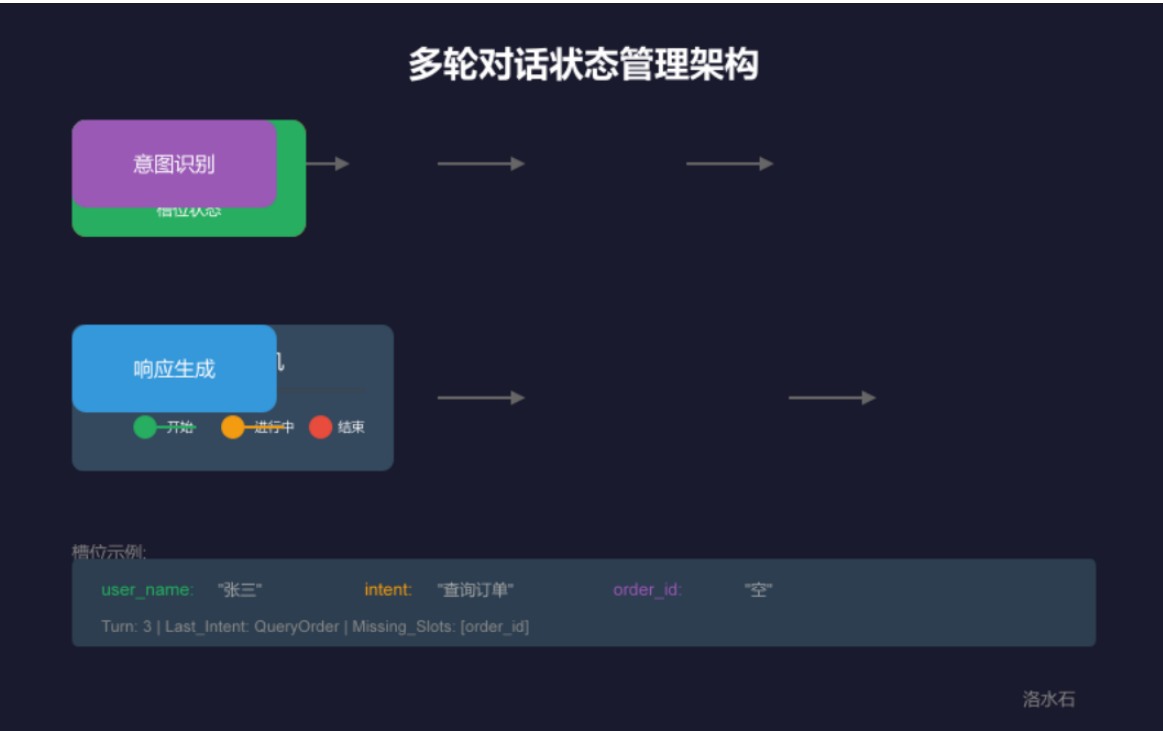
多轮对话是智能客服系统的核心能力,相比单轮问答,多轮对话需要维护对话状态、理解上下文意图、填充对话槽位,并基于对话策略做出智能响应。本篇文章详细介绍多轮对话状态管理、意图识别模块设计、槽位填充机制、上下文理解与指代消解,以及对话策略与分支处理的具体实现。
2 多轮对话状态管理
2.1 Session与Context定义
多轮对话状态管理是多轮对话的基础设施,主要包含两个核心概念:
**Session(会话)**:标识一次完整的对话交互,伴随用户发起对话开始,到用户主动结束或超时自动结束。Session具有唯一标识符会话ID,关联用户的身份信息,并记录对话创建时间和最后活跃时间。
**Context(上下文)**:贯穿整个Session的对话上下文数据容器,存储以下关键信息:
- **历史消息列表**:保存对话中所有的用户输入和机器人回复
- **槽位状态**:记录当前已填充和待填充的槽位信息
- **当前意图**:用户当前表达的核心意图
- **对话阶段**:标记对话所处的状态(如初始、追问、确认、完成)
2.2 Redis Session存储设计
在企业级应用中,Session数据通常存储在Redis等分布式缓存中,以支持水平扩展和多实例部署:
@Service
public class SessionService {
@Autowired
private RedisTemplate<String, Object> redisTemplate;
private static final String SESSION_KEY_PREFIX = "dialogue:session:";
private static final int SESSION_EXPIRE_SECONDS = 1800; // 30分钟
public DialogueContext getOrCreateSession(String sessionId) {
String key = SESSION_KEY_PREFIX + sessionId;
DialogueContext context = (DialogueContext) redisTemplate.opsForValue().get(key);
if (context == null) {
context = new DialogueContext();
context.setSessionId(sessionId);
context.setCreateTime(new Date());
saveSession(context);
}
context.setLastActiveTime(new Date());
return context;
}
public void saveSession(DialogueContext context) {
String key = SESSION_KEY_PREFIX + context.getSessionId();
redisTemplate.opsForValue().set(key, context, SESSION_EXPIRE_SECONDS, TimeUnit.SECONDS);
}
}
2.3 对话状态机
多轮对话采用状态机模式管理对话流程,典型状态包括:
|
状态 |
描述 |
可转换状态 |
|
INIT |
对话初始化 |
IN_PROGRESS |
|
IN_PROGRESS |
对话进行中 |
IN_PROGRESS, WAITING_CONFIRM, COMPLETED |
|
WAITING_CONFIRM |
等待用户确认 |
IN_PROGRESS, COMPLETED |
|
COMPLETED |
对话正常结束 |
- |
|
TRANSFER_HUMAN |
转人工处理 |
- |
3.1 意图识别架构
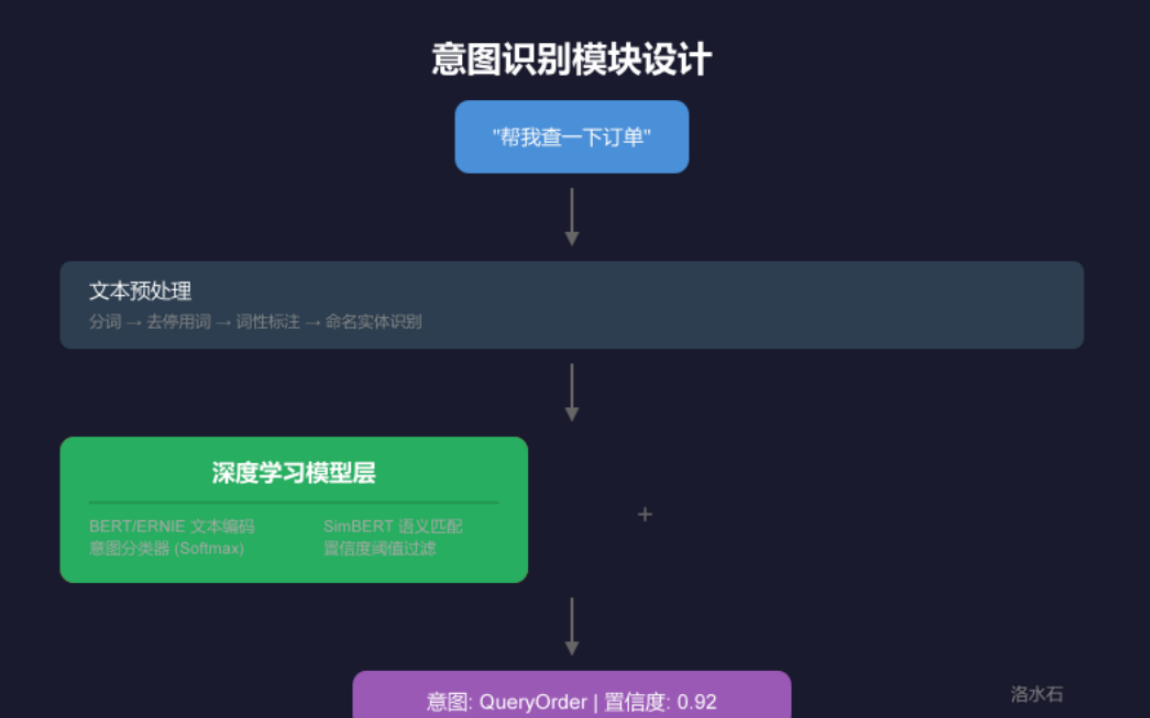
意图识别模块采用多层级融合的架构设计,兼顾准确性和实时性:
**第一层:规则匹配**
- 正则表达式匹配:处理结构化的用户表达
- 关键词字典匹配:基于业务术语库进行快速匹配
- 模板规则库:预定义常见问法的模板
**第二层:深度学习模型**
- BERT/ERNIE:中文语义编码,提取文本特征
- 意图分类器:基于编码特征进行意图分类
- SimBERT:语义相似度计算,支持问法扩展
3.2 规则匹配实现
规则匹配适用于结构清晰、表达固定的业务场景:
@Component
public class RuleIntentMatcher {
private final Map<String, List<IntentRule>> intentRules = new ConcurrentHashMap<>();
@PostConstruct
public void initRules() {
// 查询订单意图规则
List<IntentRule> orderRules = Arrays.asList(
PatternRule.builder()
.pattern(".*查.*订单.*")
.intent("QueryOrder")
.priority(1)
.build(),
PatternRule.builder()
.pattern("(帮我|我要|我想)(查|看|找).*")
.intent("QueryOrder")
.priority(2)
.build()
);
intentRules.put("QueryOrder", orderRules);
}
public MatchResult match(String userInput) {
for (Map.Entry<String, List<IntentRule>> entry : intentRules.entrySet()) {
for (IntentRule rule : entry.getValue()) {
if (rule.matches(userInput)) {
return MatchResult.success(entry.getKey(), rule.getPriority());
}
}
}
return MatchResult.noMatch();
}
}
3.3 模型分类实现
模型分类提供更强的泛化能力,支持多样化的用户表达:
@Service
public class IntentClassifier {
@Autowired
private BertModel bertModel;
@Autowired
private IntentClassificationHead classificationHead;
public IntentResult classify(String userInput) {
// 1. 文本编码
Encoding encoding = bertModel.encode(userInput);
// 2. 获取[CLS]向量
Vector clsVector = encoding.getClsVector();
// 3. 意图分类
Map<String, Double> intentScores = classificationHead.predict(clsVector);
// 4. 选取最高分意图
String bestIntent = intentScores.entrySet().stream()
.max(Map.Entry.comparingByValue())
.map(Map.Entry::getKey)
.orElse("Unknown");
double confidence = intentScores.get(bestIntent);
return IntentResult.builder()
.intent(bestIntent)
.confidence(confidence)
.allScores(intentScores)
.build();
}
}
4.1 槽位设计原则
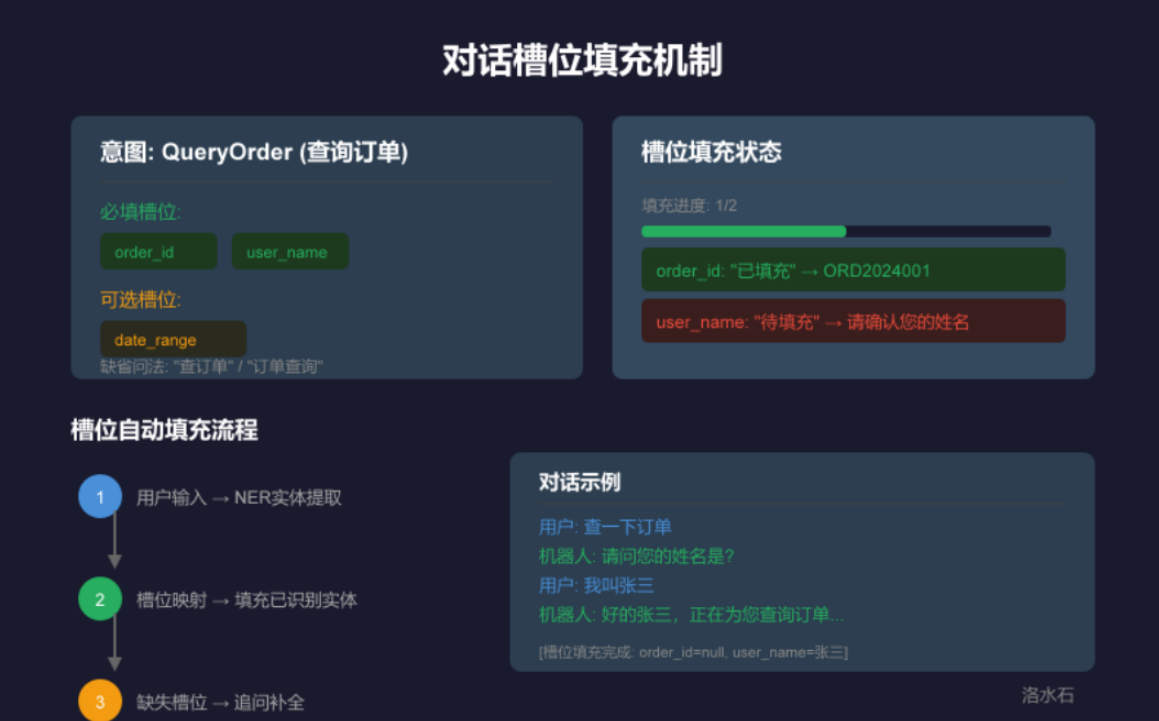
槽位(Slot)是意图的组成部分,用于捕获意图所需的参数信息。槽位设计遵循以下原则:
**必填槽位与可选槽位**:
- 必填槽位:缺则无法完成业务,如订单号、用户身份
- 可选槽位:缺失时可使用默认值或跳过
**槽位类型定义**:
@Data
public class SlotDefinition {
private String slotName; // 槽位名称
private SlotType type; // 槽位类型
private boolean required; // 是否必填
private String defaultValue; // 默认值
private List<String> synonyms; // 同义词列表
private List<String> questionTemplates; // 追问模板
}
public enum SlotType {
TEXT, // 文本
NUMBER, // 数字
DATE, // 日期
ENUM, // 枚举
ENTITY // 实体
}
4.2 槽位自动填充流程
槽位填充是将用户输入中的信息自动映射到对应槽位的自动化过程:
**流程说明**:
1. **实体提取**:对用户输入进行命名实体识别(NER),提取关键信息
2. **槽位映射**:将提取的实体映射到对应的槽位
3. **缺失追问**:对于未填充的必填槽位,生成追问话术
@Service
public class SlotFillingService {
@Autowired
private NerService nerService;
@Autowired
private SlotMappingService slotMappingService;
public SlotFillingResult fillSlots(String userInput, IntentDefinition intent) {
// 1. NER实体提取
List<ExtractedEntity> entities = nerService.extract(userInput);
// 2. 槽位映射
Map<String, Object> filledSlots = slotMappingService.map(entities, intent.getSlots());
// 3. 检查缺失槽位
List<String> missingSlots = intent.getSlots().stream()
.filter(slot -> slot.isRequired() && !filledSlots.containsKey(slot.getSlotName()))
.map(SlotDefinition::getSlotName)
.collect(Collectors.toList());
return SlotFillingResult.builder()
.filledSlots(filledSlots)
.missingSlots(missingSlots)
.isComplete(missingSlots.isEmpty())
.build();
}
public String generateClarification(String slotName) {
SlotDefinition slot = getSlotDefinition(slotName);
return slot.getQuestionTemplates().stream()
.findFirst()
.orElse("请提供" + slotName + "信息");
}
}
4.3 多轮槽位填充示例
以查询订单为例,展示多轮槽位填充的完整过程:
5.1 上下文理解
上下文理解是指系统根据对话历史信息,理解用户当前输入的过程。关键能力包括:
**对话历史累积**:保存完整的对话历史,支持回溯分析
**上下文状态跟踪**:记录每轮对话的意图、槽位、实体等信息
@Data
public class DialogueContext implements Serializable {
private String sessionId;
private List<DialogueTurn> history;
private Map<String, Object> slots;
private String currentIntent;
private int turnCount;
public void addTurn(String userInput, String systemResponse,
String intent, Map<String, Object> slots) {
DialogueTurn turn = DialogueTurn.builder()
.userInput(userInput)
.systemResponse(systemResponse)
.intent(intent)
.slots(new HashMap<>(slots))
.turnNumber(++turnCount)
.timestamp(new Date())
.build();
history.add(turn);
}
}
5.2 指代消解实现
指代消解是处理代词、指示词等指代表达的核心技术:
@Service
public class CoreferenceResolution {
@Autowired
private BertModel bertModel;
public String resolve(String userInput, DialogueContext context) {
// 1. 检测指代词
List<CoreferenceMention> mentions = detectMentions(userInput);
// 2. 消解指代
String resolvedInput = userInput;
for (CoreferenceMention mention : mentions) {
String antecedent = findAntecedent(mention, context);
if (antecedent != null) {
resolvedInput = resolvedInput.replace(mention.getText(), antecedent);
}
}
return resolvedInput;
}
private String findAntecedent(CoreferenceMention mention, DialogueContext context) {
// 常见指代词映射
switch (mention.getType()) {
case "这":
case "这个":
// 返回上一轮提到的订单号、产品等
return context.getLastMention("object");
case "他":
case "她":
// 返回上文中提到的人物
return context.getLastMention("person");
default:
return null;
}
}
}
**常见指代类型**:
6.1 对话策略类型
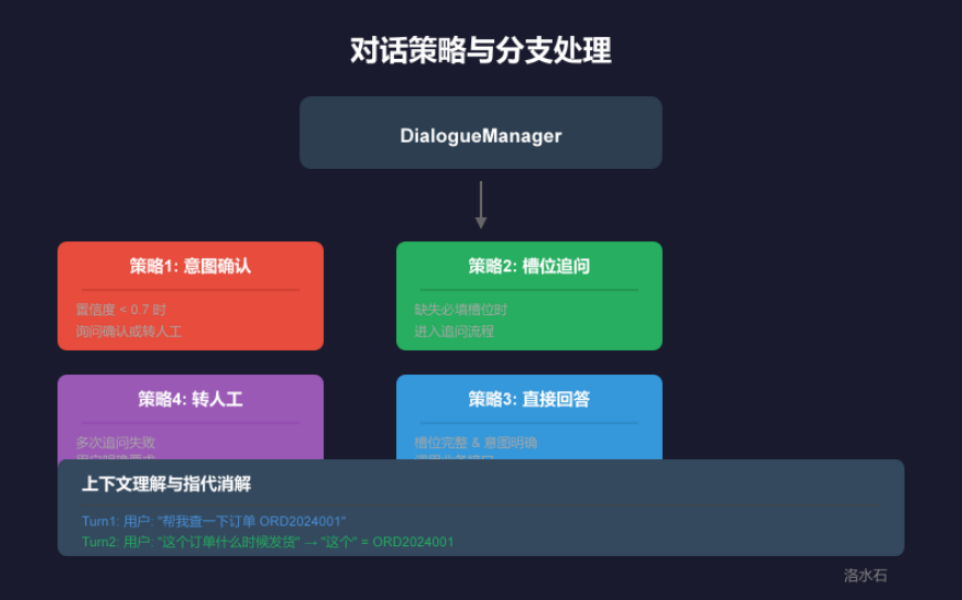
**策略一:意图确认**
- 触发条件:意图识别置信度低于阈值(默认0.7)
- 处理方式:询问用户确认或提供多个选项
**策略二:槽位追问**
- 触发条件:必填槽位缺失
- 处理方式:按照槽位优先级逐个追问
**策略三:直接回答**
- 触发条件:意图明确且槽位完整
- 处理方式:调用业务接口,返回答案
**策略四:转人工**
- 触发条件:追问次数超限、用户明确要求、系统无法处理
- 处理方式:将会话转接至人工客服
6.2 对话管理器实现
@Service
public class DialogueManager {
@Autowired
private SessionService sessionService;
@Autowired
private IntentClassifier intentClassifier;
@Autowired
private RuleIntentMatcher ruleMatcher;
@Autowired
private SlotFillingService slotFillingService;
@Autowired
private CoreferenceResolution coreferenceResolution;
@Autowired
private DialoguePolicy dialoguePolicy;
public DialogueResponse process(String userInput, String sessionId) {
// 1. 获取会话上下文
DialogueContext context = sessionService.getOrCreateSession(sessionId);
// 2. 指代消解
String resolvedInput = coreferenceResolution.resolve(userInput, context);
// 3. 意图识别(规则+模型融合)
IntentResult ruleResult = ruleMatcher.match(resolvedInput);
IntentResult modelResult = intentClassifier.classify(resolvedInput);
IntentResult finalIntent = fuseIntentResults(ruleResult, modelResult);
// 4. 槽位填充
SlotFillingResult slotResult = slotFillingService.fillSlots(
resolvedInput,
getIntentDefinition(finalIntent.getIntent())
);
// 5. 对话策略决策
DialoguePolicy.Decision decision = dialoguePolicy.decide(
finalIntent, slotResult, context
);
// 6. 执行策略
return executeDecision(decision, context);
}
private IntentResult fuseIntentResults(IntentResult rule, IntentResult model) {
// 规则优先,模型兜底
if (rule.isMatched() && rule.getConfidence() > 0.8) {
return rule;
}
if (model.getConfidence() > 0.7) {
return model;
}
// 置信度都不高,返回规则匹配结果但标记低置信
return rule.isMatched() ? rule.toLowConfidence() : model;
}
}
6.3 策略执行示例
public class DialoguePolicy {
public enum DecisionType {
DIRECT_ANSWER, // 直接回答
SLOT_CLARIFY, // 槽位追问
INTENT_CONFIRM, // 意图确认
TRANSFER_HUMAN // 转人工
}
public Decision decide(IntentResult intent, SlotFillingResult slots,
DialogueContext context) {
// 检查是否需要转人工
if (shouldTransferHuman(context)) {
return Decision.transferHuman("转接人工客服");
}
// 检查缺失槽位
if (!slots.isComplete()) {
String nextQuestion = generateSlotQuestion(slots.getNextMissingSlot());
return Decision.slotClarify(nextQuestion, slots.getMissingSlots());
}
// 置信度确认
if (intent.getConfidence() < 0.7) {
return Decision.intentConfirm(intent);
}
// 直接回答
return Decision.directAnswer();
}
}
本篇文章详细介绍了多轮对话系统的核心技术:
1. **状态管理**:通过Session和Context实现对话状态的持久化和共享
2. **意图识别**:融合规则匹配和深度学习模型,兼顾准确性和泛化能力
3. **槽位填充**:自动化实体提取与槽位映射,支持缺失槽位追问
4. **上下文理解**:维护对话历史,支持指代消解和上下文推理
5. **对话策略**:基于决策树或规则引擎,实现智能对话流程控制
下一篇文章将介绍FAQ知识库设计与精确检索方案。

Agent 垂直技术社区,欢迎活跃、内容共建。
更多推荐
 27
27 0
0- 0


 已为社区贡献11条内容

所有评论(0)