Bellman-Ford最短路径算法应用----城市间最短路径(包括负值)
#include <stdio.h>#include <string.h>#include <stdlib.h>#include <stdbool.h>struct Dis{/*记录起点到每个顶点的最短路径信息*///string path;int weight;int pre;char path[100];}dis...
这篇博文不介绍Bellman-Ford的原理,很多文章都有分析。想了解原理的同学可以移步其他文章,这里仅做算法如何应用的介绍。
在最开始的时候,我找了很多有关该算法的文章,包括但不限于google、CSDN、Wikipedia、B站,但很多都是关于原理,没有具体应用,所以那时候很难理解这个算法。
Bellman-Ford算法可以应用到求负权图的情况,但也只能判断该图是否存在负环,如何处理这个负环,还是一个问题。由于要完成课设作业,所以还需要自己对这个算法进行改进。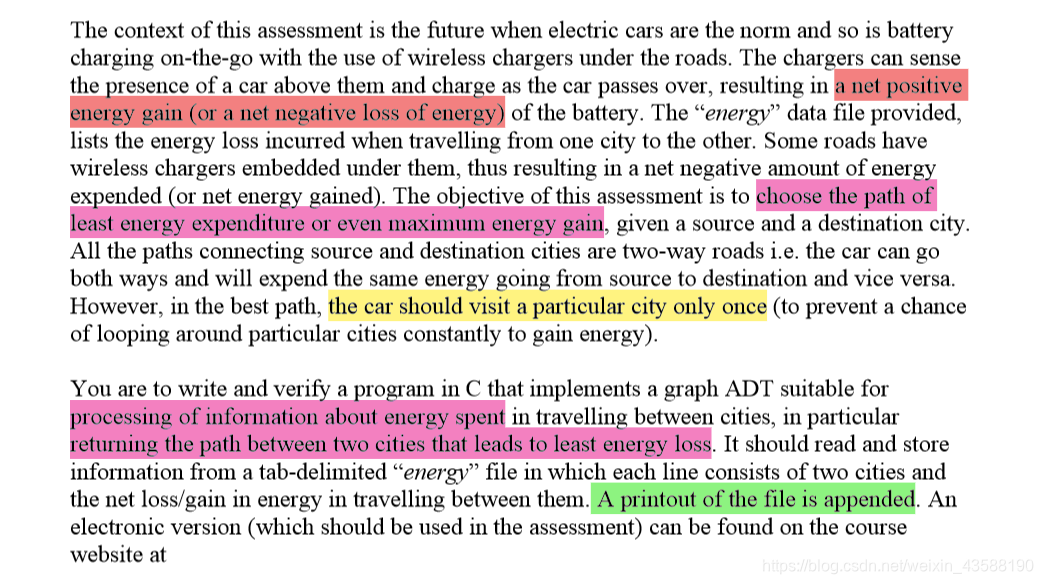
编译环境:windows10 + VS2017
#include <stdio.h>
#include <string.h>
#include <stdlib.h>
#include <stdbool.h>

struct Dis
{
	/*记录起点到每个顶点的最短路径信息*/
	//string path;
	int weight;
	int pre;
	char path[100];
}dis1[100];

int MAX = 9999;
int vexNum = 22;
int edgeNum = 86;

int u[100], v[100], w[100];
int info[44][3] = { {0,1,60},{2,3,-47},{4,5,161},{6,7,61},{8,9,-43},
{9,10,103},{10,11,63},{4,12,79},{13,14,92},{5,10,77},{2,0,39},{15,16,74},
{17,13,65},{3,1,76},{18,10,90},{11,19,82},{7,10,122},{19,3,63},{7,3,29},
{20,8,130},{1,5,145},{12,2,116},{10,20,139},{6,2,64},{13,12,140},
{11,18,-61},{14,0,135},{15,17,-28},{11,7,100},{13,4,-30},{10,6,129},
{9,20,116},{2,1,89},{16,13,154},{5,7,61},{4,6,56},{13,15,50},{7,19,74},
{0,3,55},{14,16,177},{2,7,53},{18,9,68},{6,13,20} };

int numofCity(char s1[50])
{
	if (strcmp(s1, "York") == 0)
		return 0;
	else if (strcmp(s1, "Hull") == 0)
		return 1;
	else if (strcmp(s1, "Leeds") == 0)
		return 2;
	else if (strcmp(s1, "Doncaster") == 0)
		return 3;
	else if (strcmp(s1, "Liverpool") == 0)
		return  4;
	else if (strcmp(s1, "Nottingham") == 0)
		return  5;
	else if (strcmp(s1, "Manchester") == 0)
		return 6;
	else if (strcmp(s1, "Sheffield") == 0)
		return 7;
	else if (strcmp(s1, "Reading") == 0)
		return 8;
	else if (strcmp(s1, "Oxford") == 0)
		return 9;
	else if (strcmp(s1, "Birmingham") == 0)
		return 10;
	else if (strcmp(s1, "Leicester") == 0)
		return 11;
	else if (strcmp(s1, "Blackpool") == 0)
		return 12;
	else if (strcmp(s1, "Carlisle") == 0)
		return 13;
	else if (strcmp(s1, "Newcastle") == 0)
		return 14;
	else if (strcmp(s1, "Glasgow") == 0)
		return 15;
	else if (strcmp(s1, "Edinburgh") == 0)
		return 16;
	else if (strcmp(s1, "Moffat") == 0)
		return 17;
	else if (strcmp(s1, "Northampton") == 0)
		return 18;
	else if (strcmp(s1, "Lincoln") == 0)
		return 19;
	else if (strcmp(s1, "Bristol") == 0)
		return 20;
	else if (strcmp(s1, "Newcastle") == 0)
		return 21;

}

void change_1()
{
	FILE *fp1, *fp2;
	int i = 0;
	char s1[50], s2[50], s3[50];
	int a1, a2;
	char ch;
	fp1 = fopen("energy.txt", "r");
	fp2 = fopen("energy_02.txt", "w");
	if (fp1 == NULL)
		printf("open error£¡\n");
	else if (fp2 == NULL)
		printf("open error£¡\n");
	else
	{
		while (fscanf(fp1, "%s\t%s\t%s", &s1, &s2, &s3) != EOF)
		{
			// fputc(ch,fp2);
			a1 = numofCity(s1);
			a2 = numofCity(s2);
			fprintf(fp2, "%d\t%d\t%s\n", a1, a2, s3);
			//putchar(ch);
			// ch=fgetc(fp1);
			 //printf("%c",fgetc(fp1));
		}
	}

	fclose(fp1);
	fclose(fp2);
}

void bellman(int begin)
{
	int temp = 0;
	for (int i = 0; i < edgeNum / 2; i++)
	{
		u[temp] = info[i][0];
		v[temp] = info[i][1];
		w[temp] = info[i][2];
		dis1[temp].weight = MAX;
		temp++;
		u[temp] = info[i][1];
		v[temp] = info[i][0];
		w[temp] = info[i][2];
		dis1[temp].weight = MAX;
		temp++;
	}

	for (int i = 0; i < vexNum; i++)
	{
		char ch1[20], ch2[20];
		sprintf(ch1, "%d", begin);
		sprintf(ch2, "%d", i);
		if (i == begin)
		{
			strcat(dis1[i].path, "V");
			strcat(dis1[i].path, ch1);
			//printf("%s\n",dis1[i].path);
		}
		else
		{
			strcat(dis1[i].path, "V");
			strcat(dis1[i].path, ch1);
			strcat(dis1[i].path, "-->V");
			strcat(dis1[i].path, ch2);
			//printf("%s\n",dis1[i].path);
		}
	}

	dis1[begin].weight = 0;
	//printf("%d",dis1[begin].weight);
	int count = 1;


	//printf("%d",dis1[1].pre);
	while (count != vexNum)
	{
		for (int i = 0; i < vexNum; i++)
		{
			int ch = 0;
			bool isVisited[1000];
			bool visited1 = false;
			memset(isVisited, false, edgeNum);
			for (int j = 0; j < edgeNum; j++)
			{
				char temp[100] = "";
				if ((dis1[v[j]].weight > dis1[u[j]].weight + w[j]) && (isVisited[w[j]] != true) && (dis1[u[j]].pre != v[j]) && (dis1[u[j]].weight != MAX) && visited1 != true)
				{

					dis1[v[j]].weight = dis1[u[j]].weight + w[j];
					isVisited[w[j]] = true;
					ch = 1;
					dis1[v[j]].pre = u[j];

					//printf("%d\n",dis1[v[j]].pre);x1
					char x[20];
					sprintf(x, "%d", v[j]);

					//strcat(dis1[u[j]].path, "-->V");
					strcpy(temp, dis1[u[j]].path);
					strcat(temp, "-->V");
					strcat(temp, x);
					//printf("%s\n", dis1[u[j]].path);
					strcpy(dis1[v[j]].path,temp);
					//printf("%s\n",dis1[v[j]].path);

					if (w[j] == -43)
						visited1 = true;
				}
			}
			if (ch == 0)
				break;
		}
		count++;
	}
	//printf("done");
	//printf("%s %s",ch1,ch2);
}


void print(int begin)
{
	char str[100] = "";
	char x[20];
	sprintf(x, "%d", begin);
	strcat(str, "V");
	strcat(str, x);
	//printf("%s\n",str);
	//printf("以%s为起点的图的最短路径为:",str);中文乱码
	printf("the shortest path of %s is: \n", str);
	//printf("%s\n",dis1[2].path);
	for (int i = 0; i != vexNum; i++)
	{
		if (dis1[i].weight != MAX)
		{
			printf("%s = %i\n", dis1[i].path, dis1[i].weight);
			//cout << dis1[i].path << "=" << dis1[i].weight << endl;
		}
	}
}


int main()
{
	//change_1();
	bellman(3);
	 print(3);
	return 0;
}
运行结果(这是测试用例,主要是检查可以任意输出每两个城市间的路径和权重)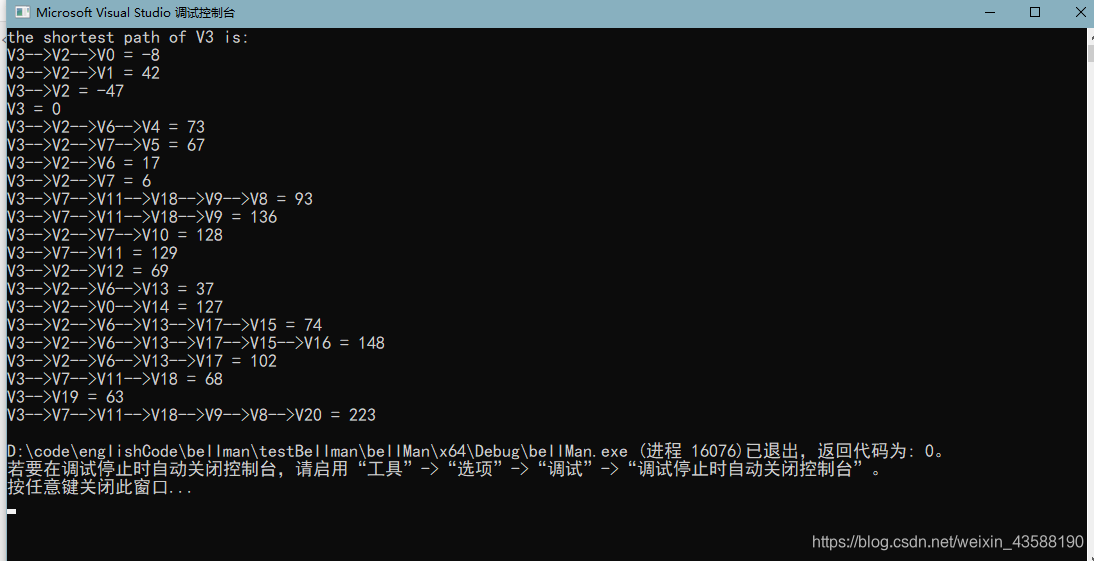
在完成了图的构建和算法的优化后,现在就要将城市和相隔距离填到图中,并做一些特殊化的处理。主要思路就是:**将每个城市任意顺序编号,然后存到数组,经过Bellman-Ford算法得到如上图的最短路径后,再对这些字符串做处理,输出每个结点编号代表的城市名。**这里也是程序的几大难点之一。
最开始拿到题目时,有几个问题一直困扰着我。
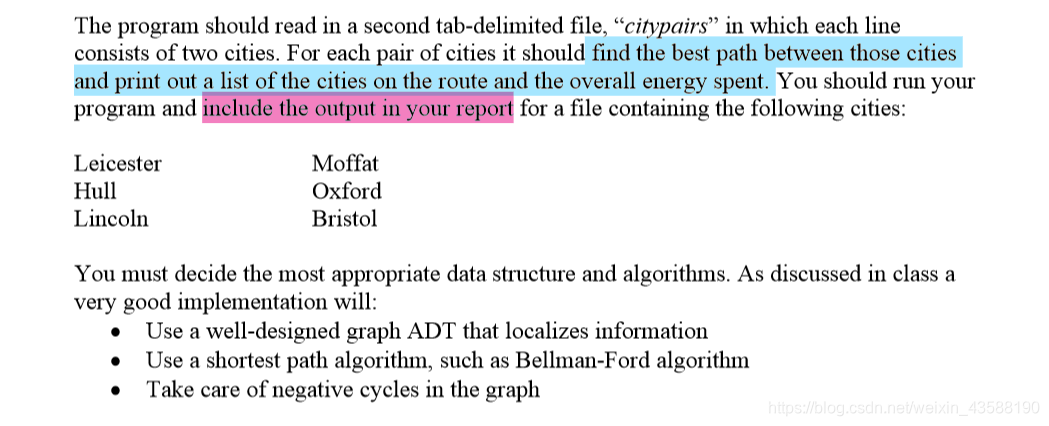
- 使用哪种数据结构来存储,怎样使用提供的energy.txt中的数据。
- 如何实现算法并对其进行优化,因为有少数城市间的距离为负,如何处理这个负值,避免负环情况的出现。
- 如何将得到的路径字符串转换为相应的城市名。
对于第一点,最后采用的是结构体,首先将城市名自定义成数字,然后存到数组中,通过数组对结构体进行初始化。最开始想的是直接对文件进行操作,但后来发现,从文件中读出来的数据为字符类型,还需要转化才能存到数组中,降低了程序的可读性,毕竟我们的重点不在这儿,所以放弃了这种方式。
对于第二点,每次负循环发生时,下一个将要访问的结点肯定是前面已经访问过的一个结点,所以在结构体中增加了pre这个属性,用于记录当前这个结点是从哪一个结点来的,从而能在if语句判断的时候,剔除掉这种情况。然后将每个负环只求一次,最后得到两个城市间的最短路径。
对于第三点,可以使用对字符串操作,依次遍历字节并进行对比,最后输出相应的城市名。
写在最后,**上面提到的各种情况,包括问题和解决方案,都是花费了大量时间调试得到的结果,所以希望你也这样。**关于注释的问题,由于最开始是中文写的注释,要交给学校,所以就删了。如果哪天有空我会更新注释。
完整代码在上面的基础上只有少许改动,如果你get到了我的idea,后面应该可以自己实现,如果有问题可以留言或者私信。
这里是整个项目的需求文档(英文版)、城市数据文件(energy.txt)、最后完成的代码(有需自取)。
运行结果截图: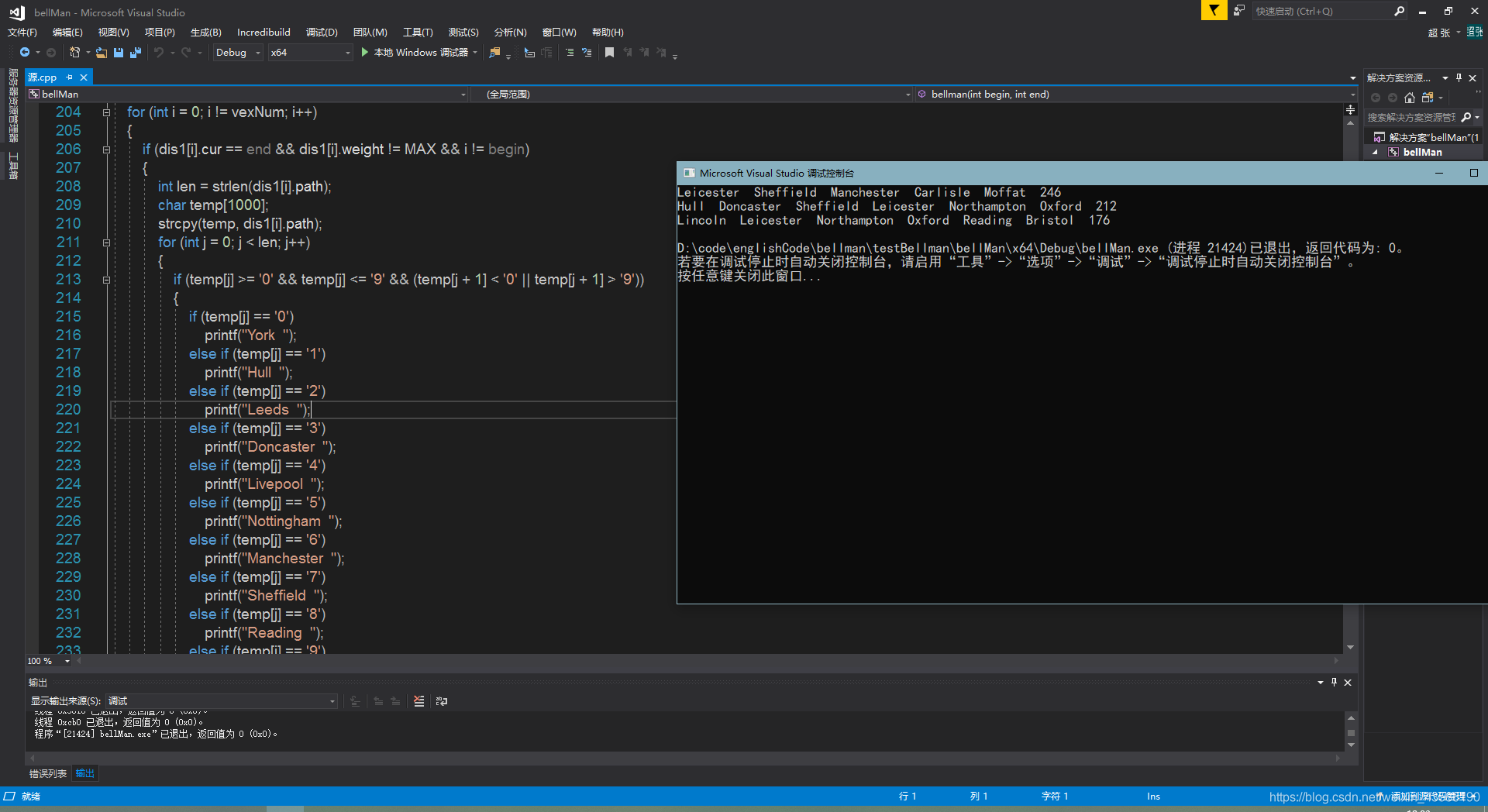

Agent 垂直技术社区,欢迎活跃、内容共建。
更多推荐

 0
0 0
0- 0


 已为社区贡献1条内容

所有评论(0)